Contents10 sections
Ceiling speakers are worth it when you want even sound across a whole room without anything visible, and not worth it when you want a precise stereo image from a seated position. That single distinction decides almost every specification.
The question is really two questions — is the sound good enough, and is the permanent installation justified. The engineering answer to the first is yes for distributed audio and cinema height channels, and no for critical two-channel listening. The answer to the second depends on ceiling construction, which is where most projects actually get decided.
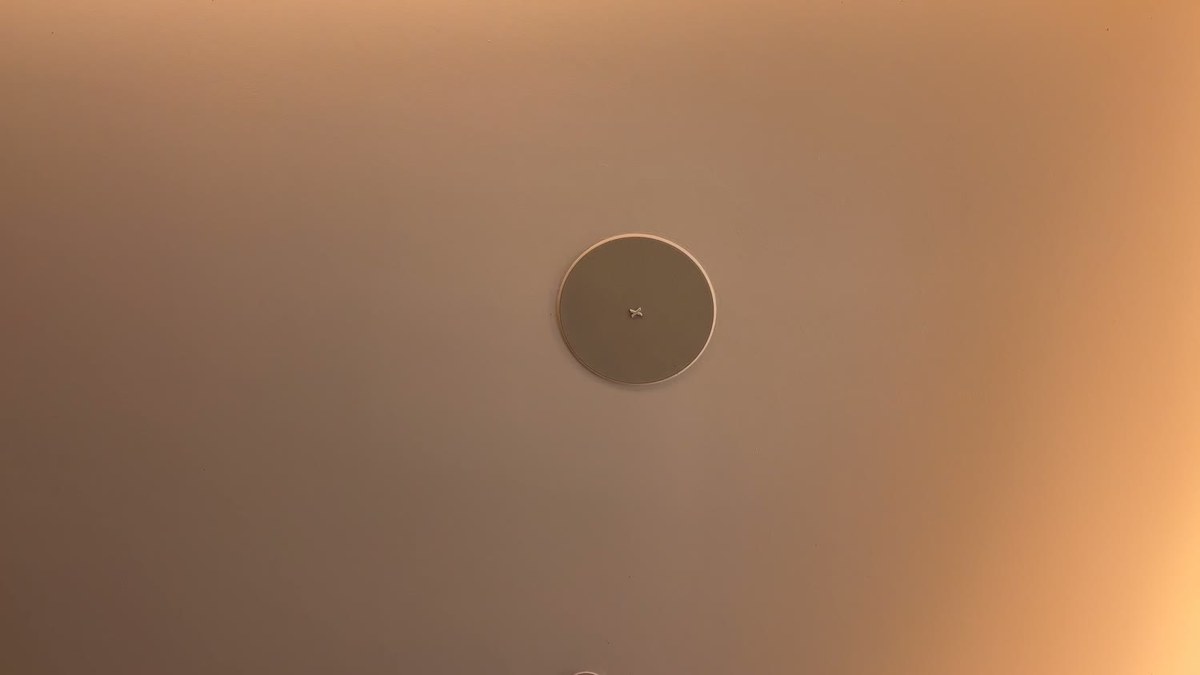
Ceiling speakers are worth it for distributed audio, height channels and clean rooms
Three cases justify the hole in the ceiling on their own:
- Whole-room and multi-room music. A pair of ceiling speakers covers a room more evenly than a stereo pair on stands, because the source is above head height and nobody sits inside a near-field hotspot. Coverage angle is the specification that matters — Aspen 6 covers 110°, Aspen 8 covers 100°.
- Dolby Atmos height channels. Overhead is not a compromise here — it is the specified position. Height channels are supposed to arrive from above, so the main objection to ceiling speakers does not apply at all.
- Rooms where nothing may be visible. When the architecture will not accept a box, the real comparison is not ceiling speaker versus floorstander. It is ceiling speaker versus no audio.
The café below is the second and third cases together: a grid of Aspen units painted into the ceiling, covering a room with banquettes, hard glazing and no sensible wall to put a speaker on. The full build is in the clubhouse café case study.
Room by room: where ceiling speakers earn their place
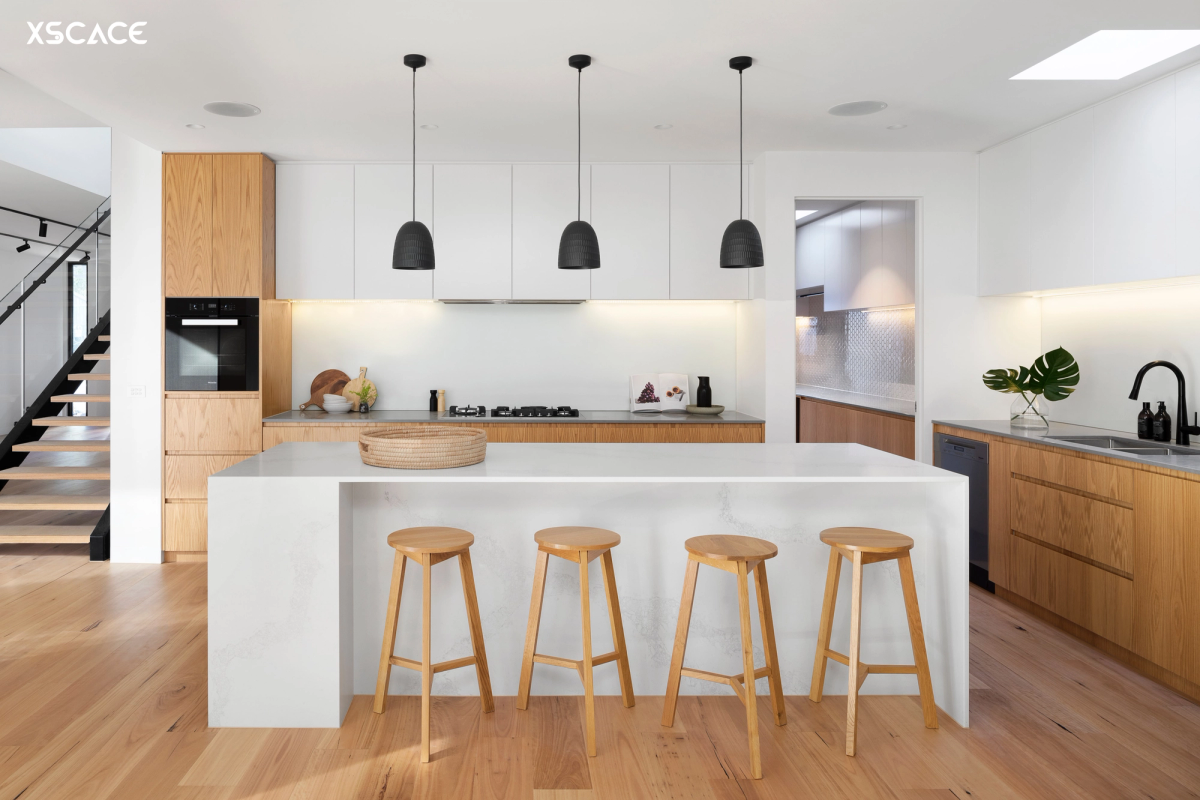
“Worth it” is not a property of the speaker, it is a property of the room and what happens in it. The same speaker is the right answer in a kitchen and the wrong answer three metres away in front of a television.
| Room / use | Worth it? | Why | What it needs |
|---|---|---|---|
| Kitchen | Yes | Nobody sits still, hard surfaces everywhere, no stereo image to protect | 2 speakers, wide dispersion |
| Dining room | Yes | Background level under conversation; even coverage matters more than imaging | 2–4 depending on table length |
| Bedroom | Yes | Low listening levels, no critical listening position | 2, kept off the bed axis |
| Bathroom | Yes | Provided the model is moisture-rated | Moisture-rated model only |
| Covered terrace | Yes | Provided the model is weather-rated for the exposure | IP-rated model, verified rating |
| Home gym | Yes | Level and even coverage matter, imaging does not | Higher sensitivity for level |
| Living room — background music | Yes | Coverage across a whole social space beats a sweet spot nobody uses | 2–4 on a coverage calculation |
| Living room — serious stereo | No | The image collapses overhead; you cannot place a phantom centre on a ceiling | Ear-height speakers instead |
| Front left/centre/right for TV | No | Dialogue should arrive from the screen, not above it | In-wall or on-wall LCR |
| Dolby Atmos height channels | Best use there is | The format is written for overhead sources; nothing else does this job | 2 or 4, at 30–55° elevation |
The pattern is consistent. Where people move around and nobody is seated in a fixed listening position, a ceiling speaker is the correct engineering answer and usually the only discreet one. Where somebody sits still and expects sound to come from a specific place in front of them, it is the wrong one — and no amount of money spent on the speaker changes that, because the problem is geometry, not quality.
What you give up, stated plainly
Three things, and they are worth knowing before the ceiling is cut rather than after.
You lose the phantom centre. Two speakers either side of a seat can place a voice between them; two speakers above a seat cannot place it in front. This is why in-wall or on-wall speakers remain the correct choice for the front of a cinema, including ours — a ceiling speaker is not a substitute for an LCR array, and a manufacturer that tells you otherwise is selling rather than specifying.
You lose reversibility. A cut ceiling is a permanent decision. Cable is cheap while the ceiling is open and expensive afterwards, so run it to every position you might ever use, even if you only fit half of them now.
You often lose the bottom octave. Most in-ceiling speakers roll off well above the point where a soundtrack needs support, which is why they are specified with a subwoofer. Some carry their own — our Ghost 2.0 has a built-in 5.5-inch subwoofer driver and is rated 80 Hz to 20 kHz at ±3 dB, which is lower than a typical in-ceiling reaches — but that capability is bought with cavity depth, and it needs a 200 mm void to fit. There is no free version of this trade.
They are not worth it for critical stereo listening
Sound arriving from overhead cannot produce the stereo image that two speakers at ear level in front of you produce. Nothing in the driver, the amplifier or the room correction changes that — the geometry is wrong for the task. If someone will sit down specifically to listen to music and wants instruments placed across a soundstage, ceiling speakers are the wrong specification, and an in-wall LCR or a conventional pair is the right one.
This is a constraint, not a fault, and it is the honest half of the answer most buying guides leave out. The full list is in the disadvantages of in-ceiling speakers.
How many ceiling speakers a room actually needs
This is the question behind the question, and it is answerable with geometry rather than opinion. A ceiling speaker radiates a cone. Where that cone reaches ear height it has covered a circle, and the diameter of that circle is what sets the spacing:
coverage diameter = 2 × (ceiling height − ear height) × tan(coverage angle ÷ 2)
Two spacings come out of it. Edge-to-edge spacing — circles just touching — is the widest spacing with no gap at ear level, and is right for background music. Overlapped spacing, at about 70% of that, gives level that barely changes as you walk across the room, and is right for anywhere people are listening rather than just hearing. The figures below use a seated ear height of 1.2 m and the published coverage angles.
| Ceiling height | Model | Coverage angle | Coverage diameter at ear level | Spacing for even coverage |
|---|---|---|---|---|
| 2.4 m | Aspen 6 | 110° | 3.4 m | 2.4 m |
| 2.4 m | Aspen 8 | 100° | 2.9 m | 2.0 m |
| 2.7 m | Aspen 6 | 110° | 4.3 m | 3.0 m |
| 2.7 m | Aspen 8 | 100° | 3.6 m | 2.5 m |
| 3.0 m | Aspen 6 | 110° | 5.1 m | 3.6 m |
| 3.0 m | Aspen 8 | 100° | 4.3 m | 3.0 m |
| 3.6 m | Aspen 6 | 110° | 6.9 m | 4.8 m |
| 3.6 m | Aspen 8 | 100° | 5.7 m | 4.0 m |
Worked example: a 6 × 8 m lounge with a 2.7 m ceiling. Aspen 8 covers 3.6 m at ear level, so even-coverage spacing is 2.5 m. Two rows of three — six speakers — cover it properly. A single stereo pair in the same room is not a cheaper version of that; it is a different and worse result, loud under the speakers and thin at the far end.
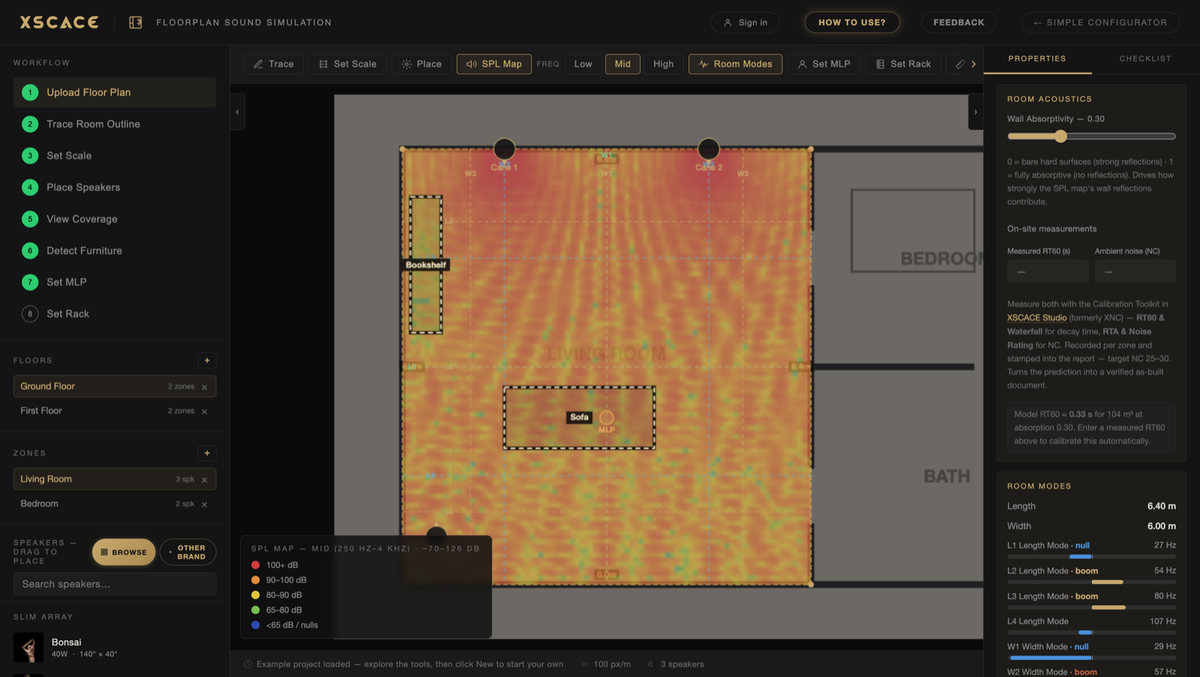
Every XSCACE project runs this as a simulation on the traced floorplan rather than as arithmetic, because real rooms have beams, ductwork and downlights in the way. The method is set out in the XSCACE installation workflow.
Whether they are worth it usually comes down to cavity depth
The most common reason a ceiling speaker cannot be used is not sound quality. It is that there is nowhere to put it. A conventional round in-ceiling speaker needs 115–200 mm of clear cavity above the plasterboard. A concrete slab has none, and a service void full of ductwork often has less than it looks.
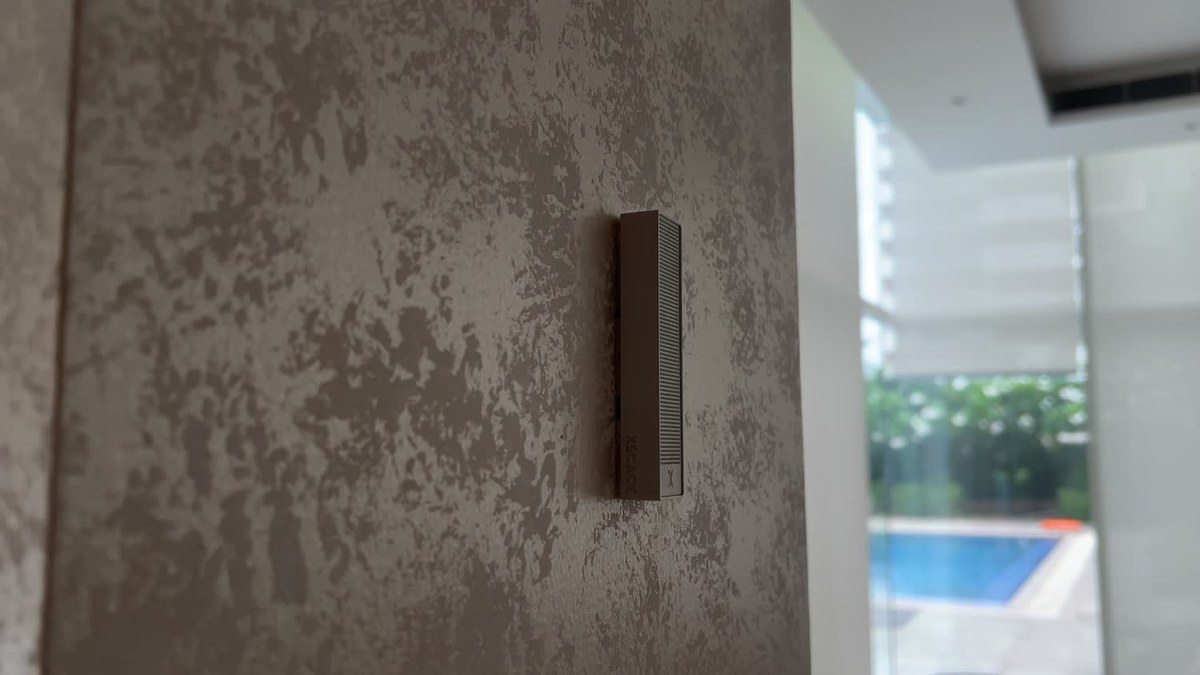
This is where slim array designs change the answer. Bonsai In-Ceiling / In-Wall needs 25 mm, QuadCane In-Ceiling / In-Wall needs 32 mm and Cane In-Ceiling / In-Wall needs 35 mm — roughly a sixth of the depth a round 8" speaker needs. A room that cannot take an Aspen 8 can usually still take a Cane.
| Model | Cavity depth needed | Low-frequency limit | Sensitivity | Max SPL | Room size |
|---|---|---|---|---|---|
| Bonsai In-Ceiling / In-Wall | 25 mm | 300 Hz (–6 dB) | 86 dB | 103 dB | Up to 15 × 15 ft |
| QuadCane In-Ceiling / In-Wall | 32 mm | 150 Hz (±3 dB) | 95 dB | 116 dB | Up to 30 × 30 ft |
| Cane In-Ceiling / In-Wall | 35 mm | 150 Hz (±3 dB) | 92 dB | 110 dB | Up to 20 × 20 ft |
| Aspen 6 | 115 mm | 50 Hz (±3 dB) | 87 dB | 108 dB | Up to 18 × 18 ft |
| Aspen 8 | 130 mm | 40 Hz (±3 dB) | 89 dB | 111 dB | Up to 25 × 25 ft |
| Aster 6 LCR | 155 mm | 35 Hz (±3 dB) | 92 dB | 115 dB | Up to 25 × 30 ft — cinema front channel |
| Ghost 2.0 | 200 mm | 80 Hz (–3 dB) | 92 dB | 112 dB | Up to 20 × 20 ft |
A ceiling speaker is only worth it with a subwoofer, unless it is deliberately not carrying bass
Read the low-frequency column above and the pattern is obvious. A 6" ceiling driver reaches 50 Hz and an 8" reaches 40 Hz; a slim array reaches 150 Hz. Everything below those figures has to come from somewhere else, and Acacia 6 Powered or Acacia 10 Powered is where it comes from.
A slim array crossed over at 200 Hz to a subwoofer is not a speaker that lacks bass. It is a two-part system in which each part does the job its physics suits — and it is the only way to get full-range sound out of a 32 mm ceiling void. Judging a slim array on its own low-frequency figure, with no subwoofer in the system, is judging half a design.
Sensitivity decides how much amplifier the system needs
Sensitivity quietly determines project cost, because it sets how much amplification the room needs. Every 3 dB of sensitivity halves the power required for the same output. QuadCane at 95 dB reaches a given level on roughly a quarter of the power an 86 dB speaker needs.
In practice that is the difference between one amplifier and two. A Xylem 4 driving high-sensitivity ceiling speakers covers zones that a lower-sensitivity specification would split across more channels. How power actually reaches a ceiling speaker is covered in how in-ceiling speakers get power.
The gym below is that argument built: a fully glazed room, hard on every surface, covered by QuadCane at 95 dB sensitivity off a single Xylem 4. Details in the clubhouse gym case study.
What ceiling speakers cost, in bands
System cost is set by channel count, amplification and subwoofers, not by the speakers alone — which is why the spacing table above matters more to a budget than any single product does. Published budget bands for a complete room run from $5K–$15K for a living-room 5.1.2 up to $100K+ for a reference 7.1.4. The bands, and what each covers, are set out on the home cinema design guide. Pricing for a specific room comes from your integrator, who accounts for the building, the cabling and the install.
If the objection is the grille rather than the ceiling, that is a different decision — invisible and concealed speakers compared with ultra-slim ones.
How to decide in one pass
Four questions settle it:
- How much clear cavity is above the ceiling? Under 100 mm rules out round in-ceiling models and points to a slim array.
- Will anyone sit down to listen critically? If yes, ceiling speakers should not be the main channels.
- How many does the room need at the spacing above? If the answer is six and the budget is for two, the room will not sound the way it was sold. The speaker placement calculator works the spacing and count out from the coverage angle and the ceiling height.
- Is there a subwoofer in the design? If not, the system will be thin regardless of which ceiling speaker is chosen.
Every XSCACE installation answers those before a speaker is selected, using floorplan simulation to place the units and XSCACE Studio to calibrate them afterwards.