Contents7 sections
Two different products get asked for with the same sentence: "I don't want to see the speakers." One answer is a plaster-over invisible speaker that disappears entirely. The other is an ultra-slim architectural speaker that keeps a paintable grille but measures a few millimetres deep. They are not competitors so much as answers to different versions of the question, and picking the wrong one is expensive because both decisions are made before the ceiling closes.
XSCACE makes the second kind, not the first. That is worth stating plainly at the top, because the useful version of this comparison is the one that tells you when to buy something else. For how the category as a whole divides up, there is a wider comparison of premium architectural speaker brands.
Hidden, concealed, invisible: one request, three products
Clients rarely ask for an invisible speaker by name. They ask for hidden speakers, or concealed speakers, or simply say they want the sound without seeing anything. The three words get used interchangeably in a brief, and they do not describe the same product. That is where specifications go wrong.
Hidden usually means the speaker should not read as an object in the room — a flush, paintable grille the client stops noticing is normally enough. Concealed is stricter: the speaker sits behind something, a fabric panel, a slot in the joinery, a plaster ceiling, and the surface reads as architecture. Invisible is literal: the panel is skimmed over and there is no surface feature at all.
Cost follows that sequence, and so does the serviceability problem. A hidden speaker is a shallow architectural one you can unclip. A concealed speaker is a conventional speaker behind a detail somebody has to build and maintain. An invisible speaker is a panel under plaster — the only one of the three where getting it back out means booking a plasterer.
What each one actually is
An invisible speaker is a flat panel fitted into the wall or ceiling cavity and then skimmed over with plaster or jointing compound. The finished surface is continuous — no grille, no trim, no seam. Sound radiates through the plaster itself, because the panel drives the surface rather than firing through an opening. Amina and Sonance are the established names, and both make genuinely accomplished products.
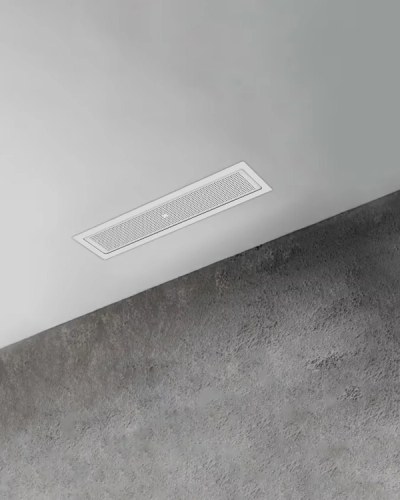
An ultra-slim architectural speaker takes the opposite approach: keep a conventional driver, and make the housing shallow enough to disappear into the building. The grille remains visible but sits nearly flush and is usually paintable, so it reads as a detail rather than as a speaker. Depths of 12 to 24 mm are achievable for on-wall arrays, which means no cavity at all.

The trade-off nobody states clearly
Radiating sound through a layer of plaster costs you something. It costs efficiency, it constrains how much high-frequency detail survives the journey, and it limits bass extension. This is physics rather than a criticism of any manufacturer — the same panel with the plaster removed would measure better.
For the jobs invisible speakers are designed for, that cost is irrelevant. Background music through a hallway, ambient audio in a bathroom, multi-room in a house where the client will not accept a visible grille anywhere — these are cases where absolute concealment is the requirement and moderate output is entirely sufficient.
For a cinema front stage or Dolby Atmos height channels, the same cost becomes the deciding factor. Height channels have to reach the seat at a 30 to 55 degree elevation with intelligible detail intact, and a plaster-over panel disperses diffusely by design. That is exactly the wrong characteristic for a channel whose whole job is to place a sound above a specific point in the room.
Cavity depth decides more than aesthetics
Most plaster-over panels need roughly 90 to 100 mm of cavity plus the plaster build-up, and they have to go in before the ceiling is finished. A standard 2×4 timber stud gives about 89 mm of usable depth, which is marginal, and retrofitting into a completed room is not really possible without opening it up.
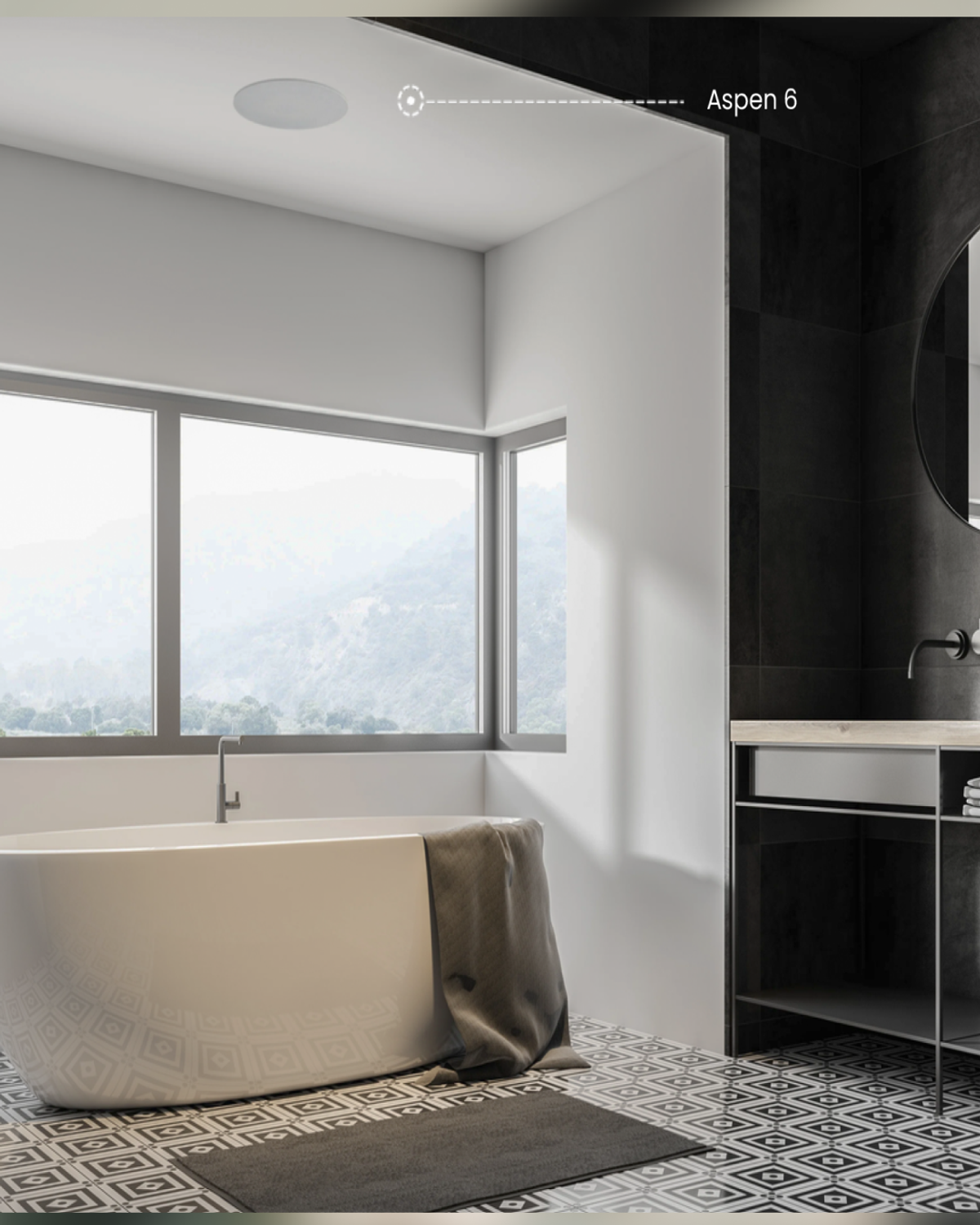
Slim in-ceiling speakers vary widely. Our own range spans the whole spread: the Aspen 6 needs 115 mm of cavity, while the Ghost 2.0 needs 200 mm because the housing carries its own bass driver — a difference of nearly a hundred millimetres between two speakers in the same series, which is why the figure has to be checked per model rather than per brand. Slim on-wall arrays need no cavity whatsoever, which is frequently the honest answer in a finished room, a rented property, or a masonry building where chasing out a void is not on the table.
Serviceability is a real cost
An invisible speaker cannot be serviced without breaking the finish. If a unit fails, the repair is cutting out plaster, replacing it, re-skimming and repainting — and matching an existing paint finish across a ceiling is rarely as simple as it sounds. In a specified new build with a maintenance budget that is an acceptable risk. In a rented property, or a room with an expensive or hand-applied finish, it deserves more weight than it usually gets at specification stage.
A grille comes off. That is the whole argument.
Which to choose
Choose a plaster-over invisible speaker when total concealment is a hard requirement, the surface must be unbroken, output demands are moderate, the ceiling is still open, and the finish can be repaired if it ever needs to be. Background music, ambient zones, heritage interiors and any project where a designer has specified an uninterrupted plane.
Choose an ultra-slim architectural speaker when the room needs real output — a cinema front stage, Atmos height channels, a main listening space — or when the cavity is too shallow, the room is already finished, the grille can be painted to disappear, or the system has to be serviceable. Most home cinema work falls here, which is why it is what XSCACE builds.
The two also combine well. Invisible panels for the ambient zones and slim arrays for the cinema is a common and sensible specification, and there is no reason a house has to pick one philosophy throughout.
Decide before you cut
Both choices are effectively permanent once the ceiling closes, and both depend on numbers — cavity depth, ceiling height, elevation angle to the seat — that are easy to establish beforehand and expensive to discover afterwards. Trace the room, place the speakers and check the geometry before anyone cuts anything.
The home cinema design guide sets out the placement geometry and ceiling height limits in full, and the in-ceiling range lists cavity depth per model so it can be checked against the building before anything is specified.