Xylem 4

4-Channel DSP Amplifier

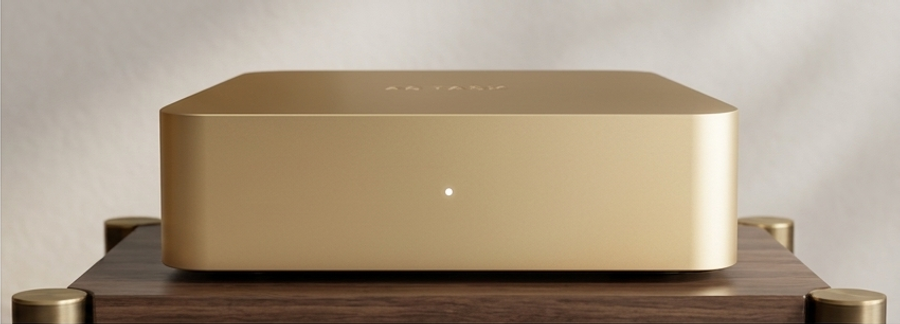
4×100W for multi-channel stereo, surround, or architectural arrays. Network-configured DSP as standard, 218mm champagne chassis.

XAM-DSP-XLM4
400W8ΩPowered
Champagne
Add to System →Brochure

Pricing is quoted by your regional distributor. Find yours →
Move cursor to illuminate
Design Philosophy
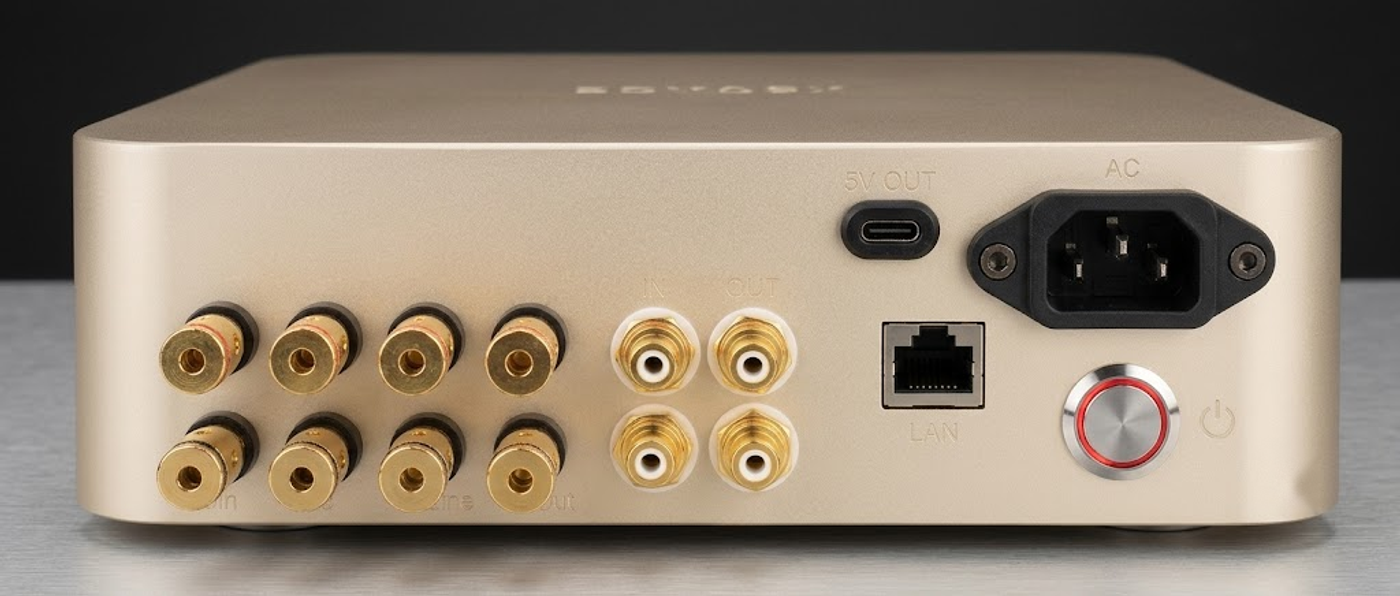
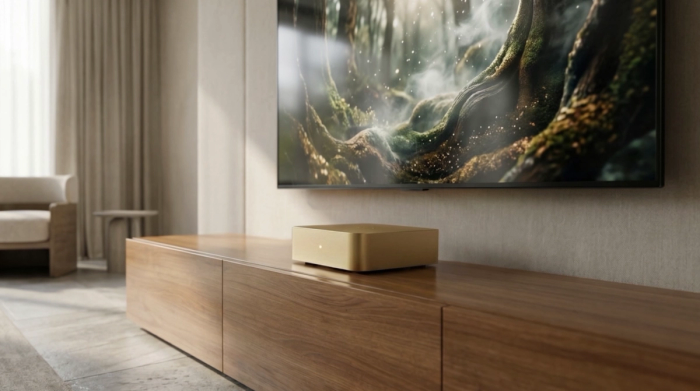
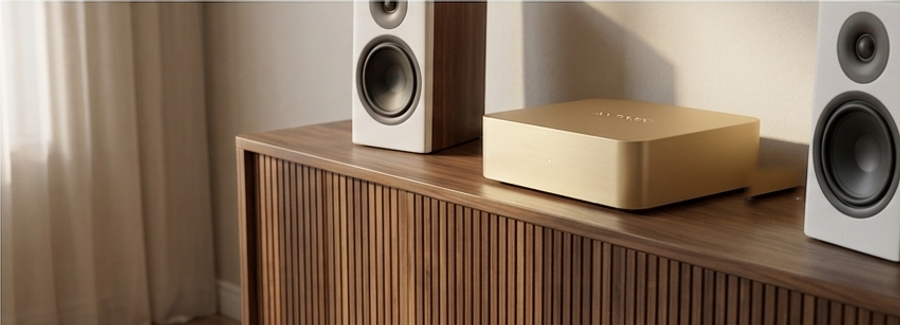
Four channels. 218 millimetres wide.Four channels of 100W into 8Ω, in a CNC-machined aluminium chassis 218 × 193 × 64 mm that runs without a fan. Four zones in less space than most stereo amplifiers take.
PsySculpt runs on the signal, live.
One chip. Every parameter.
Configured over the network.
Every parameter. Recalled.
01 / 05
SigmaDSP · ADAU1701 · PsySculpt™

Inside the Xylem

Every parameter is executed in real time by a dedicated DSP chip and shaped by XSCACE proprietary psychoacoustic processing. No approximations. No look-up tables.

ADAU1701 DSP IC
CLASS D OUTPUT STAGE
SIGMADSP · ANALOG DEVICES
ADAU1701

28/56-bit audio processor running at 50 MIPS. Executes all crossover calculations, parametric EQ biquad filters, and per-channel delay compensation in the digital domain — with onboard program storage that survives any power event.

50 MIPS28/56-bit8× BiquadNon-volatile
XSCACE PROPRIETARY
PsySculpt™
EQUAL-LOUDNESS COMPENSATION

Equal-loudness compensation, running continuously. A log-decay peak detector tracks programme level with a 10 ms hold, and that measurement drives low and high shelving filters in real time — so the tonal balance you tuned at reference still holds at two in the morning. A level-tracked bass stage compresses rather than clips as the system is pushed, and a hard ceiling sits ahead of the converters. One switch bypasses the whole chain.

It is not room correction. Room correction is measured and applied in XSCACE Studio, from a microphone in the room. PsySculpt is about how the ear’s sensitivity changes with level — the Fletcher–Munson problem — and it runs whether or not anyone has measured anything.

Learn more →
How PsySculpt works · signal path
ADAU1701 · 48 kHz · 28/56-bit
PSYSCULPT™ · ONE SWITCH BYPASSES THE CHAINSUB FEED · LOW-PASSEDLEVEL → GAININPUTAnalog · Hi-LevelDC BLOCKOffset removedLOUDNESSPre-comp · L&H shelves · PostDYNAMIC BASS200 Hz LP · 60 Hz · 2:1HARMONIC GEN.Bass overtonesCEILINGHard clipDAC · OUTL · R · SubLEVEL DETECTORLog-decay peak · 10 ms hold
← swipe to follow the path →
Solid: the audio. Dashed: the measurement. Nothing in the dashed path touches the sound directly — it only tells the champagne stages how much to do.
Applied correction
+0 dB+4 dB+8 dB+12 dB+16 dB2060 Hz2001k6.8k Hz20k
Late evening · 45 dB SPL
Full correction — both ends lifted
Why the ends move

Hearing is not flat, and it does not stay the same shape as level changes. Turn a system down and the bass and the air leave the recording before the midrange does — which is why a mix that sounded right at reference sounds thin at midnight.

The level detector measures the programme continuously and the shelves apply the correction the ear needs at that level — corners at 60 Hz and 6.8 kHz, as implemented, with the midrange left alone. Nothing is added that was not in the recording. The balance is held where the ear stops holding it.

The full PsySculpt story →
Low extension · one octave down
2040801503001k5k20kRATED150 HzWITH PSYSCULPT75 Hz
150 Hz75 Hz
Cane · usable low end
The side-chain synthesises the overtones of fundamentals the driver cannot reproduce, so the ear infers the fundamental. Nothing below the driver’s range is amplified — there is nothing there to amplify. Extension target down to 40 Hz, set per channel in XSCACE Studio.
XSCACE Studio · Mac · iPhone · iPad · Windows

From the seat, not the rack.

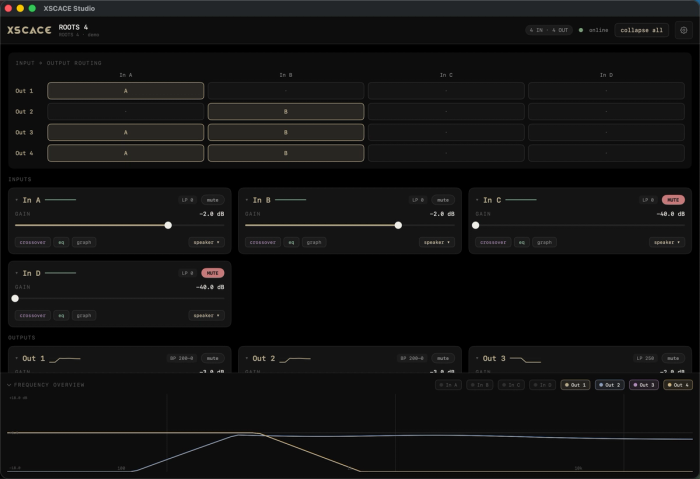
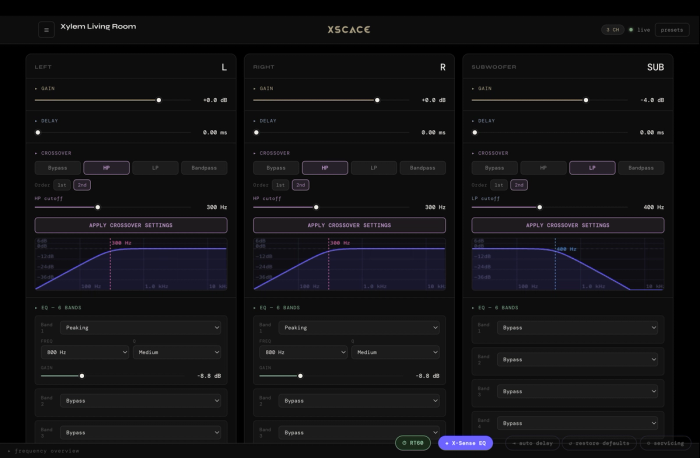
Sit where the room will be listened to, open a laptop, and the Xylem 4 appears on the network. Every crossover, delay, EQ band and limiter is edited there, live, with the music running — you hear the change from the chair it was made for, not from behind the amplifier. Calibrate by hand with the eleven-instrument toolkit, or let X-Sense EQ measure the room and write the correction for you.
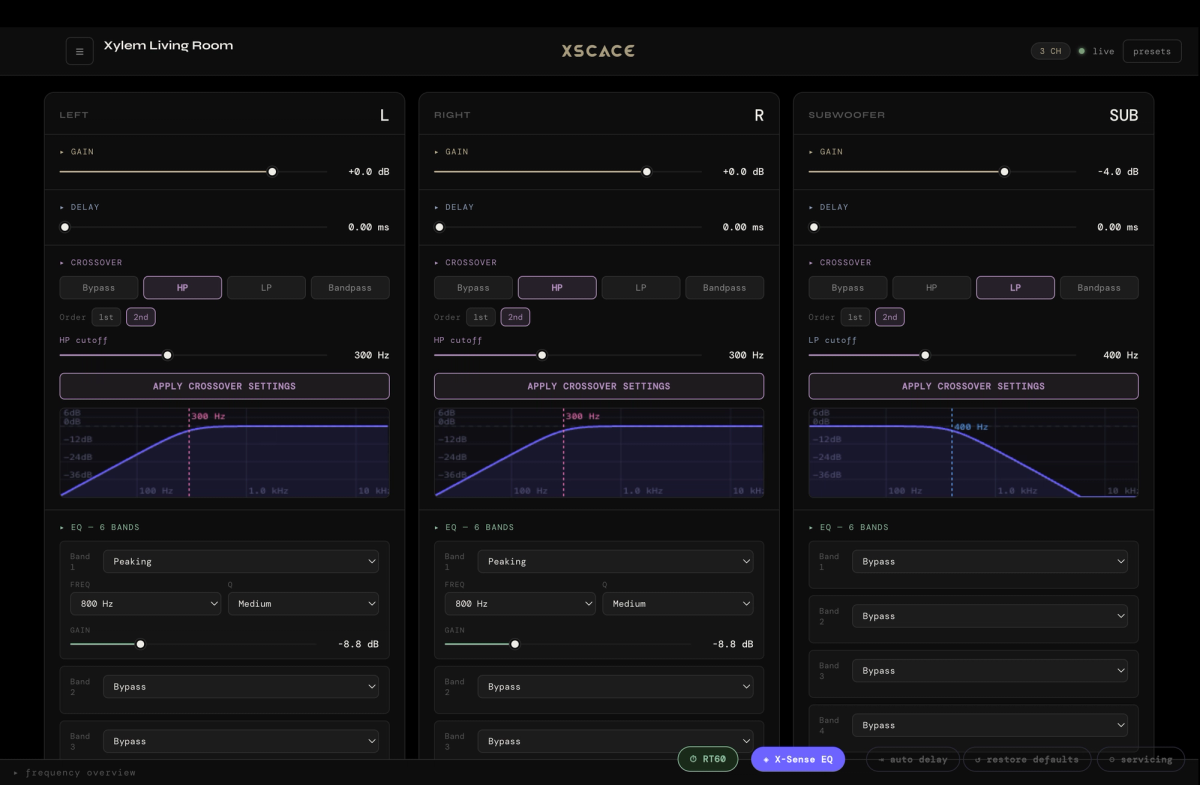
XSCACE Studio connected to a Xylem amplifier over the network, showing gain, delay, crossover with live filter response curves and six-band EQ across left, right and subwoofer channels
Live DSP · Dashboard
A Xylem found on the network and opened in Studio. Gain, delay, crossover and six bands of parametric EQ per channel — the crossover response drawn as it is edited, applied to the amplifier live.
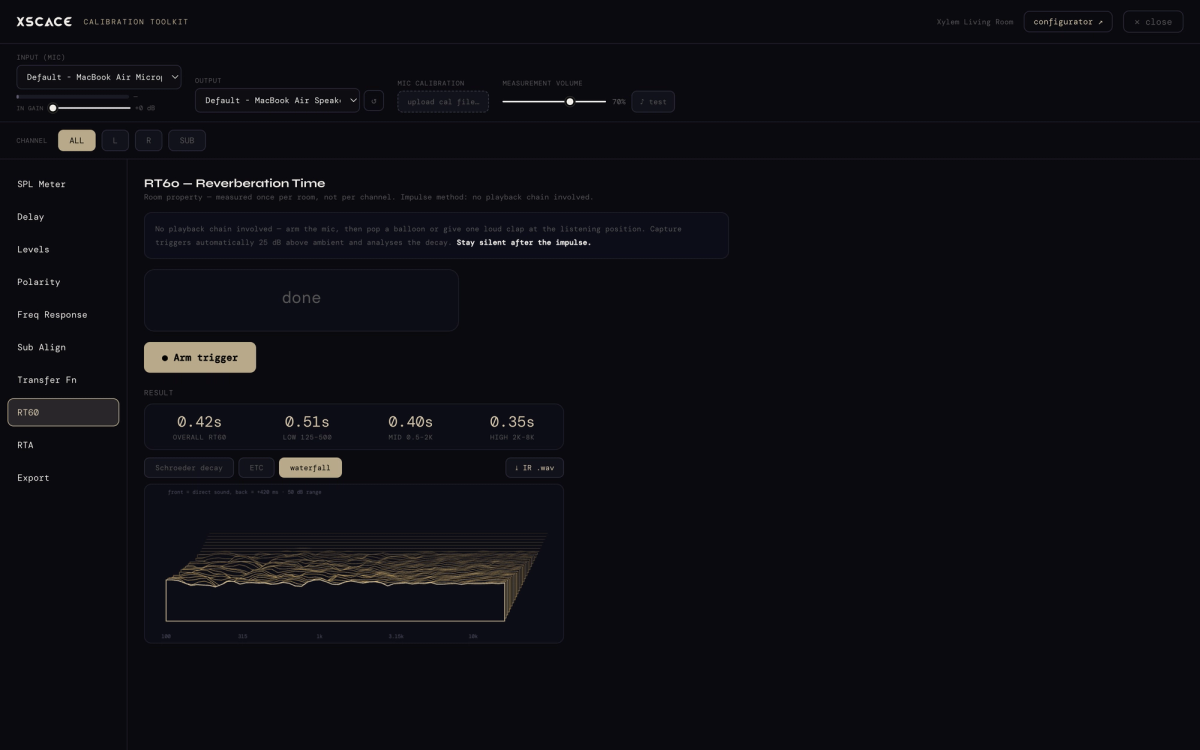
RT60 measured per room in the XSCACE Studio calibration toolkit, showing overall and per-band reverberation time with a spectral decay waterfall
Calibration · RT60
Measured from a microphone in the room, not estimated. 0.42 s overall here, broken out by band, with the decay waterfall behind it. This is where room correction happens — manually, or guided by X-Sense EQ — not in PsySculpt.
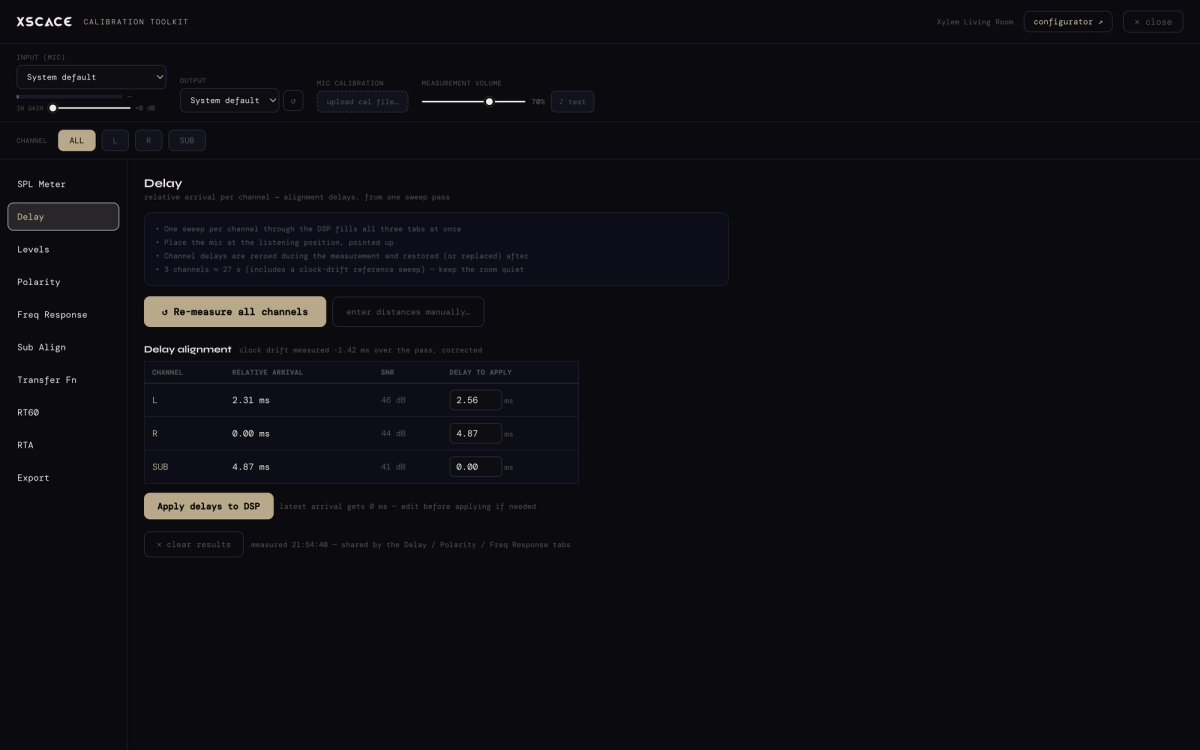
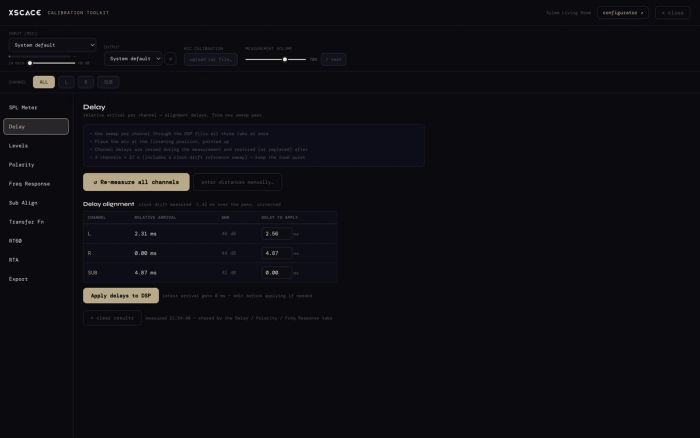
Delay alignment in XSCACE Studio showing measured relative arrival time and level for left, right and subwoofer channels, with delays ready to apply to the DSP
Calibration · Delay
One sweep per channel measures true acoustic arrival at the listening position — 2.31 ms, 0.00 ms, 4.87 ms here — and writes the alignment straight to the DSP.
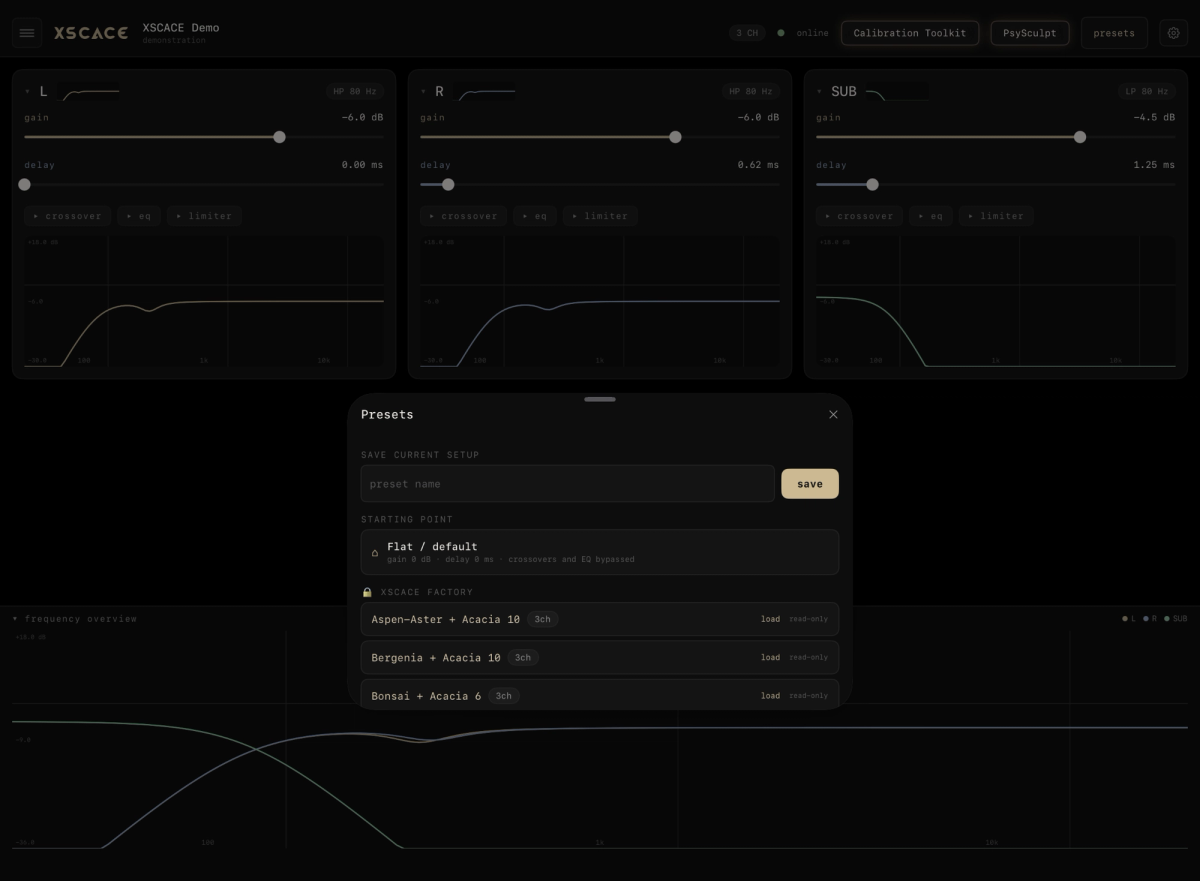
XSCACE Studio presets panel: save the current setup under a name, or load an XSCACE factory preset for a speaker and subwoofer pairing
Presets · every XSCACE speaker
Pick the speaker. Done.

Wire up a Cane, a Bonsai, a QuadCane — the Xylem 4 lists an XSCACE factory preset for every speaker model, crossover, EQ and limiter threshold included. Load it and the system is playing correctly before anything has been measured. Tune further, then save the result under your own name; the next identical zone starts from it.
Bonsai + Acacia 6Cane + Acacia 10QuadCane + JuniperGhost 2.0 + Acacia 10Aspen-Aster + Acacia 10Bergenia + Acacia 10+ Save current setup…
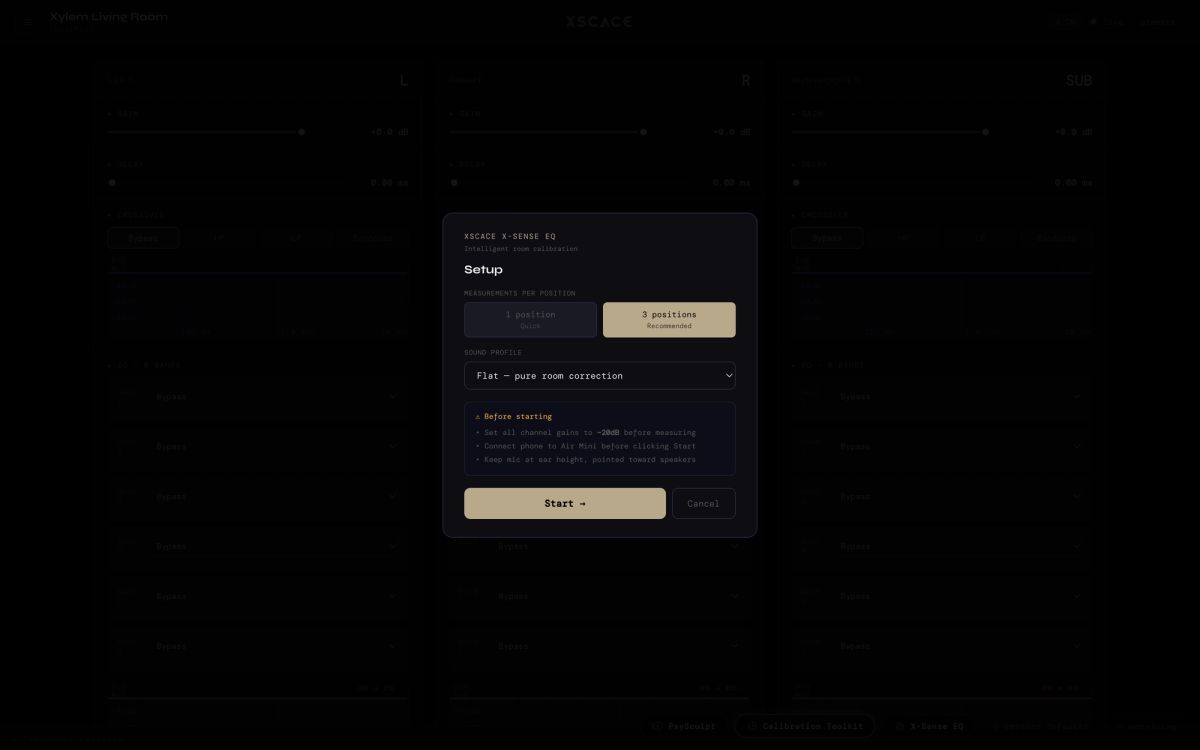
X-Sense EQ setup in XSCACE Studio: one or three measurement positions, a room profile, and a Start button that sweeps the room and writes corrective EQ to the amplifier
X-Sense EQ · auto EQ, live
The room measured. The amp tuned, while it plays.

Microphone at the seat, one or three positions, a room profile, Start. X-Sense sweeps the room, fits corrective EQ to the profile and writes it to the Xylem 4 live — then measures again and overlays before, target and after, so the correction is proven rather than promised. It tunes the Xylem and the Root 4 the same way.

1 or 3 positions6 room profilesVerification passXylem · Root 4
IP control

Found on the LAN. No USB, no laptop on a ladder.

Gain

Per channel, matched across a multi-amp system.

EQ

Six parametric bands per channel, run as biquads on the ADAU1701.

Crossover

Frequency, slope and alignment in software — DSP-active, nothing passive in the path.

Limiter

Per channel, so a driver is protected by the amplifier driving it.

Calibration

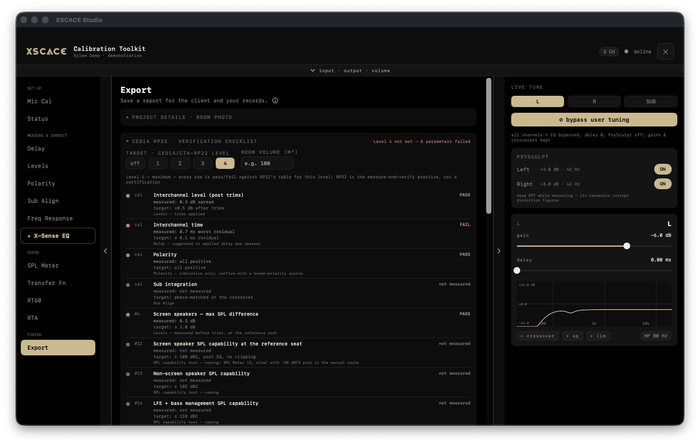
RT60, delay, levels, polarity and SPL from a measurement microphone.

Live tuning

Adjust against the music already playing. What you change is what you hear.

X-Sense EQ

Guided room correction: sweeps from up to three listening positions, corrective EQ fitted to a chosen sound profile, then a verification pass that overlays before, target and after.

Recall

Written to the amplifier. The configuration survives the power, not the laptop.

XSCACE Studio →Every feature, explained →
400W Total · Class D

Channel power distribution

4 × 100W @ 8Ω — 400W total, multi-channel. Drives 4–8Ω loads.

CH
PWR
Function
CH 1
100W
Full Range — L
EQDELAYXOVER
CH 2
100W
Full Range — R
EQDELAYXOVER
CH 3
100W
Full Range — L
EQDELAYXOVER
CH 4
100W
Full Range — R
EQDELAYXOVER
TOTAL OUTPUT400W
Contents6 sections

Technical Specifications

17 parameters · scroll to explore
Power RMS
100W
fills a large living room
01 / 17
Electronics
Power RMS
100W
Total Power
400W
Channels
4
Amp Class
Class D
Impedance
Physical
Dimensions
H 64 × W 218.1 × D 193.1 mm
Weight
1.7kg
Housing
CNC-machined Aluminium
Colours
Champagne
Power Type
Powered
THD+N
<0.1% @ 1KHz, 1W, 8Ω
Connectivity
Inputs
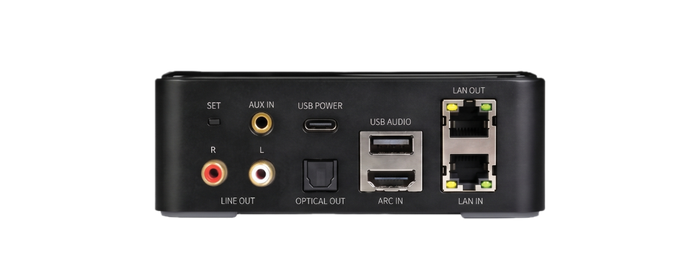
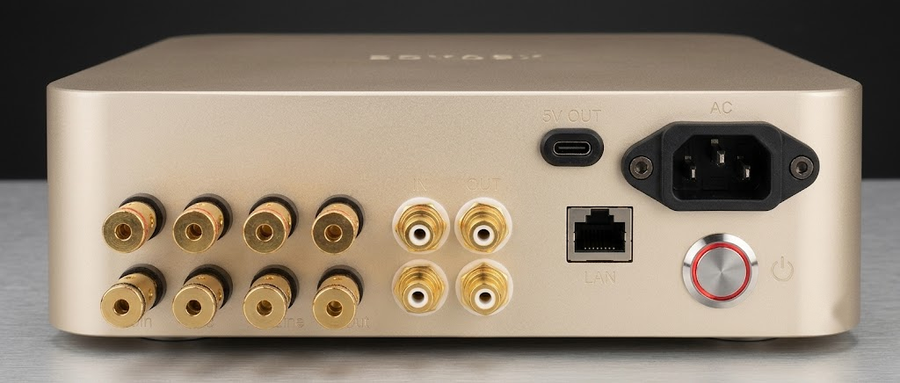
Line In, High Level Speaker Input
Outputs
Line Out, High Level Speaker Output, 5V Output
DSP
48 kHz, 48-bit fixed-point DSP (Analog Devices ADAU1701)
THD+N
<0.1% @ 1KHz, 1W, 8Ω
SNR
>109dB @ 1KHz
Protection
Short, DCP, OVP, UVP, OCP, OTP
Proprietary Technology

Built different. By design.

Full Technology Story
Pairs With

Built to work together

In Use

Common installations

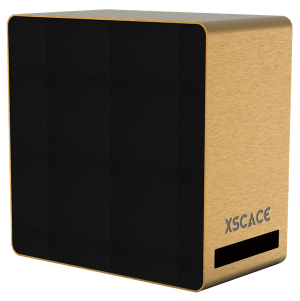
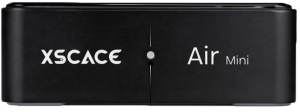
Four Zones or 2 × Stereo, Powered Sub · Air Mini · Xylem 4 · 4× Cane · Acacia 10 Powered
Sound Simulation
Don’t see your setup?
Draw your own room, place this speaker in it, and see the predicted coverage before you specify.
Technical Reading

Engineering notes.

Engineering notes and technical background on the Xylem 4 — how it is built, measured and configured.
The Xylem DSP Amplifier: Programmable Tuning, PsySculpt and XSCACE Studio
Article
The Xylem DSP Amplifier: Programmable Tuning, PsySculpt and XSCACE Studio
What is inside the Xylem, what PsySculpt actually does, how the tuning is arrived at, and how the amplifier is
How Do In-Ceiling Speakers Get Power?
Article
How Do In-Ceiling Speakers Get Power?
No socket in the ceiling, no switch, no plug — passive speakers take an amplified signal down two conductors.
Case Study: A Library Sound System in a Clubhouse Book Cafe
Article
Case Study: A Library Sound System in a Clubhouse Book Cafe
A reading room of oak shelving, plaster piers and pool-terrace glazing — covered by the smallest speaker XSCAC
How Every XSCACE Installation Is Wired, Controlled and Calibrated
Article
How Every XSCACE Installation Is Wired, Controlled and Calibrated
Two signal chains, three stages, and the reasoning behind each: how an XSCACE system goes from a traced floor
Case Study: A Commercial Gym Sound System in a Fully Glazed Clubhouse
Article
Case Study: A Commercial Gym Sound System in a Fully Glazed Clubhouse
A clubhouse gym glazed on three sides, floored in timber and free of soft furnishing — covered with distribute
Root 4 Now Runs on XSCACE Studio
Article
Root 4 Now Runs on XSCACE Studio
Root-series amplifiers are now discovered, configured and calibrated in XSCACE Studio on macOS — the same appl
Your Wireless Speaker Is Lying to You About Time
Article
Your Wireless Speaker Is Lying to You About Time
A wireless receiver's clock does not hold still. Six measurement architectures, each killed by a specific benc
XSCACE Studio: Every Feature in the Desktop DSP App, Explained
Article
XSCACE Studio: Every Feature in the Desktop DSP App, Explained
Live DSP editing, auto delay to 27ms, per-channel routing, and RT60-based room correction — a full walkthrough
Gallery

Xylem 4 in context

Scroll
Xylem 4 1
Xylem 4 2
Frequently asked questions9 answers
What is the XSCACE Xylem 4?

The backbone of multi-zone luxury residential and commercial audio systems in Canada, the UK, and India requiring precise DSP control and XSCACE speaker optimisation.

What is the power output of the Xylem 4?

The Xylem 4 is rated at 100W RMS into 8Ω.

What type of product is the Xylem 4?

The Xylem 4 is an amplifier product.

What DSP does the Xylem 4 use?

48 kHz, 48-bit fixed-point DSP (Analog Devices ADAU1701). Every crossover, EQ band, delay and limiter runs on that processor and is set from XSCACE Studio over the network; the configuration is stored on the amplifier itself.

What does PsySculpt do on the Xylem 4?

PsySculpt is equal-loudness compensation running continuously on the DSP. A log-decay peak detector tracks programme level and drives low and high shelving filters from it, so perceived tonal balance stays constant as volume changes, with a level-tracked bass stage and a hard ceiling before the converters. It is not room correction — room correction is measured and applied in XSCACE Studio.

Do the Xylem 4 settings survive a power cut?

Yes. Gain, EQ, crossover, delay and limiter settings are held in non-volatile memory on the amplifier, so it returns to the configured state after any power event or firmware update.

What is the power output of the Xylem 4 at 4 ohms?

4 × 100W @ 8Ω — 400W total, multi-channel. Drives 4–8Ω loads.

How much space does the Xylem 4 need?

The chassis is 64 mm high, 218.1 mm wide and 193.1 mm deep. Chassis depth is 193.1 mm. Allow 214.1 mm total clearance behind the front face — the rear speaker connectors add 21 mm once terminated.

How deep is the Xylem 4?

The Xylem 4 requires 193.1mm of depth.

XSCACE · Size Defying Sound© 2026 XSCACE Inc.