Questions worth answering first
Frequently asked questions6 answers
How much ceiling depth do in-ceiling speakers need?
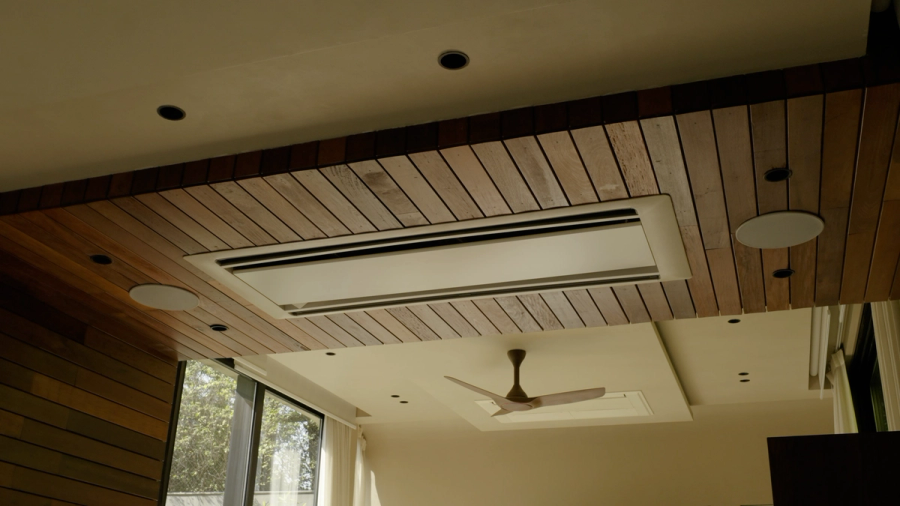
It varies by model, and it is the first thing to check against the building. The XSCACE Aspen 6 needs 115mm of clear cavity, the Aspen 8 needs 130mm, the Aster 6 LCR needs 155mm and the Ghost 2.0 needs 200mm. Measure the void before specifying, because the figure is fixed once the ceiling is closed.
What cutout size do they require?
The Aspen 6 cuts at 208.9mm with a 248.4mm outer frame, the Aspen 8 at 248.9mm with a 285.5mm frame, and the Aster 6 LCR at 208.3mm. The frame always overlaps the cutout, so small errors in the hole are covered.
Which in-ceiling speaker suits a home cinema?
The Aster 6 LCR — 150W RMS at 92dB with an aimable tweeter and 115dB maximum SPL, designed for front and centre channels where the speaker must throw toward a seated listener rather than straight down. For Atmos height channels the Ghost 2.0 is the flush option at 80W and 92dB.
Can in-ceiling speakers deliver real bass?
Down to a point. The Aspen 8 is specified from 40Hz and the Aster 6 LCR from 35Hz, which covers most music. Below that a subwoofer is doing the work, and in a cinema it always should be — room modes at those frequencies are a placement problem, not an output problem.
How many in-ceiling speakers does a room need?
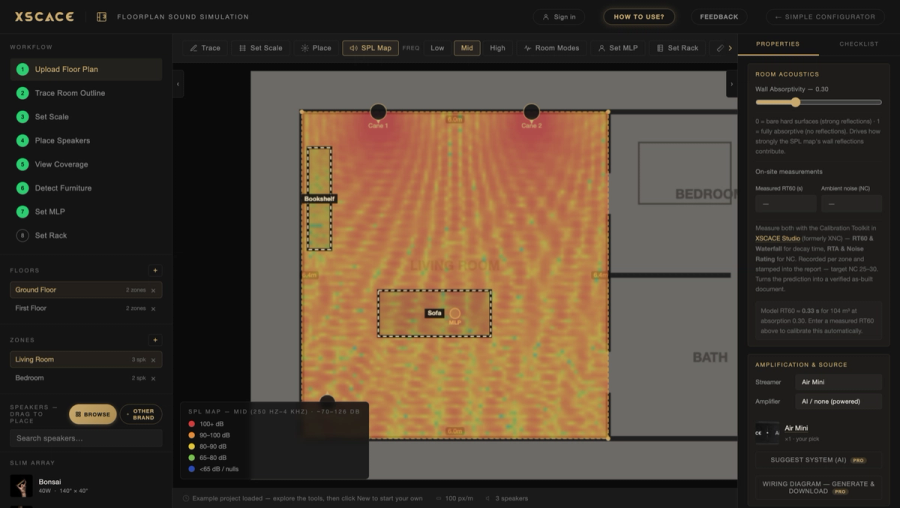
Coverage is set by ceiling height and dispersion, not floor area alone. As a starting point the Aspen 6 covers rooms to about 18×18ft and the Aspen 8 to about 25×25ft. For an even result across an irregular or open-plan space, model it on a floor plan rather than estimating.
What amplifier power do they need?
Match the amplifier to the RMS rating: Aspen 6 is 100W, Aspen 8 is 120W, Aster 6 LCR is 150W, all at 8 ohms. The Ghost 2.0 is 4 ohms, so check the amplifier is rated for a 4-ohm load before specifying it.