Contents5 sections
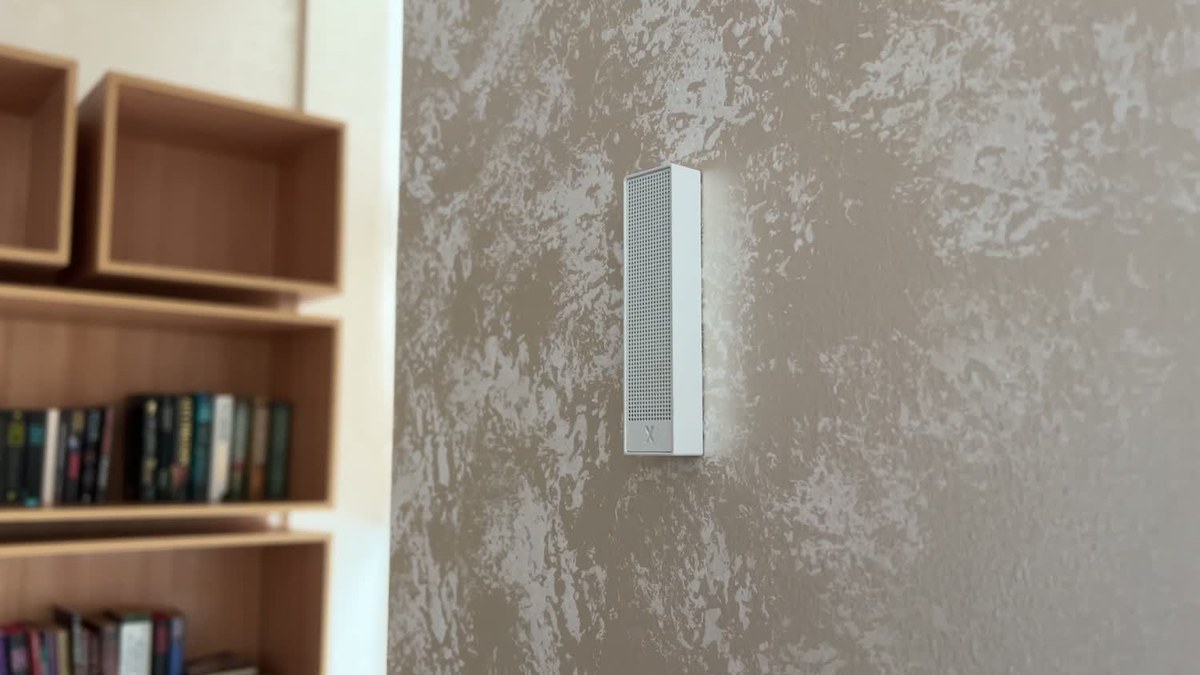
A library sound system has a brief the opposite of every other room in a building: it has to be heard without being noticed, and it must never become the reason someone looks up from a book. This clubhouse book café is oak shelving, reading tables, textured plaster piers and full-height glazing onto the pool terrace.
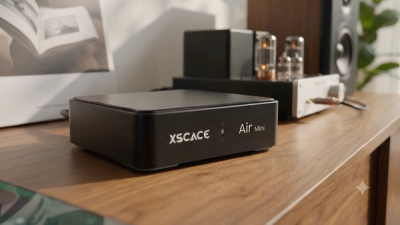
The speaker is Bonsai, at 90 × 22 × 12mm — the smallest speaker XSCACE makes. It runs with an Acacia 6 subwoofer beneath it, a Xylem 4 DSP amplifier driving it, and an Air Mini as the source.
Why a library sound system is its own kind of problem
A library is not a quiet room by accident — it is quiet because people expect it to be. That produces constraints most rooms never impose:
The system runs very low, and at low level timing and tonal balance are all that is left
Anything visually assertive on the wall reads as an intrusion in a room designed around calm
Books are the best broadband absorber in any building, so the room is acoustically dead in patches and live where the plaster and glass are
Low frequency has to be present but controlled — a reading room wants warmth underneath the music, not energy travelling through the floor
What Bonsai brings to it
Bonsai handles 40W RMS at 8Ω with 86dB sensitivity and a 103dB maximum SPL, across 300Hz–18kHz, from four power-dense custom woofers in a body 12mm deep.
That 300Hz low corner is the specification most worth understanding, because it is not a limitation. Bonsai is a satellite: it is built to hand over at 300Hz rather than to reach down on its own.
Acacia 6 is the other half. It covers 35Hz–300Hz with a 200W built-in amplifier and a 107dB maximum SPL, and its record specifies the same 300Hz crossover point that Bonsai's does. The two numbers are not a coincidence — Bonsai's bottom and Acacia's top are the same frequency, and the pair is designed to meet there.
A 300Hz crossover is high, though, and that has a consequence worth designing around. A conventional subwoofer crossed at 80Hz can go more or less anywhere, because the ear struggles to locate frequencies that low. At 300Hz the subwoofer is carrying part of the range the ear can place, so where it sits in a quiet room is a real decision rather than a convenience — and it is one the coverage prediction and the finished measurement should both be asked about.
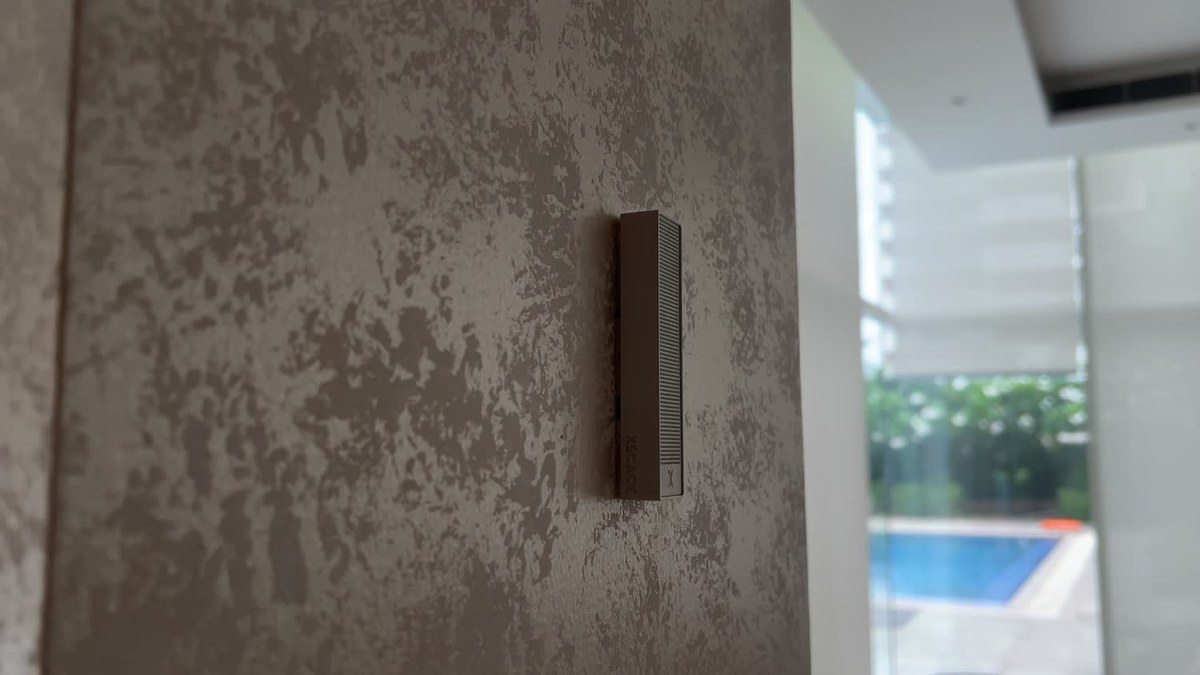
At 12mm deep it projects less than a light switch. Published coverage guidance is Up to 15 × 15 ft — bedrooms, studies, retail, which in a room broken up by shelving means several units on the piers rather than a pair at one end.
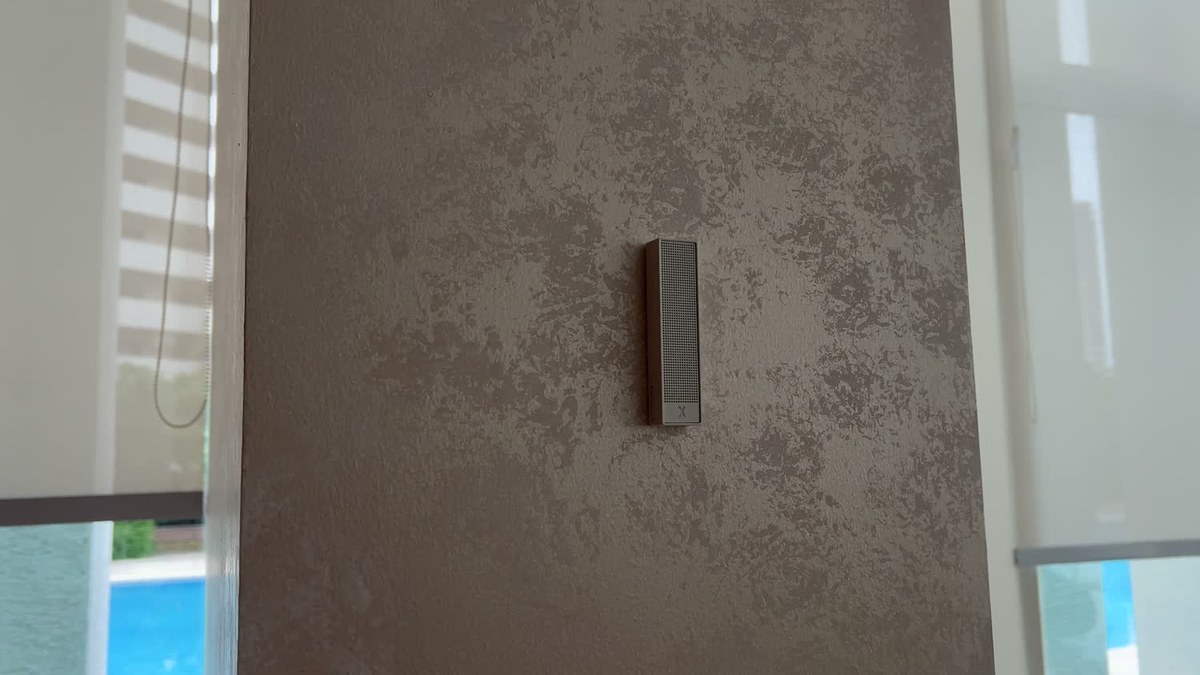
How the four parts connect
The chain is the same one every XSCACE system uses, and each link exists because of what the previous box does not do:
Air Mini → Xylem 4, line level. Air Mini is a streaming preamp with no amplifier of its own, so it hands a line-level signal onward rather than driving anything directly.
Xylem 4 → Acacia 6, line level out. The Acacia is powered — a 200W amplifier built in — so it takes signal rather than power, and costs the Xylem no amplifier channels.
Xylem 4 → Bonsai, speaker level out. Bonsai is passive at 40W RMS and 8Ω, so each unit takes an amplifier channel and can carry its own level and EQ.
That last point is what makes a room broken up by shelving work. Books absorb unevenly, so the units on the open plaster piers and the units near the shelving are not doing the same job, and per-channel level is what lets them be set differently rather than averaged.
The full explanation of both chains is in the installation workflow.
How this reading room was planned, controlled and calibrated
Every XSCACE installation follows the same three stages: planned in the simulator, controlled from the app that matches the hardware, and calibrated with measurement. A library is used quietly, and quiet listening is unforgiving — at low level, timing and tonal balance are all that is left.
Planned
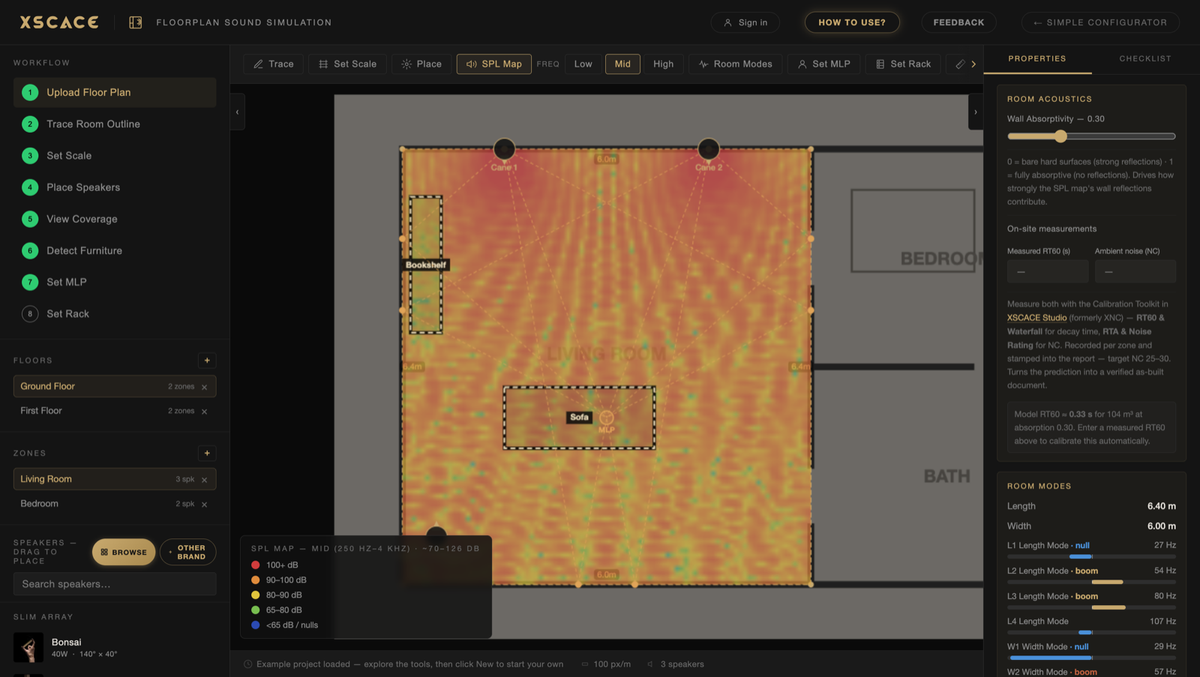
XSCACE Floorplan Sound Simulation takes a plan from trace to bill of quantities in the browser. For a room like this the outputs that matter are:
Coverage at the reading tables rather than at the room centre
Placement checked against shelving, which absorbs unevenly across frequency and changes as the shelves fill
Quantities and finishes agreed before the joinery was built
Controlled
Which control app applies depends on the amplifier the speakers are driven from: XSCACE Controller for the Air streaming amplifiers, and XSCACE Studio for the Xylem, Root and Lucifer DSP amplifiers. The two signal chains, and why a powered subwoofer takes a line feed rather than an amplifier channel, are set out in the installation workflow.
Calibrated
The calibration toolkit inside XSCACE Studio measures what the room actually does — eleven instruments covering SPL, delay, levels, polarity, frequency response, THD, sub alignment, transfer function, RT60, RTA and export, free on macOS. Here the ones that earn their place are:
RT60 to ISO 3382 — a room full of books measures very differently from the plastered and glazed parts of the same space
Levels matched unit to unit, so nobody sits under a hotspot
Frequency response at seated head height, because tonal balance is what carries at low volume
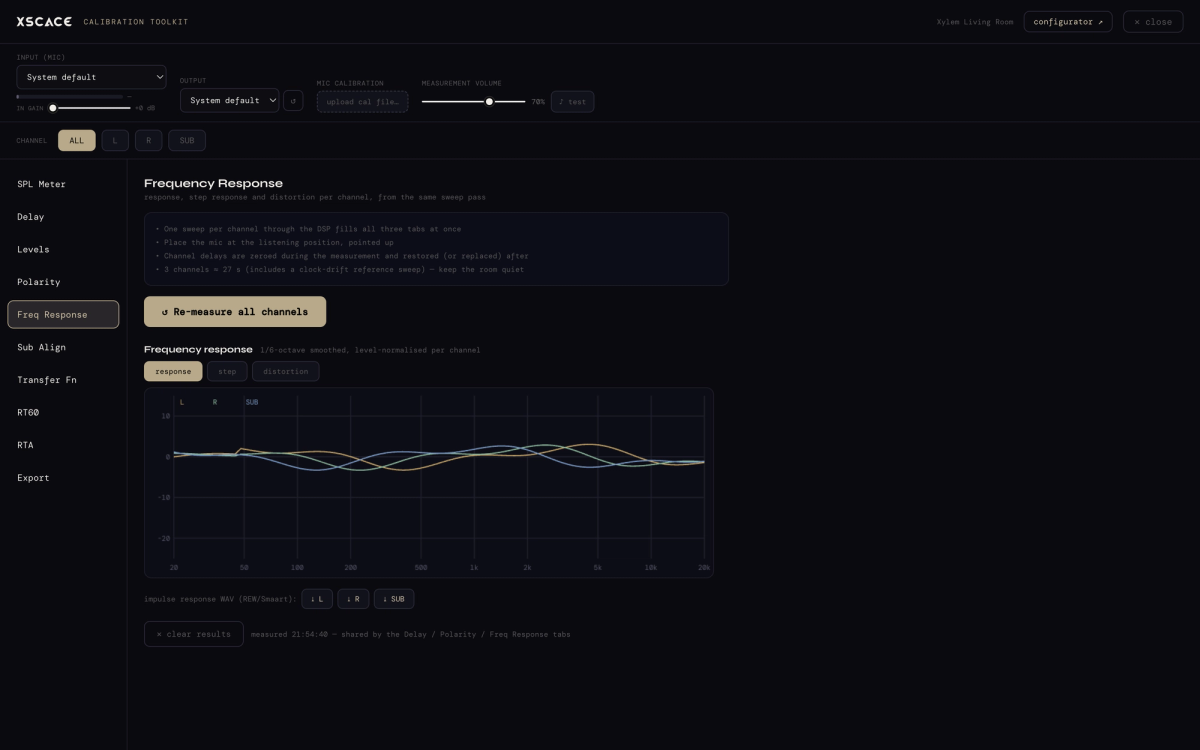
Bonsai covers 300Hz–18kHz and Acacia 6 covers 35Hz–300Hz, meeting at the 300Hz crossover both records specify. Whether that handover is actually seamless in this room, with its absorbent shelving and live plaster, is a measurement rather than an assumption.
What a specifier should take from this
Choosing the smallest speaker that meets the brief is a discipline, not a compromise. A reading room does not need output; it needs a source that is inaudible as an object and clear as a sound. Specifying something larger would have added bass nobody wanted and a visual presence the room was designed to avoid.
The book café shares a building with the clubhouse gym and the billiards room — a hard glazed gym, a hard games room, and a soft, book-lined quiet room. Three different acoustics, three different speakers from the same family, and one method across all of them.