Contents5 sections
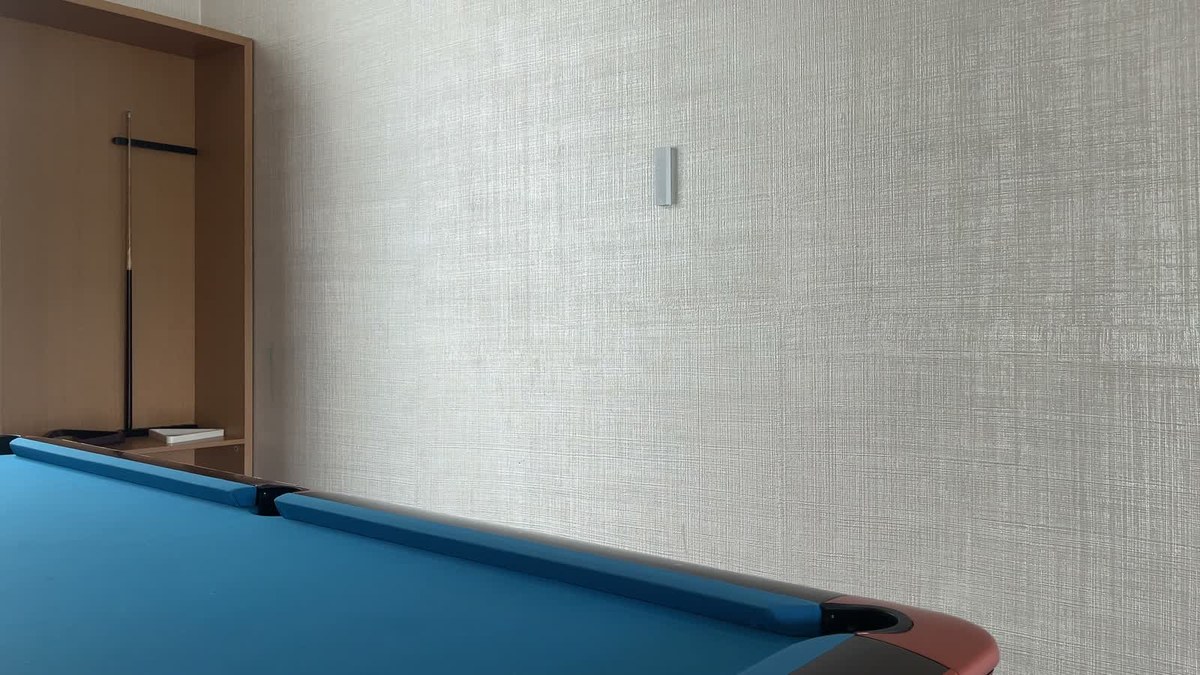
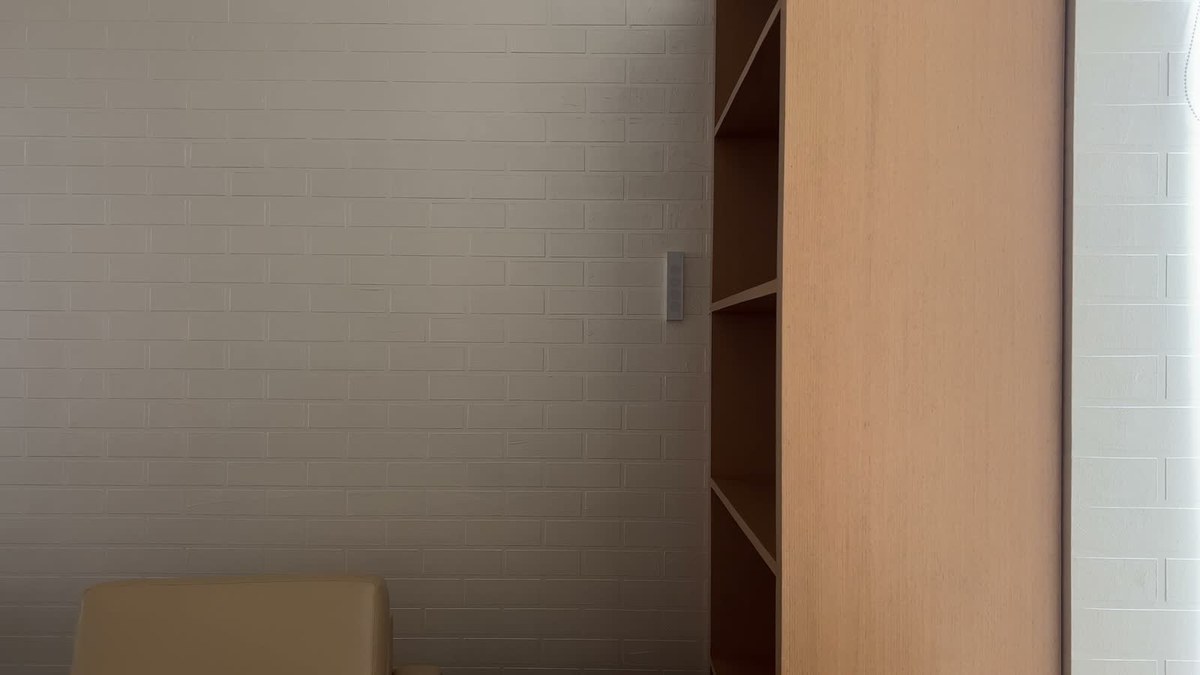
A clubhouse sound system is a different brief from a private room. It is used by people who did not specify it, maintained by staff who did not install it, and judged by a residents' committee. It has to be inconspicuous, hard to damage, and audible everywhere — in this case across a billiards room finished in textured plaster, painted brick and oak joinery.
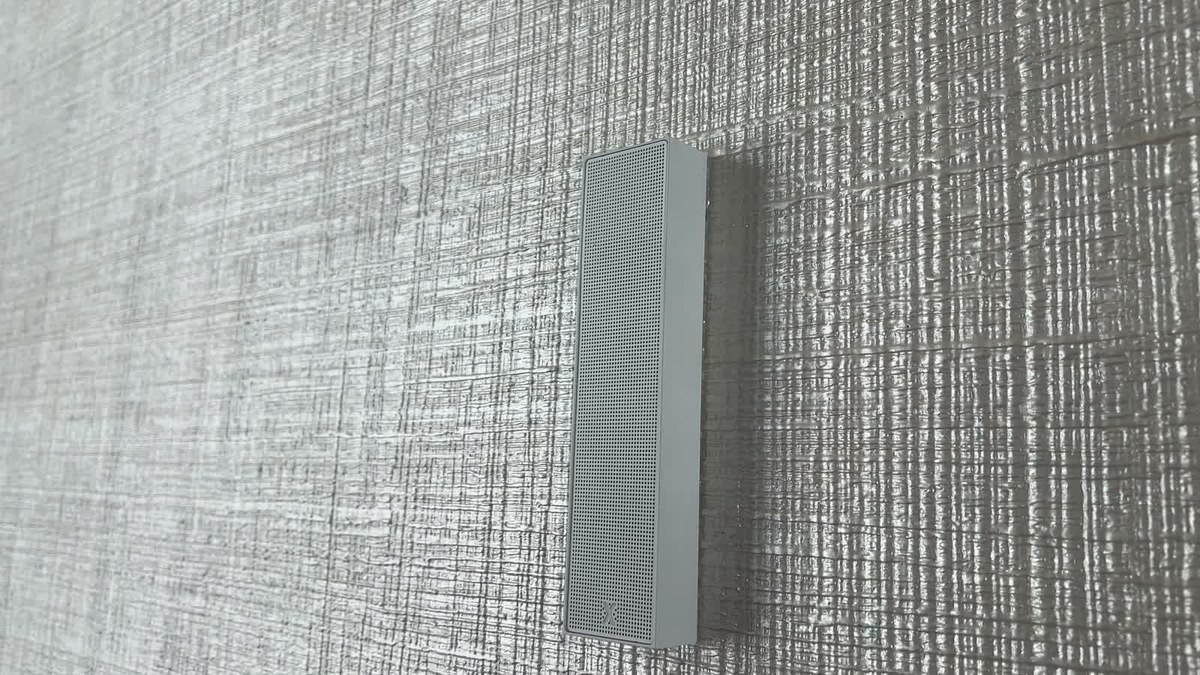
The speaker is Cane, at 183.5 × 43 × 23mm. That last figure is why it is here: 23mm of projection off a wall that people walk past with cues in their hands.
Why a billiards room is an awkward acoustic
The table dictates everything. It sits in the middle, people stand around all four sides, and nobody sits down. That produces a set of constraints most rooms do not have:
There is no listening position — coverage has to be even across a ring, not aimed at a sofa
The walls are the only available mounting surface, because the middle of the room is occupied
Everything is hard: painted brick, textured plaster, timber and slate under cloth
Anything protruding at shoulder height near a cue stroke is a liability
What Cane brings to it
Cane is a passive slim array: four power-dense custom woofers in a body 183.5mm tall, 43mm wide and 23mm deep. It handles 50W RMS and 60W peak at 8Ω, with 92dB sensitivity and a 110dB maximum SPL across 150Hz–20kHz.
The 92dB sensitivity is the number that matters in a shared room. High sensitivity means useful volume without a large amplifier behind it, which keeps the rack small in a building where plant space is contested. The 23mm depth is the number that matters to the architect — at that projection the speaker reads as a switch plate rather than as equipment.
Distribution, not a stereo pair
Because there is no seat to aim at, the answer is several sources around the perimeter rather than a pair at one end. That is the same principle used in the clubhouse gym in the same development — a hard room with no fixed listening position is a coverage problem before it is a loudness problem.
Cane is passive, so it needs an amplifier channel per speaker: 50W RMS at 8Ω, with a 200Hz crossover point if a subwoofer is added. Published guidance is coverage of Up to 20 × 20 ft — living rooms, meeting rooms, lobbies — a starting point for a layout, not a substitute for predicting the actual room.
How the amplifier, source and any subwoofer connect is the same two-chain pattern every XSCACE system uses, set out in the installation workflow. The short version for a room like this: the source feeds the amplifier at line level, the amplifier drives the passive Canes at speaker level, and a powered subwoofer — if the brief needs one — takes a line feed rather than an amplifier channel.
What a clubhouse sound system actually has to survive
In an amenity space the constraint that decides the product is rarely acoustic. It is that the speaker must survive being ignored: not knocked, not adjusted, not switched to the wrong input by a resident. A 23mm-deep unit on a wall, driven from a rack nobody has access to, is a specification decision as much as an audio one.
The acoustic part is ordinary by comparison — predict the coverage on the plan, then measure the finished room. In a room with four hard surfaces and no soft furnishing, predicting it first is the step people skip and then pay for.
How this room was planned, controlled and calibrated
Every XSCACE installation follows the same three stages: planned in the simulator, controlled from the app that matches the hardware, and calibrated with measurement. A commercial room is judged on consistency — the table by the window should hear what the table by the bar hears.
Planned
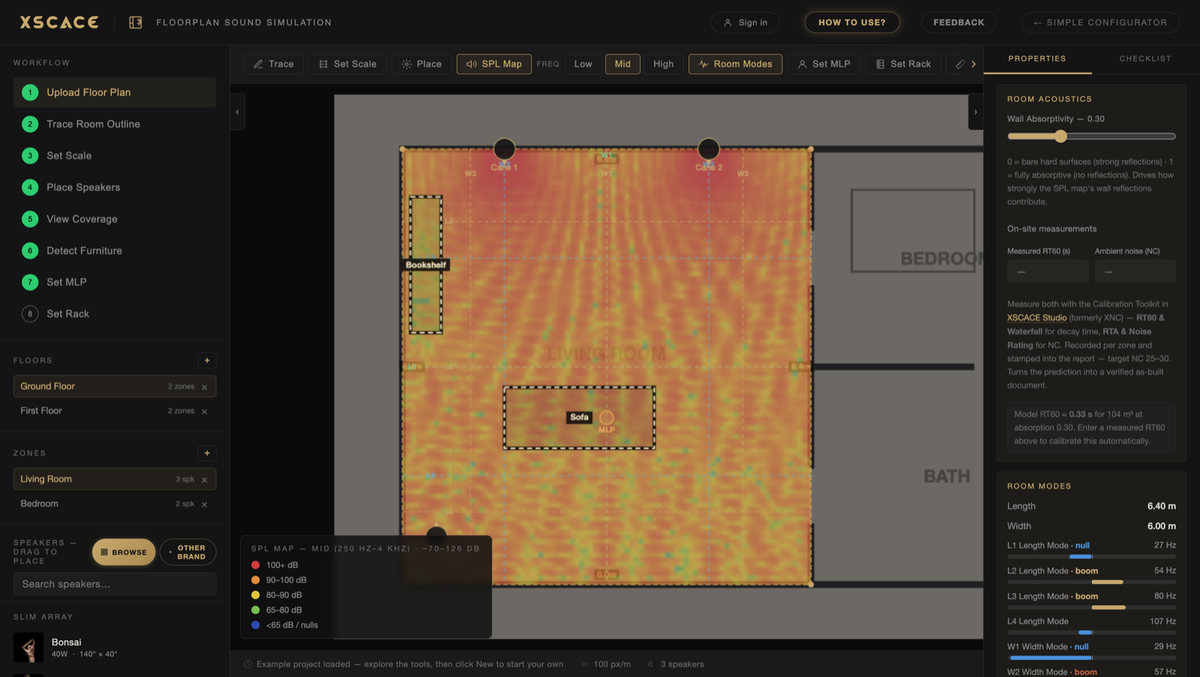
XSCACE Floorplan Sound Simulation takes a plan from trace to bill of quantities in the browser. For a room like this the outputs that matter are:
Coverage checked table by table, so no seat is the bad seat
Room modes located before the fit-out covers the structure
A bill of quantities the operator can price against
Controlled
Which control app applies depends on the amplifier the speakers are driven from: XSCACE Controller for the Air streaming amplifiers, and XSCACE Studio for the Xylem, Root and Lucifer DSP amplifiers.
Calibrated
The calibration toolkit inside XSCACE Studio measures what the room actually does — eleven instruments covering SPL, delay, levels, polarity, frequency response, THD, sub alignment, transfer function, RT60, RTA and export, free on macOS. Here the ones that earn their place are:
RTA noise rating, NC-15 to NC-65, setting the level the system must clear once the room is full
SPL measured at each zone against the design target
RT60 to ISO 3382, showing whether hard surfaces need treating as well as covering
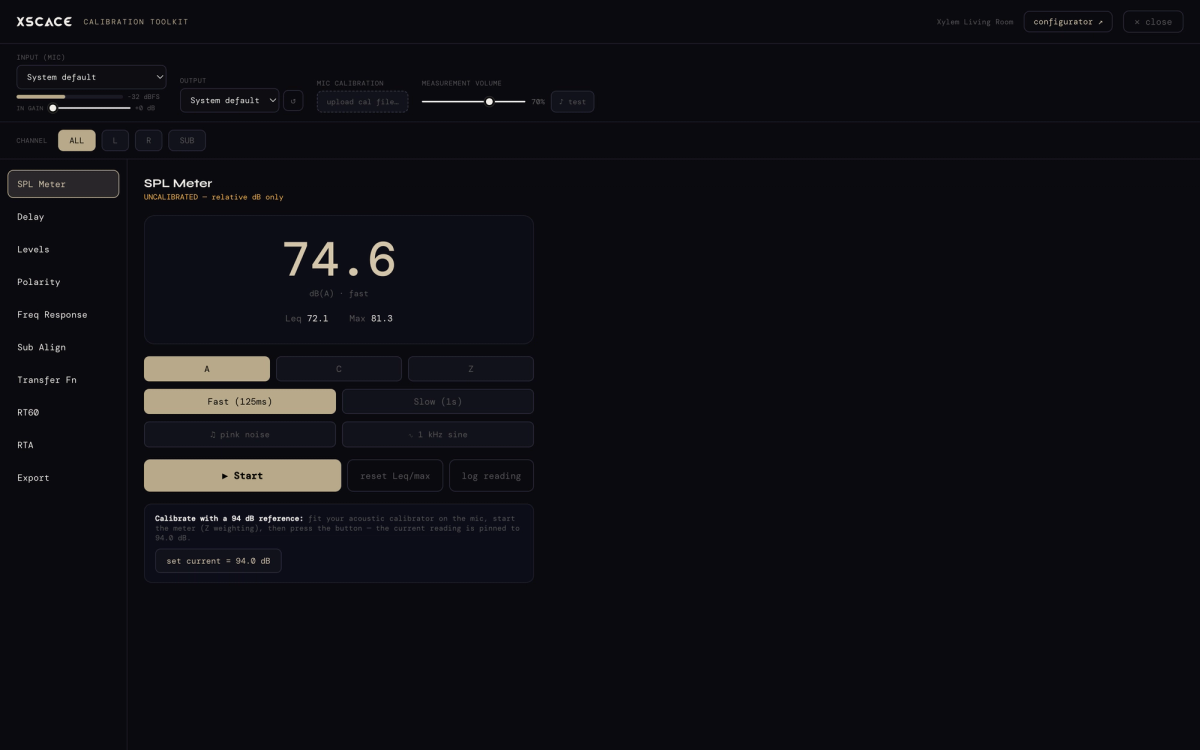
Cane publishes 92dB sensitivity and a 110dB maximum SPL — the figures the coverage prediction works from, and the ones the finished room should measure.
The same development also has a cafe covered by a distributed in-ceiling grid, book cafe covered by the smallest speaker in the range — four rooms, four acoustics, one method.