What a home cinema installation involves
Four stages, spread across a building programme rather than run end to end. Most of what decides whether a cinema room works is settled in the first two, while the ceilings are still open. XSCACE speakers are installed by authorised integrators — this is what they do, and what to have ready before they arrive.
Four stages, in build order
Survey
The integrator measures the room, records ceiling height and construction, and checks what the void and wall cavities actually allow. This is the stage that determines the channel configuration, because room dimensions set the channel count and ceiling height decides whether height channels are viable at all. A plan produced without a survey is a guess.
First fix
Cable runs, back boxes and cut-outs, before plastering. Speaker cable inside a wall or ceiling must be rated for in-wall use — CL2 or CL3 — because non-rated cable is both a fire risk and a code failure, and correcting it means opening the wall again. Cut-out positions are set from the speaker geometry, not from where the joists happen to fall.
Second fix
Speakers mounted, grilles fitted and painted if required, amplification racked and connected. Impedance matters here as much as power: some models are 4 Ω where most of a range is 8 Ω, and an amplifier chosen on wattage alone will be wrong for them.
Calibration
Levels, distances and crossovers set per channel, then room correction measured rather than estimated. Target an RT60 of 0.3–0.5 seconds; if low-frequency decay runs past 0.6 seconds the room needs treatment, not more equalisation. This is the stage most often skipped, and it is the one that decides whether the room sounds like the specification.
What to have ready
A survey goes faster, and the first quote is closer to the final one, when these are known.
Room dimensions and ceiling height
Length, width and floor-to-ceiling height. Below 2.3 m, Atmos height channels cannot reach the required elevation angle.
Construction type
Timber stud, steel stud, masonry or plasterboard on batten — and the depth of the ceiling void. A standard 2×4 stud gives roughly 89 mm, which rules out most recessed models.
Stage of the build
Pre-plaster is straightforward. Retrofit into a finished room is possible but constrains what can be specified.
Seating position
Where people will actually sit, not where furniture is now. Every speaker angle is measured from it.
Sources and control
What feeds the system, and whether it needs to integrate with existing home automation.
The planner does most of this for you. Trace the room, place the speakers and it produces the layout and a bill of quantities you can hand straight to an integrator — which turns a first conversation into a quote.
Installed by integrators, not by us
XSCACE manufactures the speakers, subwoofers and amplification. Installation is carried out by authorised distributors and the integrators they work with, in India, Thailand, the Philippines, the United Kingdom, the UAE and wider Middle East, Australia and New Zealand, and Canada.
That is deliberate rather than a limitation. Ceiling construction, cable regulations and building practice differ by market, and the person specifying a system should be the person who knows how that market builds. Tell us about the room and we will put you with the distributor who covers it.
Plan it before the first fix
Trace the room, place the speakers to the geometry, and export the bill of quantities your integrator quotes from — which turns a first survey into a specification.
Rooms our integrators have completed
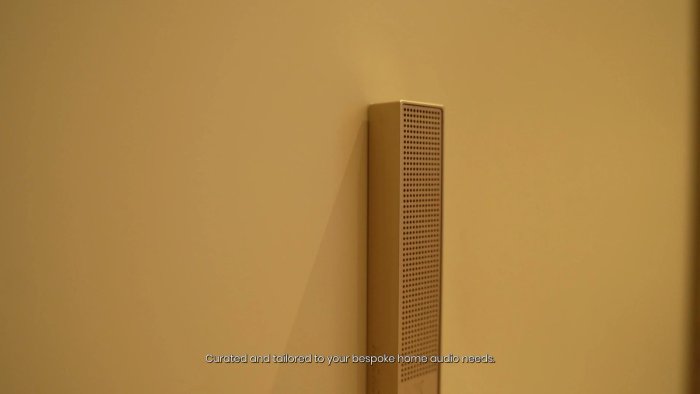
Bonsai Slim Wall Speakers Across an Apartment at Trevoc Royal Residences
Bonsai on the wall panels of the living room, lounge, dining room and bedroom of a residence at Trevoc Royal Residences — 12 mm thin, in the panel's own finish — with the simulation and calibration behind a room like this.

Grand Prix Plaza, Las Vegas — 25 Rooms of F1, Designed in the XSCACE Planner
Formula 1's permanent home in Las Vegas: F1 Hub, F1 X and F1 Drive, twenty-five rooms and 147 speakers designed as one system in the XSCACE Floorplan Sound Simulation — on Sonance, Fulcrum, Martin Audio and Q-SYS hardware; the planner works with any brand. Installation next month. The design, room by room.
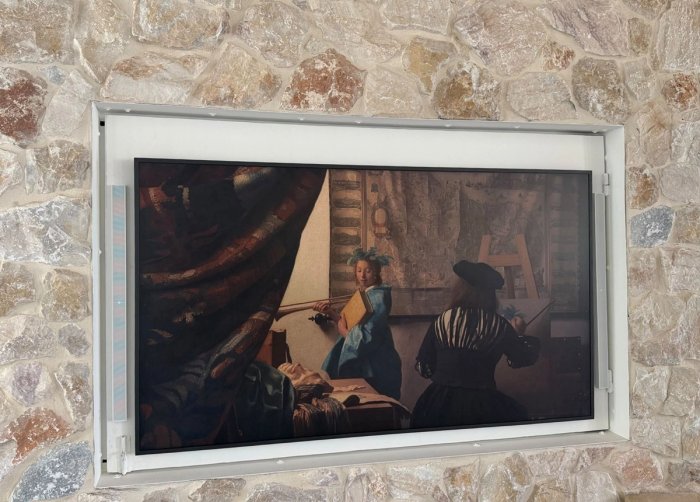
A Stone Fireplace Wall With Nowhere to Put a Speaker
A limestone feature wall with a recessed display, a working fire and no cavity to build into. A pair of 21 mm QuadCane slim arrays mounted in the frame reveal, with nothing cut into the stone.
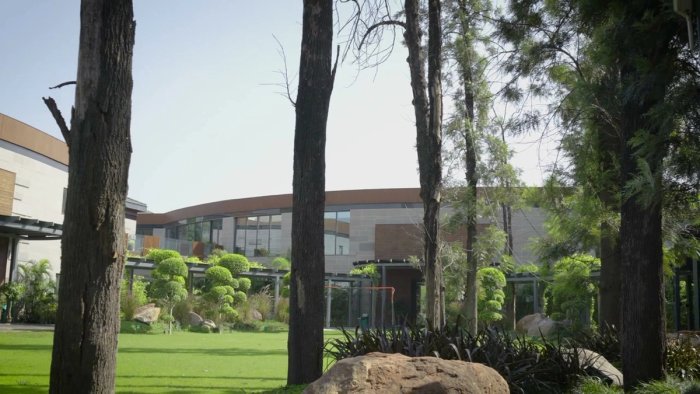
A Whole-Home System Across Nine Zones
Nine zones in one house — a reference cinema in a curved acoustic shell, a living room whose marble could not be cut, a pool terrace built for a crowd — designed in one model before a wall was closed, then measured against it.
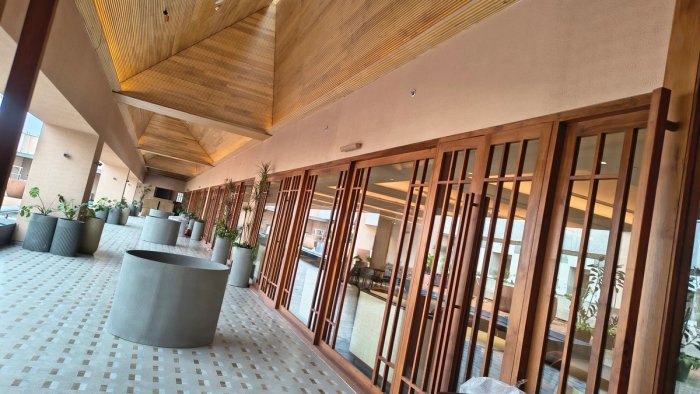
Restaurant Sound System: A Clubhouse in Two Zones
A covered terrace and a dining room behind folding teak doors, one playlist, two zones. Flush in-walls inside, slim arrays outside, and the reasoning behind each choice.
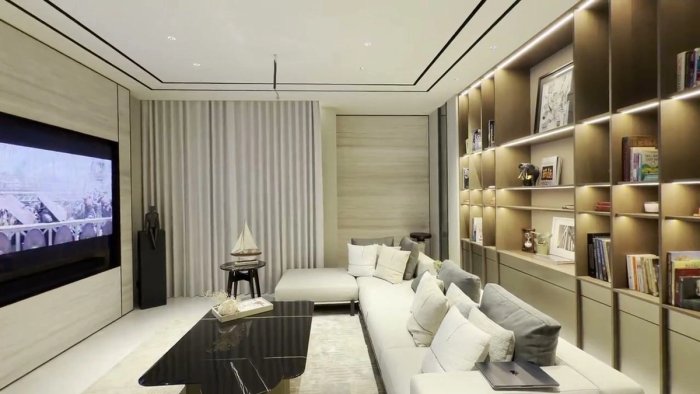
A 5.1.2 Media Room Sound System With a Custom LCR Soundbar
Three channels from a custom bar built to the width of the recess, two Canes in the shelf line, two Ghosts overhead and one powered Acacia 10 — seven channels driven by a seven-channel receiver, with nothing spare.
Common questions
Frequently asked questions6 answers
Does XSCACE install home cinemas directly?
No. XSCACE manufactures the speakers and amplification, and installation is carried out by authorised integrators. Each region has a distributor who either installs directly or works with local integrators. This keeps specification and installation with people who know the local building practice.
When in a build should I involve an integrator?
Before the walls and ceilings are closed, and ideally before they are built. Cable routes, back boxes and cut-outs all belong to first fix, and ceiling void depth has to be confirmed before anything recessed is specified. Bringing an integrator in after decoration limits the options to what fits the space that already exists.
How long does a home cinema installation take?
The work splits across the build programme rather than running continuously. First fix takes a day or two for most rooms and happens while ceilings are open; second fix and calibration take another day or two after decoration. The elapsed time is set by the building schedule, not the audio work.
Can speakers be retrofitted into a finished room?
Often yes, but the choice narrows. Cable routing becomes the constraint, and available cavity depth determines which models are possible. Slim on-wall speakers are frequently the practical answer in a finished room, since they need no recess at all.
What does a home cinema installation cost?
System cost falls into bands — roughly $5K–$15K for a living-room layout, $15K–$40K for a dedicated room, $40K–$100K for a larger installation with separate amplification. Installation labour, cabling and any building work are quoted separately by the integrator, because they depend on the building.
Which countries have XSCACE integrators?
India, Thailand, the Philippines, the United Kingdom, the United Arab Emirates and wider Middle East, Australia and New Zealand, and Canada. Each region has an authorised distributor listed on the distributors page.
Find an integrator
Authorised distributors across South Asia, South-East Asia, the Middle East, Europe, Oceania and Canada.