Xylem 3
2×100W plus 1×200W. Perfect for 2.1 setups with a dedicated bass channel. Network-configured DSP as standard, 218mm champagne chassis.
Pricing is quoted by your regional distributor. Find yours →
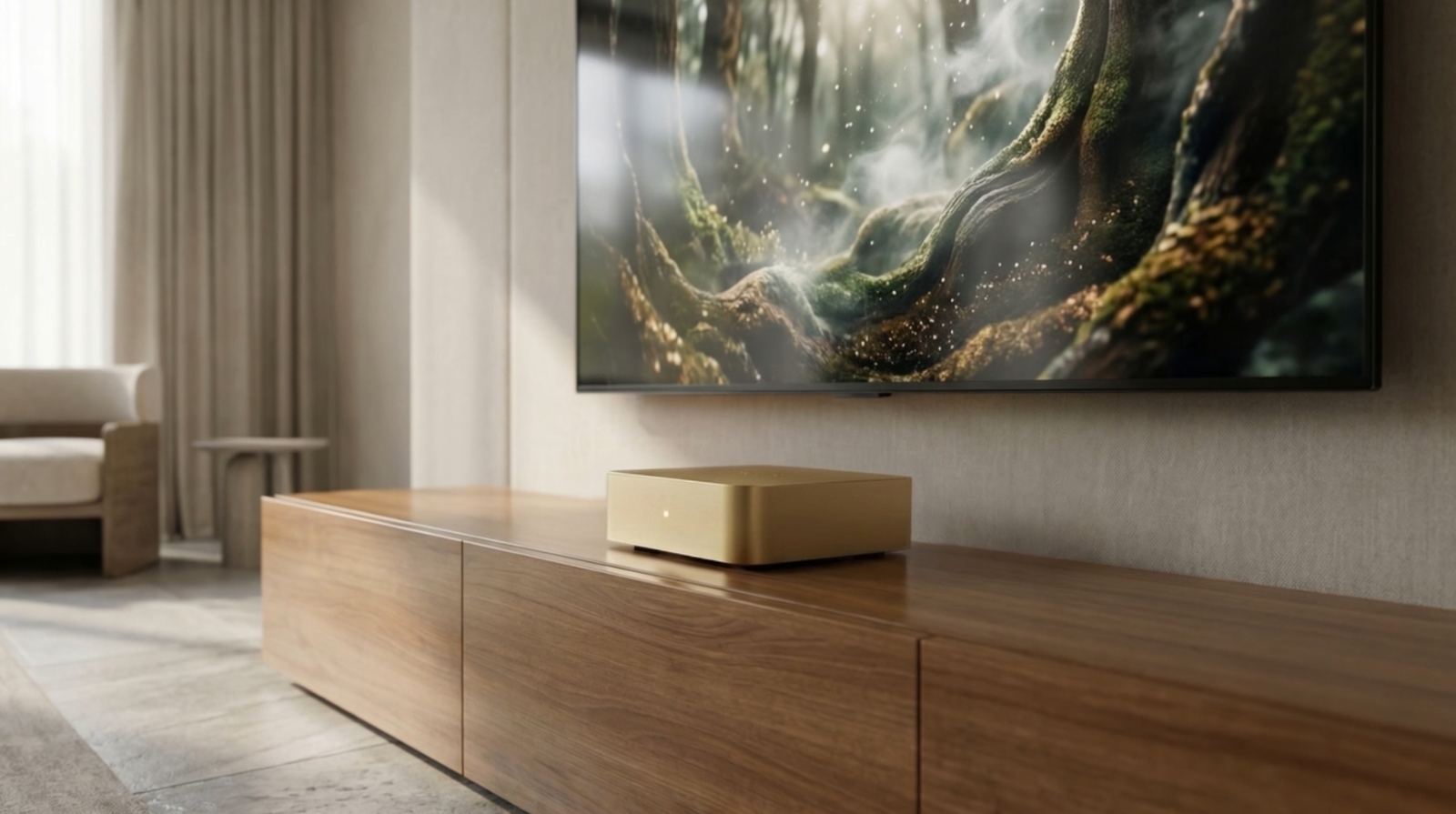
From the seat, not the rack.
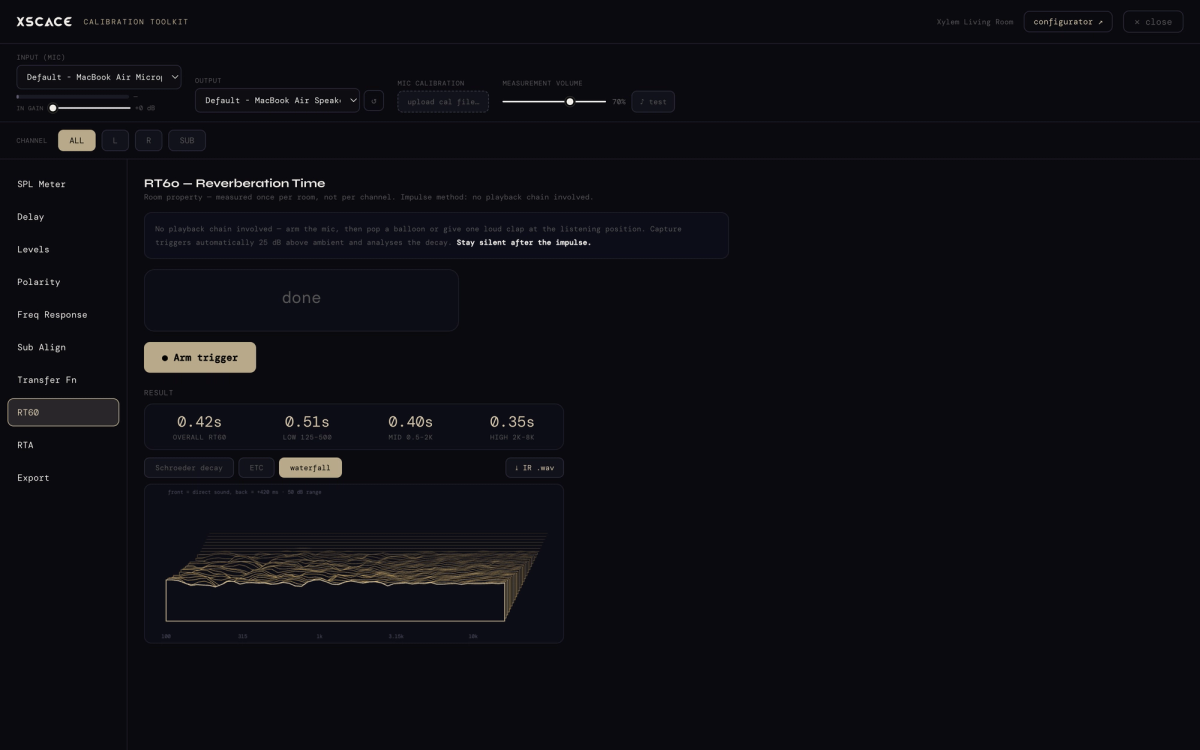
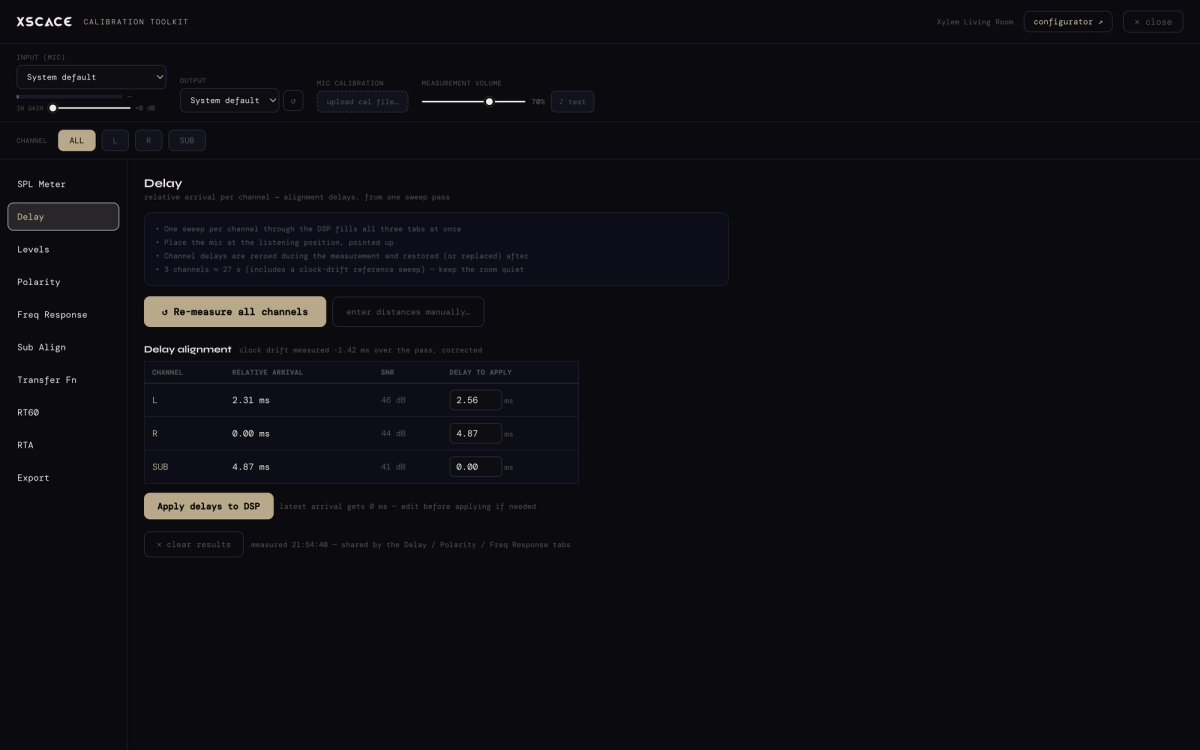
Sit where the room will be listened to, open a laptop, and the Xylem 3 appears on the network. Every crossover, delay, EQ band and limiter is edited there, live, with the music running — you hear the change from the chair it was made for, not from behind the amplifier. Calibrate by hand with the eleven-instrument toolkit, or let X-Sense EQ measure the room and write the correction for you.
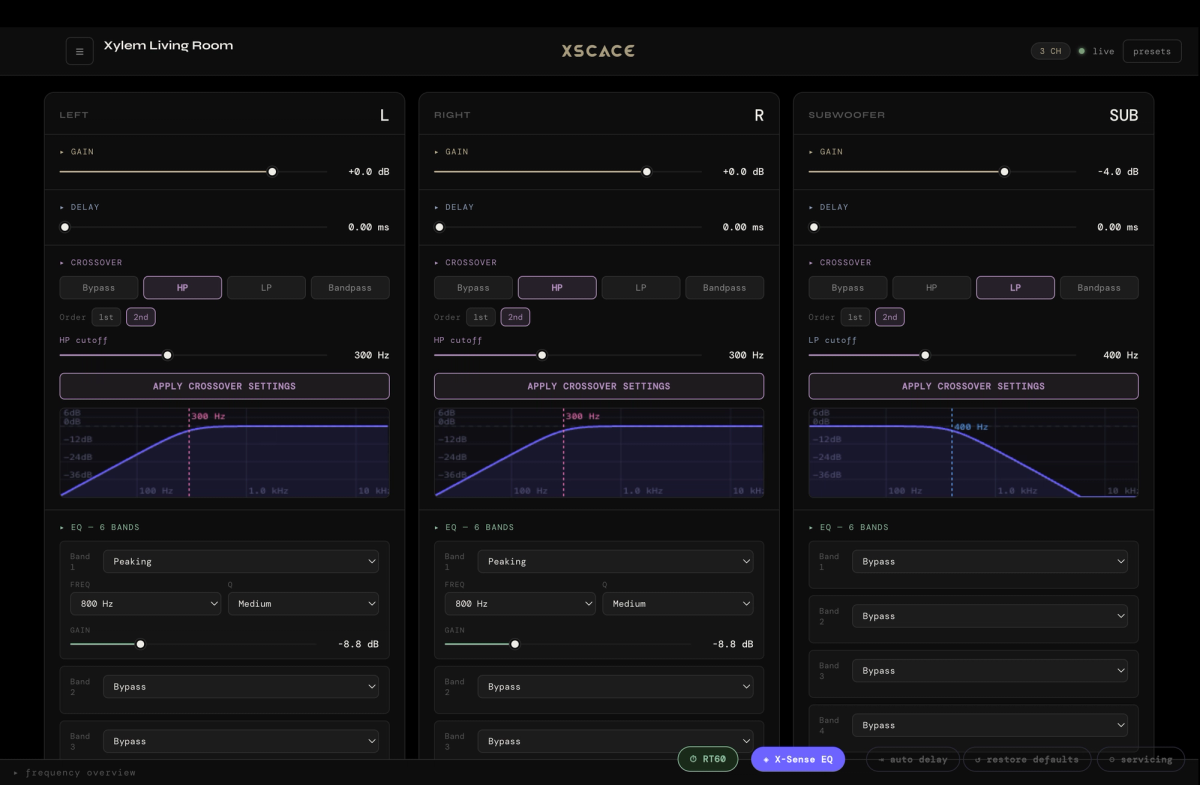
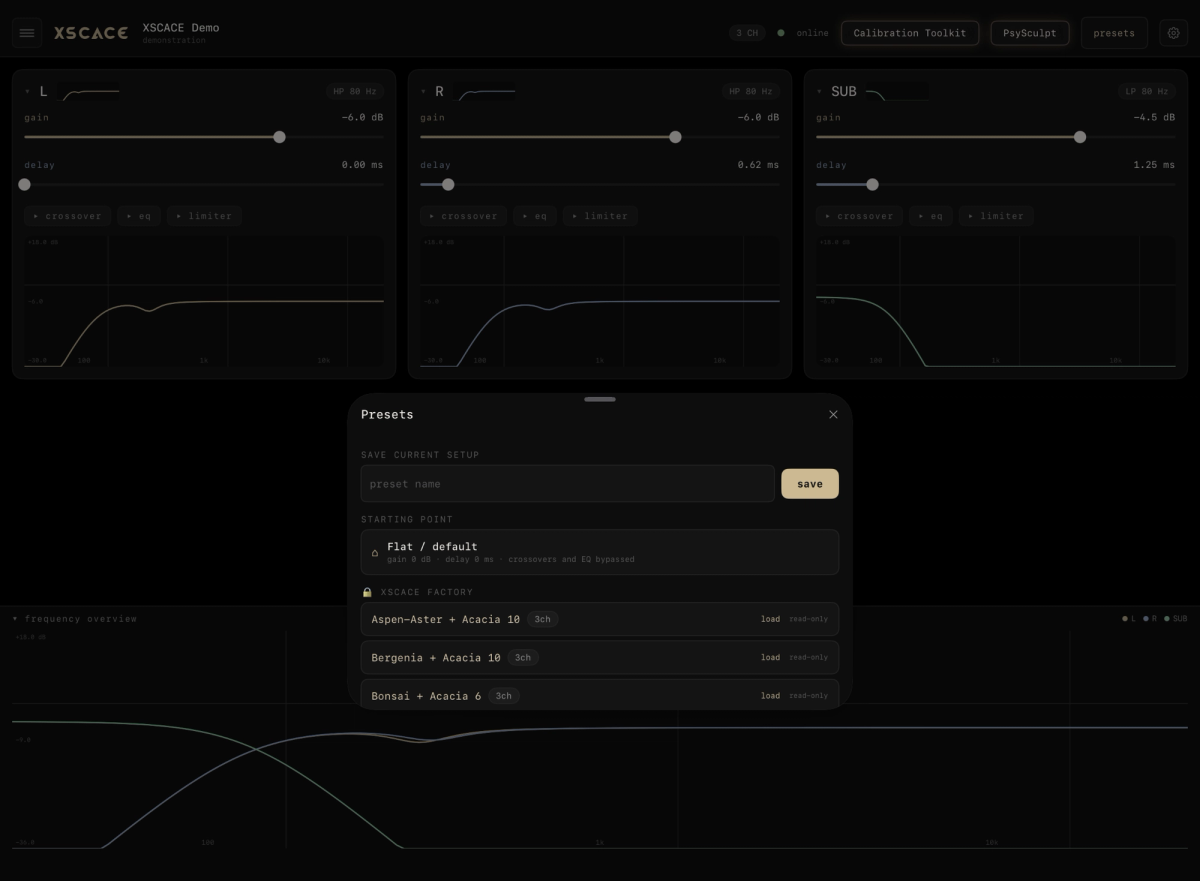
Wire up a Cane, a Bonsai, a QuadCane — the Xylem 3 lists an XSCACE factory preset for every speaker model, crossover, EQ and limiter threshold included. Load it and the system is playing correctly before anything has been measured. Tune further, then save the result under your own name; the next identical zone starts from it.
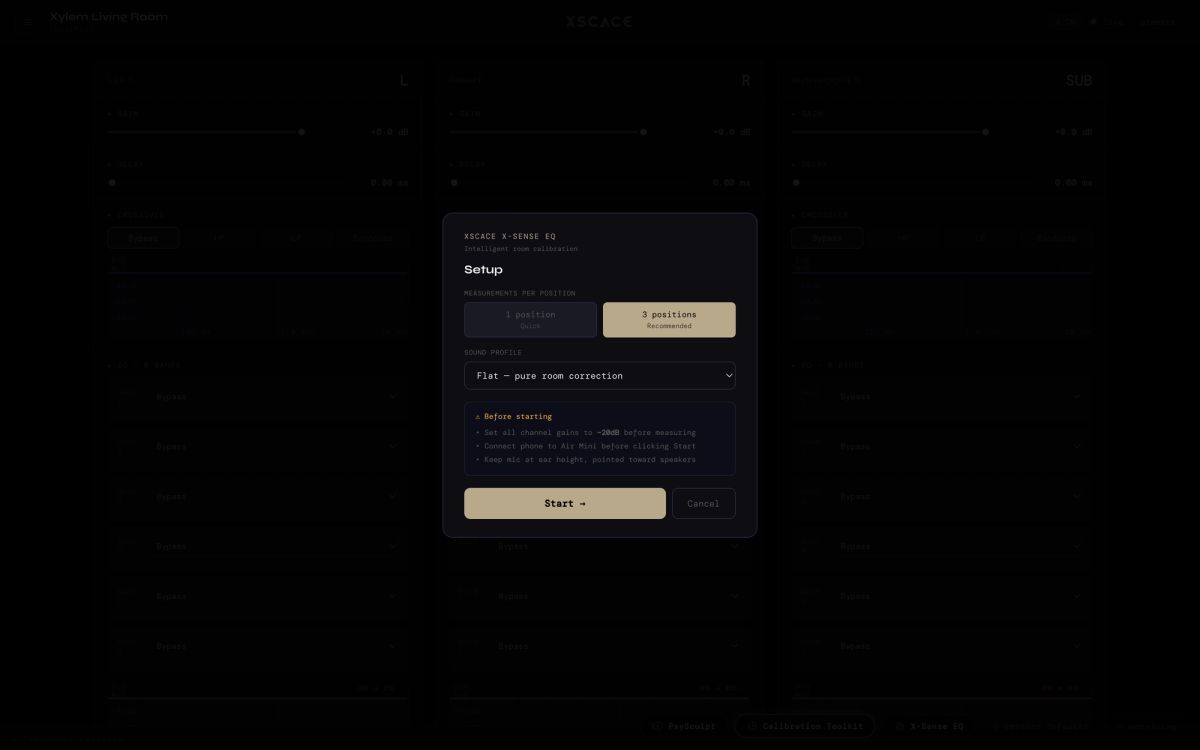
Microphone at the seat, one or three positions, a room profile, Start. X-Sense sweeps the room, fits corrective EQ to the profile and writes it to the Xylem 3 live — then measures again and overlays before, target and after, so the correction is proven rather than promised. It tunes the Xylem and the Root 4 the same way.
Found on the LAN. No USB, no laptop on a ladder.
Per channel, matched across a multi-amp system.
Six parametric bands per channel, run as biquads on the ADAU1701.
Frequency, slope and alignment in software — DSP-active, nothing passive in the path.
Per channel, so a driver is protected by the amplifier driving it.
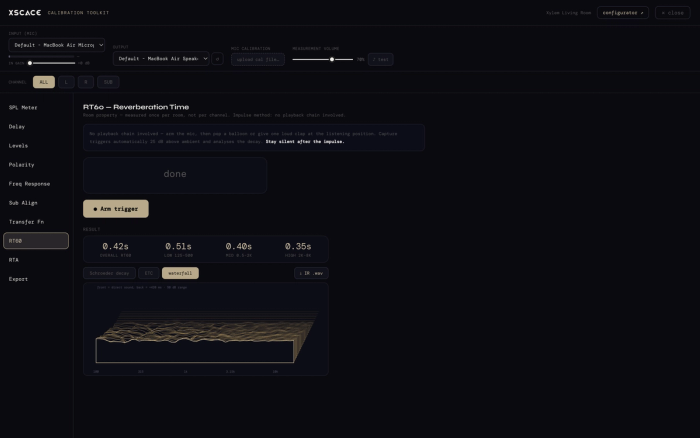
RT60, delay, levels, polarity and SPL from a measurement microphone.
Adjust against the music already playing. What you change is what you hear.
Guided room correction: sweeps from up to three listening positions, corrective EQ fitted to a chosen sound profile, then a verification pass that overlays before, target and after.
Written to the amplifier. The configuration survives the power, not the laptop.
Channel power distribution
1 × 200W + 2 × 100W @ 8Ω — 400W total, ideal for 2.1 setups. Drives 4–8Ω loads.
Contents7 sections
Technical Specifications
Built different. By design.
Built to work together
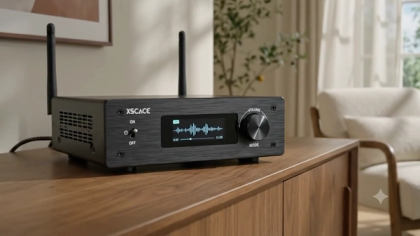
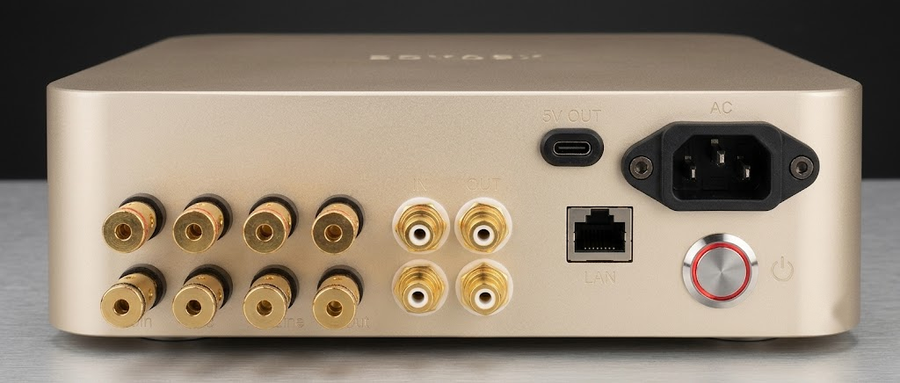
The back panel, explained
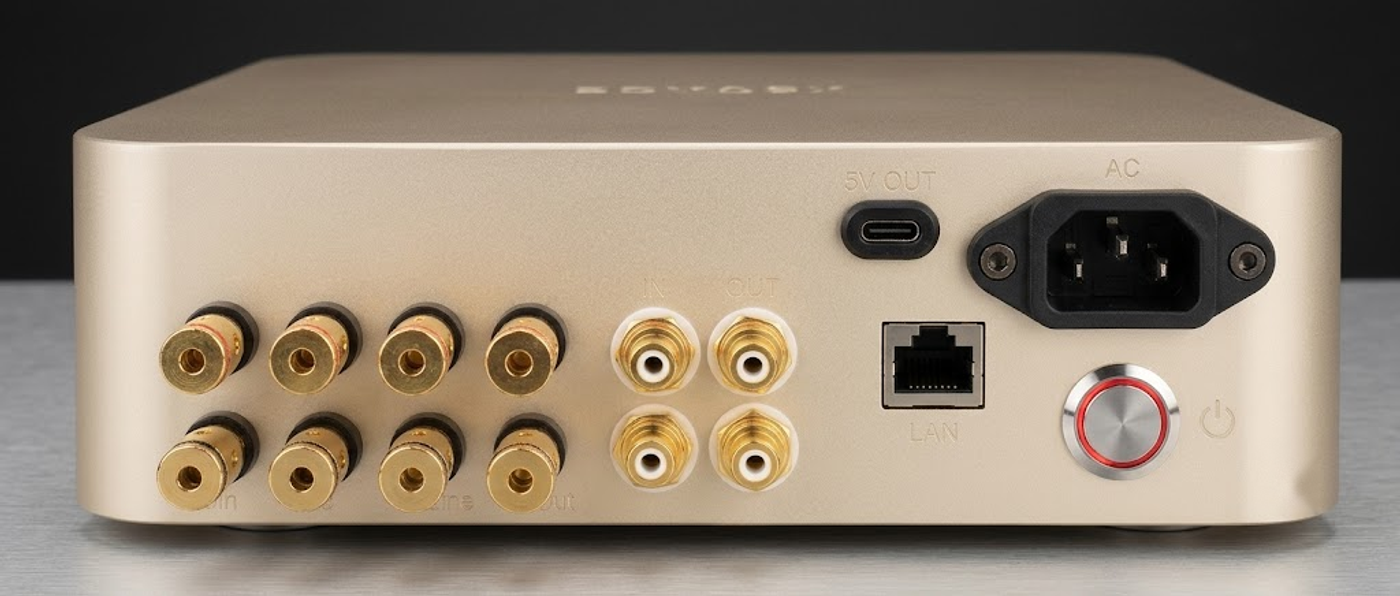
Six connections and nothing to set up by hand: speaker terminals, line in and out, network, a 5 V feed for an accessory, and mains. Plug it in and XSCACE Studio finds it on the LAN.
- 1
Speaker terminals
Gold-plated binding posts for the speaker outputs. Signal comes in at line level on RCA — there is no speaker-level input.
- 2
Line in and out
RCA line input from any source or processor, and a line output to pass the signal on to another amplifier or a subwoofer.
- 3
5 V out
USB-C 5 V supply for a small accessory beside the amplifier, so a streamer or receiver needs no wall adaptor of its own.
- 4
LAN
Network control. XSCACE Studio finds the amplifier on the LAN with no configuration and tunes every parameter live over this port.
- 5
AC
IEC mains inlet. Standard detachable cord, supplied in the box.
- 6
Power
Illuminated push button. Settings live in non-volatile memory, so the amplifier returns to its last state after a power loss.
Common installations
Engineering notes.
Engineering notes and technical background on the Xylem 3 — how it is built, measured and configured.
Xylem 3 in context
Frequently asked questions10 answers
What is the XSCACE Xylem 3?
Specified for 2.1 stereo and LCR cinema configurations in luxury residential home cinema rooms and high-performance audio installations across Canada, the UK, and India.
What is the power output of the Xylem 3?
The Xylem 3 is rated at 100W RMS into 8Ω.
What type of product is the Xylem 3?
The Xylem 3 is an amplifier product.
What DSP does the Xylem 3 use?
48 kHz, 28/56-bit fixed-point DSP (Analog Devices ADAU1701). Every crossover, EQ band, delay and limiter runs on that processor and is set from XSCACE Studio over the network; the configuration is stored on the amplifier itself.
What does PsySculpt do on the Xylem 3?
PsySculpt is equal-loudness compensation running continuously on the DSP. A log-decay peak detector tracks programme level and drives low and high shelving filters from it, so perceived tonal balance stays constant as volume changes, with a level-tracked bass stage and a hard ceiling before the converters. It is not room correction — room correction is measured and applied in XSCACE Studio.
Can a room calibrated on the Xylem 3 be verified against CEDIA RP22?
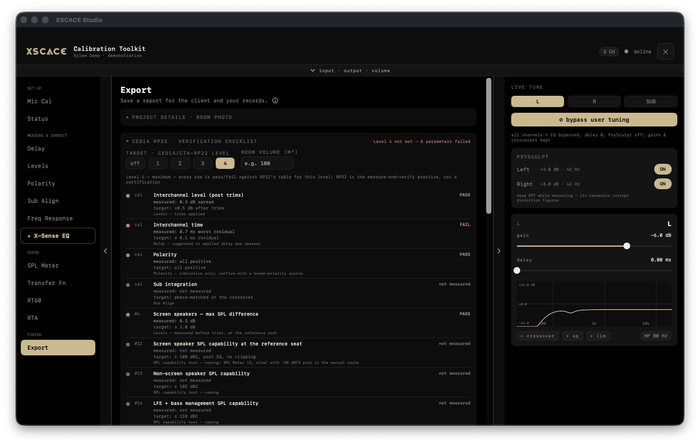
Yes. XSCACE Studio includes a CEDIA RP32 verification checklist. CEDIA/CTA-RP22 defines four objective performance levels a room can be designed to, and CEDIA RP-32 is the companion practice for measuring and verifying whether it reached one. Set the target RP22 level and the room volume, and each parameter is marked pass or fail against RP22's table for that level — interchannel level and time, polarity, sub integration, background noise floor as an NCB rating, in-room bass extension, response below the transition frequency, early reflections against the direct sound, and reflection decay time to ISO 3382-1. Parameters needing a test the current version does not run are marked "not measured" rather than assumed, and the exported client report states that this is measurement to RP32 practice rather than a certification.
Do the Xylem 3 settings survive a power cut?
Yes. Gain, EQ, crossover, delay and limiter settings are held in non-volatile memory on the amplifier, so it returns to the configured state after any power event or firmware update.
What is the power output of the Xylem 3 at 4 ohms?
1 × 200W + 2 × 100W @ 8Ω — 400W total, ideal for 2.1 setups. Drives 4–8Ω loads.
How much space does the Xylem 3 need?
The chassis is 64 mm high, 218.1 mm wide and 193.1 mm deep. Chassis depth is 193.1 mm. Allow 214.1 mm total clearance behind the front face — the rear speaker connectors add 21 mm once terminated.
How deep is the Xylem 3?
The Xylem 3 requires 193.1mm of depth.