Contents4 sections
Sound radiates in all directions from a driver — and where you mount that driver relative to the listener determines almost everything about the result. The debate over in-wall vs in-ceiling speakers is not a matter of aesthetics alone; it is a question of radiation angle, boundary coupling, and what the room is actually being used for. Both formats are architectural — they live inside the structure rather than sitting on it — but they produce meaningfully different acoustic outcomes. This article is a decision framework for homeowners, designers, and AV integrators choosing between the two.
How the Mounting Position Changes the Sound

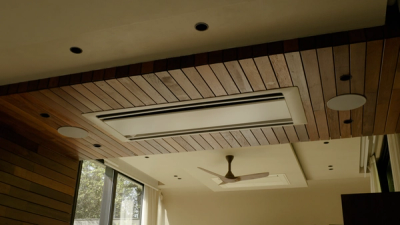
An in-ceiling speaker fires downward, perpendicular to the listener's ears. The driver is working at roughly 90 degrees to the horizontal plane of hearing. This geometry produces a diffuse, enveloping character — sound arrives from above and scatters across the room, creating ambient coverage without precise localisation. For background music in an open-plan space, this is exactly the right result. For critical stereo listening, it is not.
An in-wall speaker fires horizontally — at or near ear height when positioned correctly. The driver axis aligns with the listener's ears, producing direct, focused sound with a defined stereo image. When a left speaker and right speaker are at the same height as the listener and separated by the correct angle, the brain can resolve a stable phantom centre and a convincing soundstage. This is the geometry of a proper stereo or home cinema front system.
Bass behaviour also differs by mounting position. A speaker mounted in the ceiling loses the boundary gain that a wall-mounted driver receives. An in-wall speaker positioned near the floor-wall junction can benefit from up to 3–6 dB of additional low-frequency reinforcement from corner loading — a meaningful advantage in rooms where bass extension matters. For subwoofer-free installations, the wall format holds a clear acoustic advantage.
Room Function and the Right Choice
The function of the space is the fastest way to resolve the in-wall vs in-ceiling decision. Different room types call for different acoustic geometry:
- Living room background music — in-ceiling (envelopment, aesthetic cleanliness, no dominant listening position required)
- Dedicated listening room or studio — in-wall (precise stereo imaging, direct axis, correct ear-height geometry)
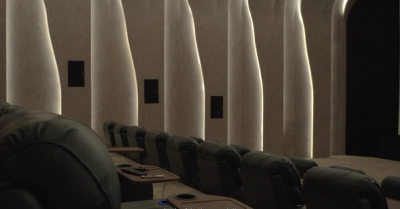
- Home cinema front L/C/R — in-wall at screen height (matches the visual source; dialogue and effects lock to image)
- Home cinema surround and height — in-ceiling for Dolby Atmos height channels, in-wall for side and rear surrounds
- Kitchen or open-plan entertaining — in-ceiling (wide omnidirectional coverage, no required listening position)
- Bedroom background audio — in-ceiling (less directional; no image pull toward one side of the bed)
- Corridor or reception area — in-ceiling (architectural cleanliness, even coverage along the run, no wall obstruction)
Practical Constraints That Make the Decision for You
Acoustic preference is one side of the equation. Construction reality is the other. Several constraints will override the ideal format:
Stud wall construction — in-wall installation requires cutting a precise opening between structural studs, which are typically spaced 400–600 mm apart. This limits the available driver diameter to approximately 6.5 inches. Wider baffles or larger drivers require structural modification or a purpose-built enclosure within the wall cavity.
Concrete or masonry walls — in-wall installation in solid masonry requires chasing, which is invasive and expensive. In these construction types, a suspended ceiling grid is nearly always easier to work with, making in-ceiling the practical default unless a false wall is being built from scratch.
Ceiling height — below 2.4 m, an in-ceiling driver can be uncomfortably close to the listener's ear, producing an overly directional or fatiguing result. In low-ceiling spaces, an in-wall format or a slim-array panel speaker is the better engineering choice.
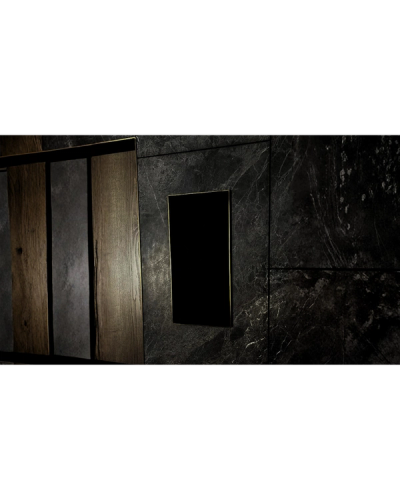
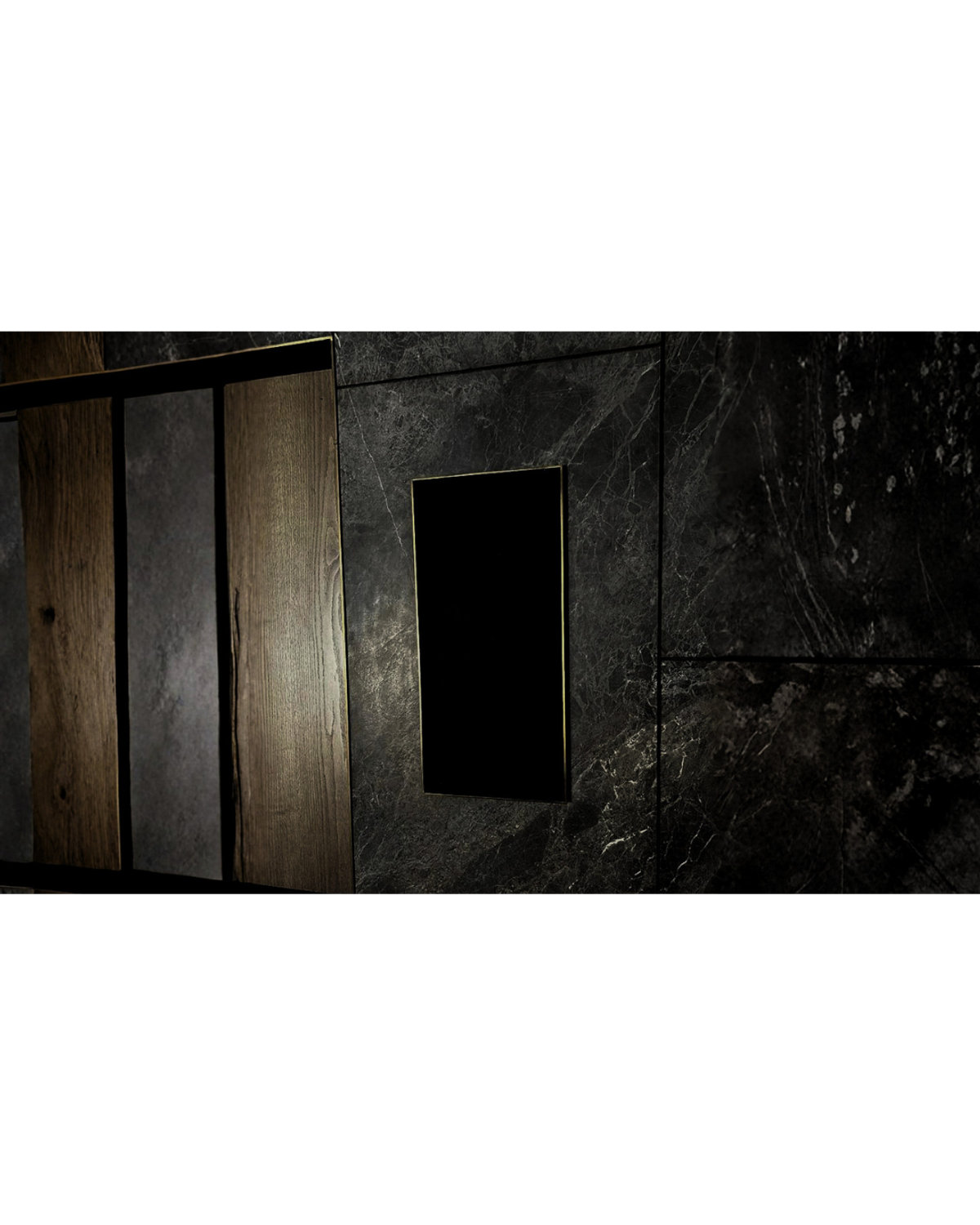
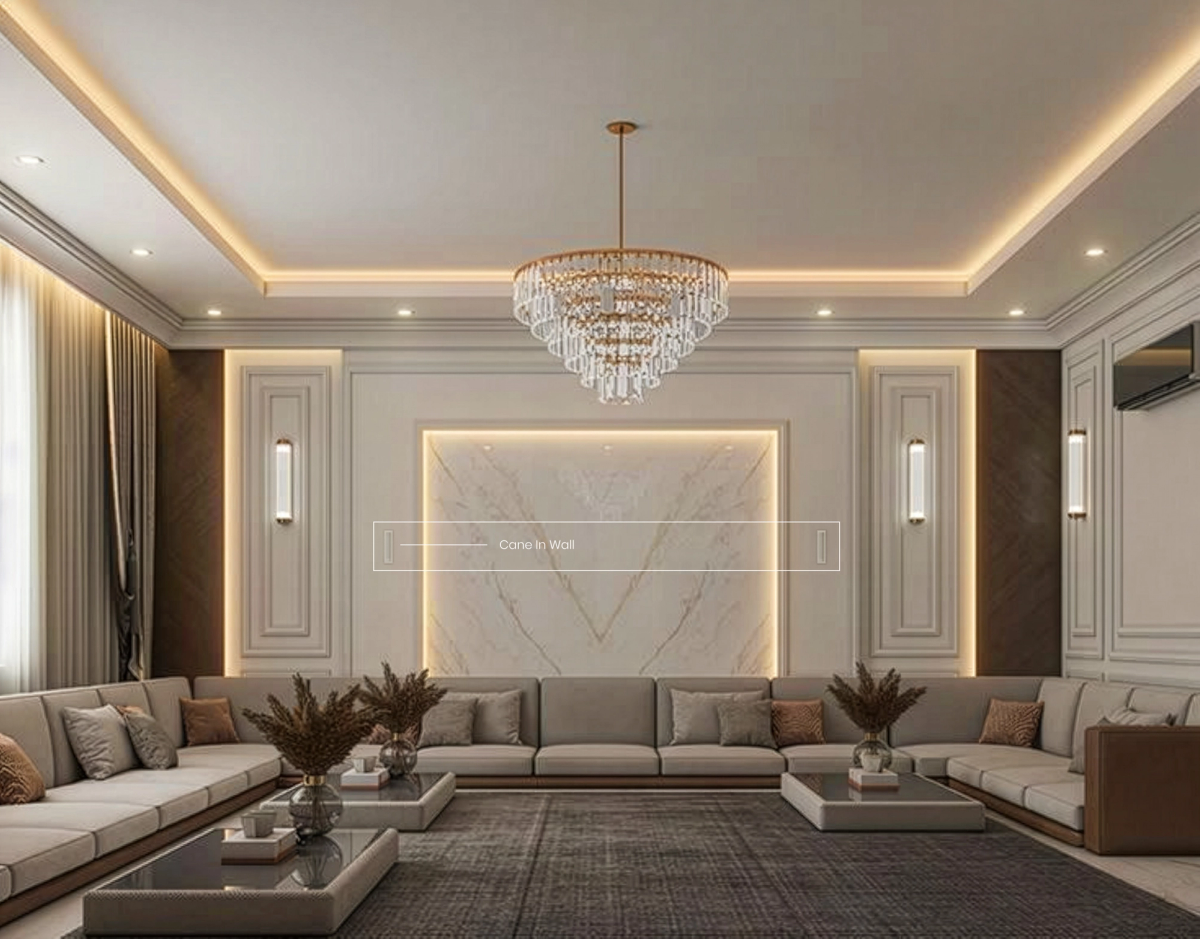
Joinery and feature walls — floating ceilings and built-in joinery provide the ideal conditions for in-wall concealment without any structural compromise. When a project brief includes a millwork wall, media wall, or bespoke cabinetry run, in-wall speakers can be integrated during construction with perfect acoustic depth and no visible break in the surface.
Retrofit projects — in-ceiling is generally easier to retrofit because cable runs can follow ceiling void space and the opening is less visible when re-plastered. In-wall retrofits require more precise patching and finishing work. For renovation projects without a full strip-out, in-ceiling is usually the lower-risk installation.
XSCACE's Range Across Both Formats
We engineered XSCACE's in-ceiling series to perform within the acoustic constraints of ceiling-mount geometry — controlled dispersion, flush-profile grilles, and driver tuning that accounts for the downward-firing radiation pattern. The Bonsai slim-array is available for in-ceiling applications where ceiling depth is restricted, delivering a 12 mm profile without sacrificing the Nano Resonance™ driver performance that underpins the entire XSCACE range.
XSCACE's in-wall series is built around the AeroFrame Chassis — a thermal management system designed to dissipate heat within the wall cavity, where ventilation is limited. In-wall drivers run warmer than freestanding speakers under sustained load; the AeroFrame addresses this without requiring external ventilation cutouts that would compromise the finish.
Both formats share the same Nano Resonance™ driver technology and PrecisionXover Array™ crossover network — the acoustic engineering is consistent across the in-wall and in-ceiling product lines. The format difference is in the mechanical integration, not the transducer quality. The Ghost 2.0 in the ceiling and the Sage in the wall are built on the same platform; what separates them is the cutout, the cavity they need and the height the sound arrives from.
Neither in-wall nor in-ceiling is universally superior. The right choice is determined by the room's function, its construction type, the ceiling height, and the listening experience the project calls for. What both XSCACE formats share: the driver engineering, crossover precision, and thermal management to deliver on their format's acoustic promise — without compromising the architecture that surrounds them.
Two questions that come up constantly once the format is chosen are answered separately: the real disadvantages of in-ceiling speakers, and how in-ceiling speakers actually get power.