Contents9 sections
The Xylem DSP amplifier series is now shipping in three configurations. All three share one design decision that separates them from most architectural amplification: the digital signal processor is not locked. The integrator who walked the room sets every filter, every routing decision and every protection threshold, rather than working inside a curve chosen by a manufacturer who has never been there.
This is the long version — what is inside the amplifier, what PsySculpt actually does, how the tuning is arrived at, and how the whole thing is driven from XSCACE Studio once it is on the wall.
Three models, one core
The series launched simultaneously. Every model uses the same DSP core, the same champagne aluminium chassis and the same programming environment, so an integrator who configures one does not have to learn another.
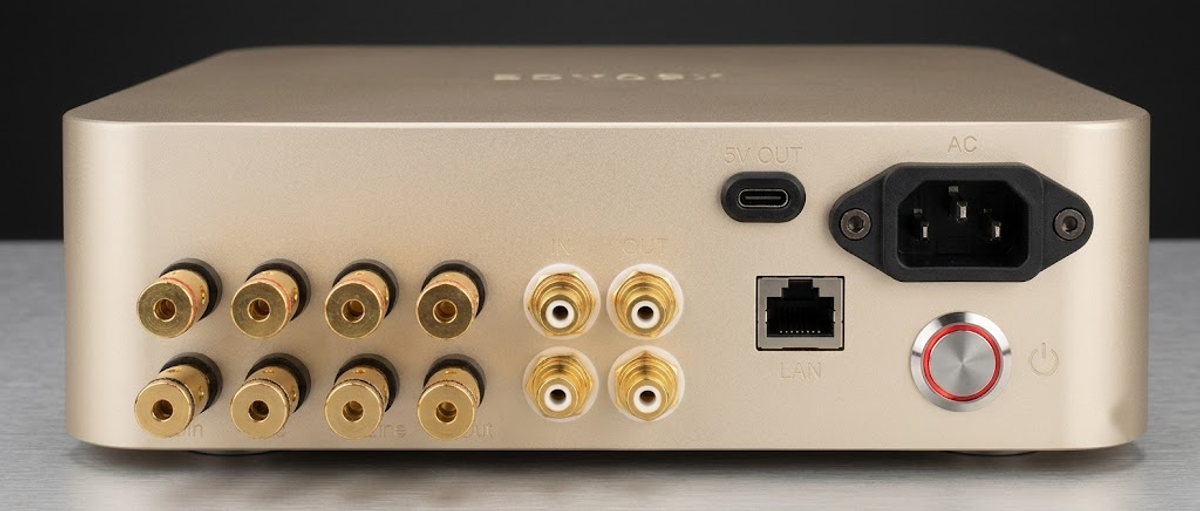
| Model | Channels | Power | Typical use |
|---|---|---|---|
| Xylem 2 | 2 | 2 × 200W — 400W total | Stereo zones, or a bi-amplified single speaker |
| Xylem 3 | 3 | 1 × 200W + 2 × 100W — 400W total | LCR for home cinema and immersive audio, or 2.1 with a dedicated bass channel |
| Xylem 4 | 4 | 4 × 100W — 400W total | Multi-zone from one unit, or a four-speaker distributed array |
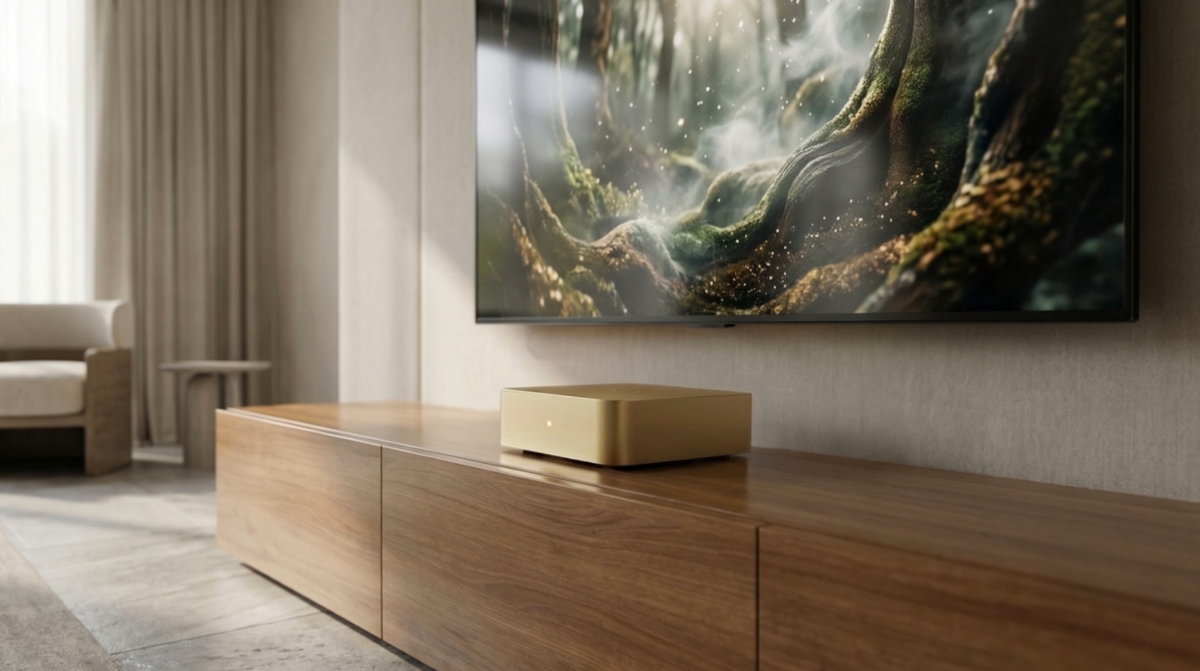
All three are Class D in the same CNC-machined aluminium chassis: 218.1 mm wide, 193.1 mm deep and 64 mm high, 1.7 kg — a shelf or a credenza, not a rack. The power figures above are per channel at 8Ω; the 400W total is the sum, not a per-channel rating.
What "programmable" actually means here
Fixed DSP — where the manufacturer sets the curve and the integrator works within it — is a reasonable answer for simple systems in neutral rooms. Most luxury residential work is not that. Hard surfaces, irregular geometry, speakers placed where the architecture allows rather than where the acoustics would prefer, arrays with timing differences between drivers: a manufacturer-set average cannot address any of it without compromise.
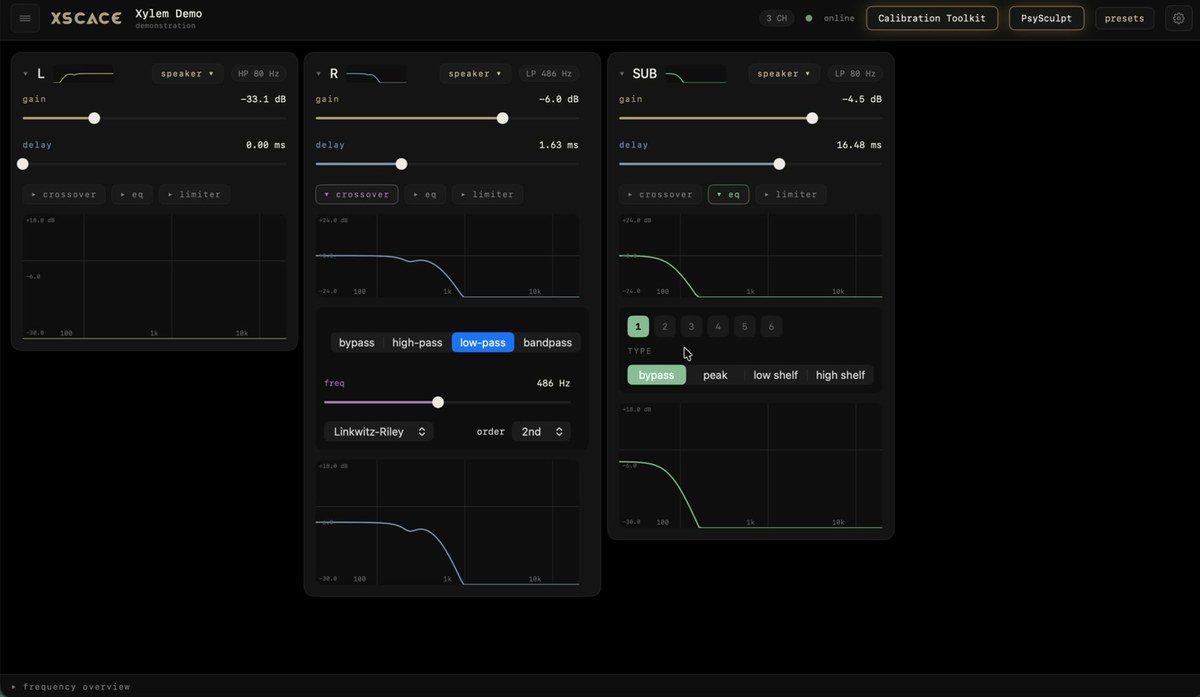
Every parameter on the Xylem's Analog Devices ADAU1701 is set from XSCACE Studio, over the network, with the music playing. What that opens up:
- Gain and delay per channel, edited live over the network
- Four crossover modes, with the response curve drawn as it is edited
- Six bands of parametric EQ per channel, run as biquads on the ADAU1701
- A per-channel limiter set by one number — the threshold in dBFS from the speaker datasheet
- PsySculpt equal-loudness compensation, bypassable in one switch
- Factory presets for every XSCACE speaker model, stored on the amplifier and recalled on power-up
Nothing is compiled or uploaded. A change is heard as it is made, and the configuration lives on the amplifier — it survives a power cut and does not need the laptop.
PsySculpt: correcting for the ear, not the microphone
PsySculpt is the tuning architecture that runs inside the Xylem, and it is the part most often misdescribed. It differs from conventional room correction in what it optimises for: the human auditory system rather than a flat measurement.
Flat measurement and flat perception are not the same thing. The ear is markedly more sensitive to resonance between 2 kHz and 5 kHz — the presence region, where consonants, overtones and spatial cues live — and measurably less troubled by brief standing-wave energy below 80 Hz when it is transient rather than sustained. A system that applies one flat EQ target across the whole spectrum is treating the ear as a measurement instrument.
So PsySculpt corrects tightly where the ear is discriminating, and more gently below 80 Hz, where masking and reduced sensitivity mean aggressive EQ tends to make a system sound thin rather than accurate. It corrects toward perceptual flatness.
The low-extension side-chain, and what it is not
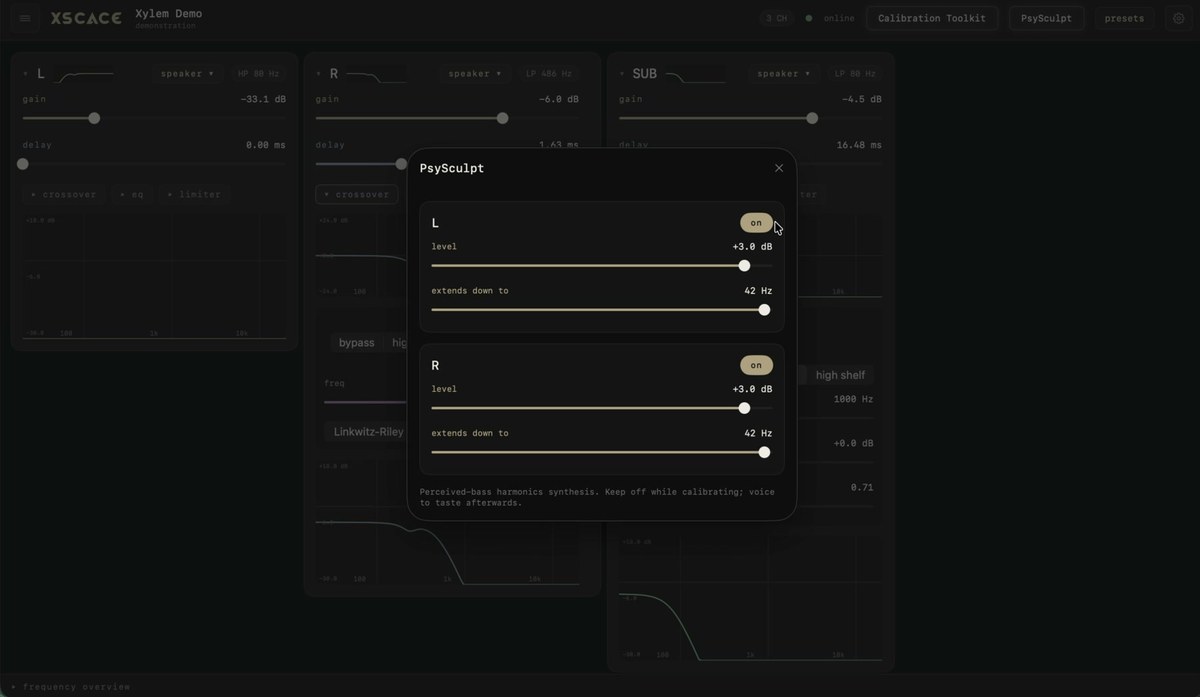
There is a separate function that gets confused with bass boost, and it is worth being precise about. The low-extension side-chain synthesises harmonics of fundamentals the cabinet cannot physically reproduce, so the ear infers a fundamental that is not actually being played. Nothing below the driver’s range is amplified, because there is nothing down there to amplify — a 12 mm cabinet does not suddenly move air at 40 Hz.
That is why the control reads "extend down to X Hz" rather than naming a filter: it sets how deep the psychoacoustic effect reaches, with a target as low as 40 Hz, and it rides along with system presets rather than being dialled in per room. The practical outcome is about an octave: a Cane rated to 150 Hz reads to about 75 Hz, a Bonsai rated to 300 Hz to about 150 Hz, a Ghost 2.0 rated to 80 Hz to the 40 Hz floor.
How the tuning is arrived at
The honest answer to "how is it made" has two halves, and only one of them is publishable.
The method is straightforward to describe. Perceptual sensitivity curves were mapped against measured room responses across more than forty residential and commercial installation geometries during the Xylem development programme. That data set is what determines where correction is applied tightly and where it is deliberately relaxed.
The second half is the co-design. Each XSCACE passive speaker has its own driver behaviour and enclosure resonance — the Acacia 6 runs 35–300 Hz at 84 dB sensitivity, the Acacia 10 runs 35–300 Hz at 88 dB — and the tuning is calibrated per model, not per range. The factory preset for the speaker it is driving arrives with crossover, EQ and limiter threshold set for that model, and the room correction measured in XSCACE Studio sits on top of it. The result is a system that is not over-processing to fight a limitation it should be respecting, and not under-correcting a problem that is physical and predictable.
The specific curves, coefficients and weighting that come out of that programme are not published, and this article is not going to pretend otherwise. What is published is the shape of the approach and the reasoning behind it, so an integrator can judge whether it suits the room in front of them.
One consequence worth stating plainly: the processing runs inside the amplifier. No external processor, no extra rack unit, no third-party DSP in the signal chain. The intelligence sits where the amplification does, and the amplifier is co-designed with the speaker. That integration is the precondition for the whole approach.
Driving it: XSCACE Studio
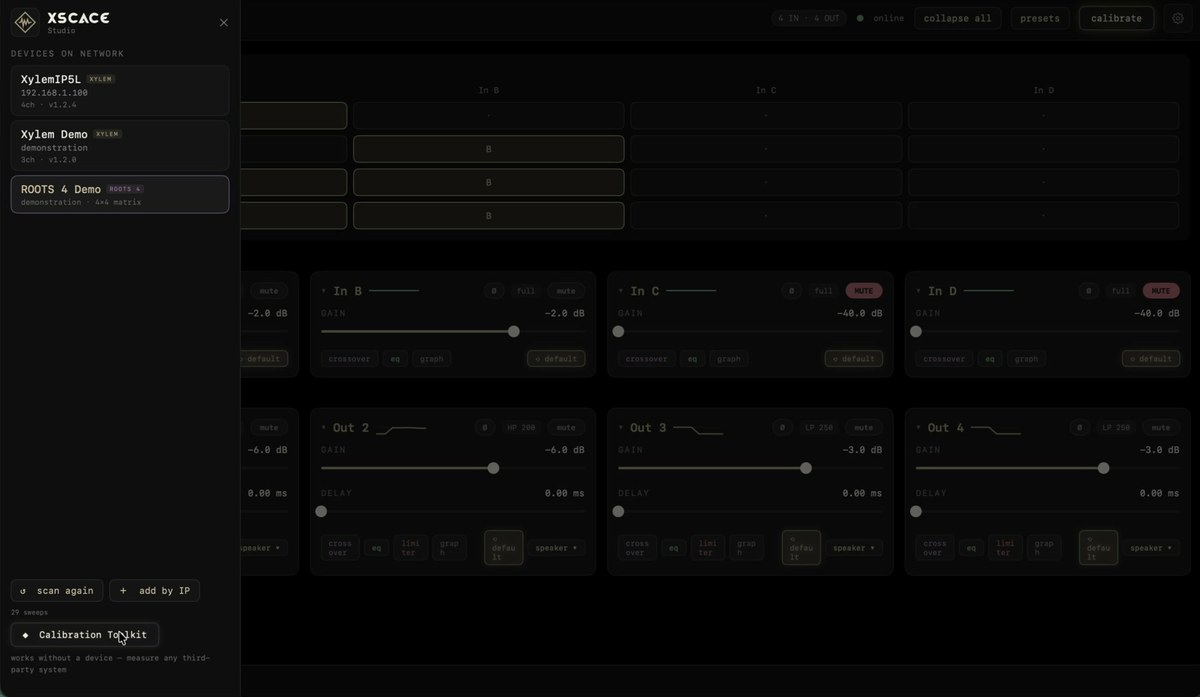
XSCACE Studio discovers every unit on the network with zero configuration — the amplifiers announce themselves, so there is nothing to pair and no address to type.
Live DSP control
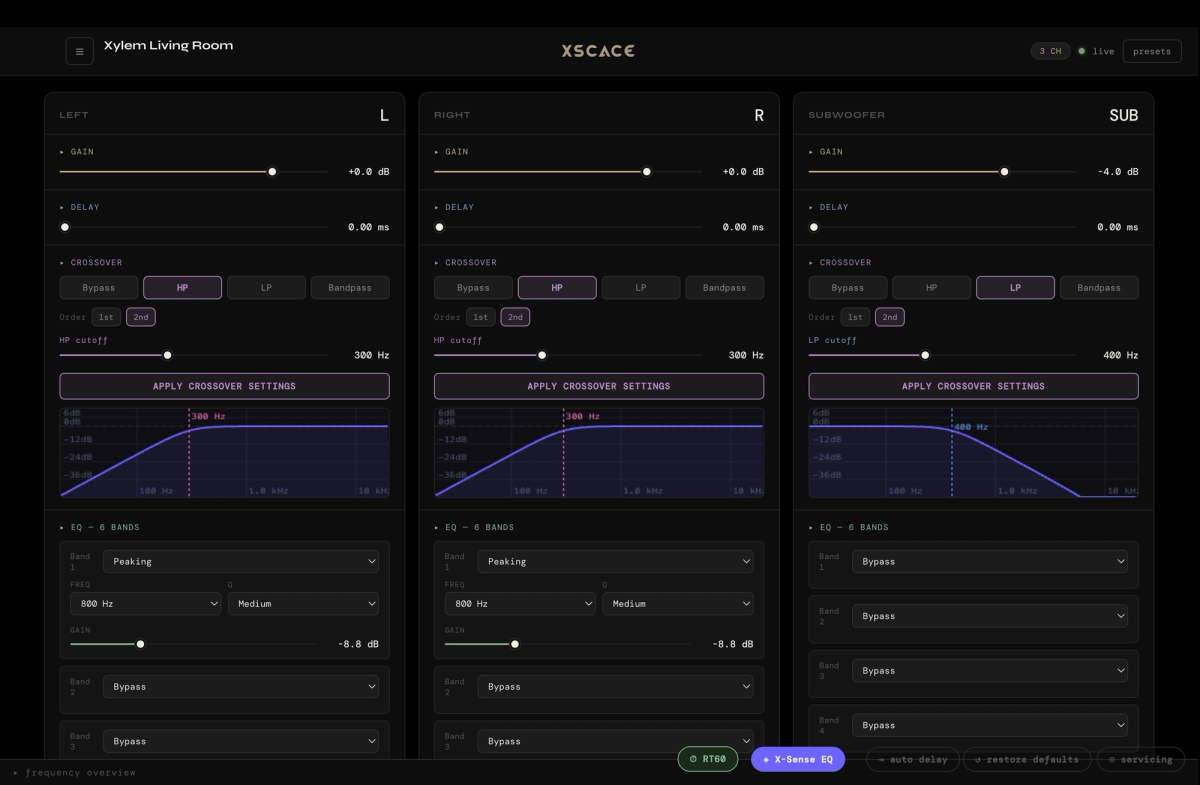
The full signal chain opens up: per-channel gain and delay, four crossover modes with the curve rendered live, and six bands of parametric EQ per channel. Changes hit the DSP over the local network with no cloud round trip. The delay block is accurate to 3 µs on a commanded 5.000 ms.
X-Sense room correction
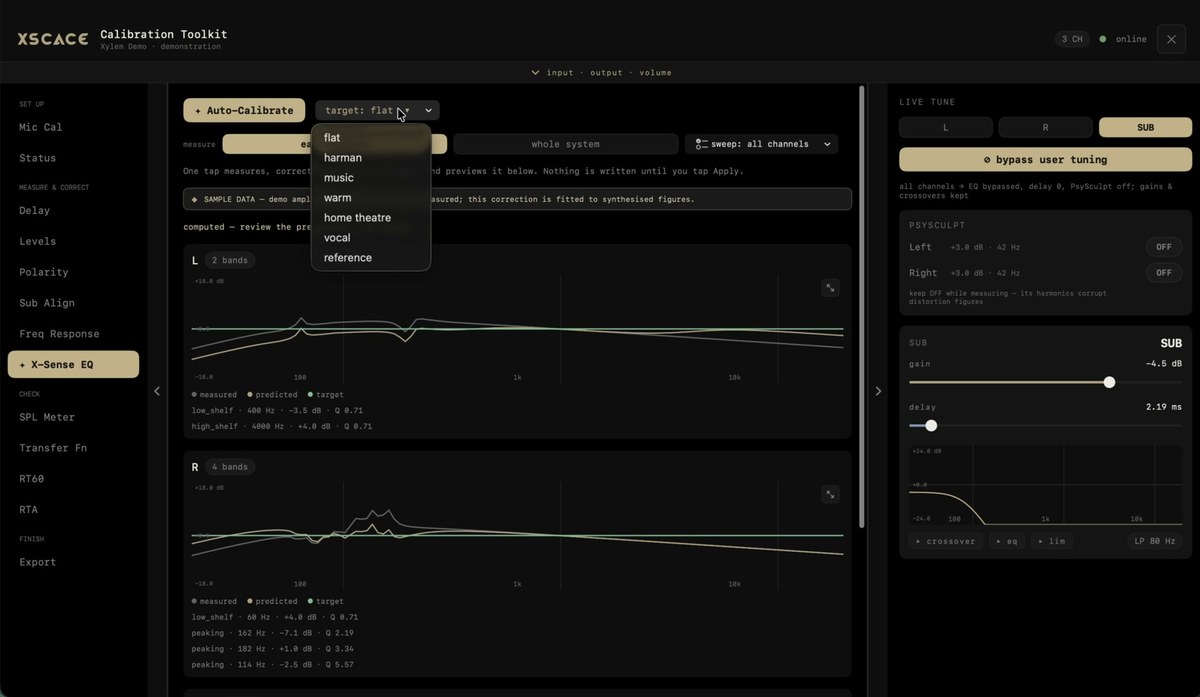
Guided calibration in minutes: sweep measurements from up to three listening positions, corrective EQ fitted against six sound profiles, and room diagnostics. A verification pass then re-measures with the EQ live and overlays before, target and after — so the correction is demonstrated rather than asserted.
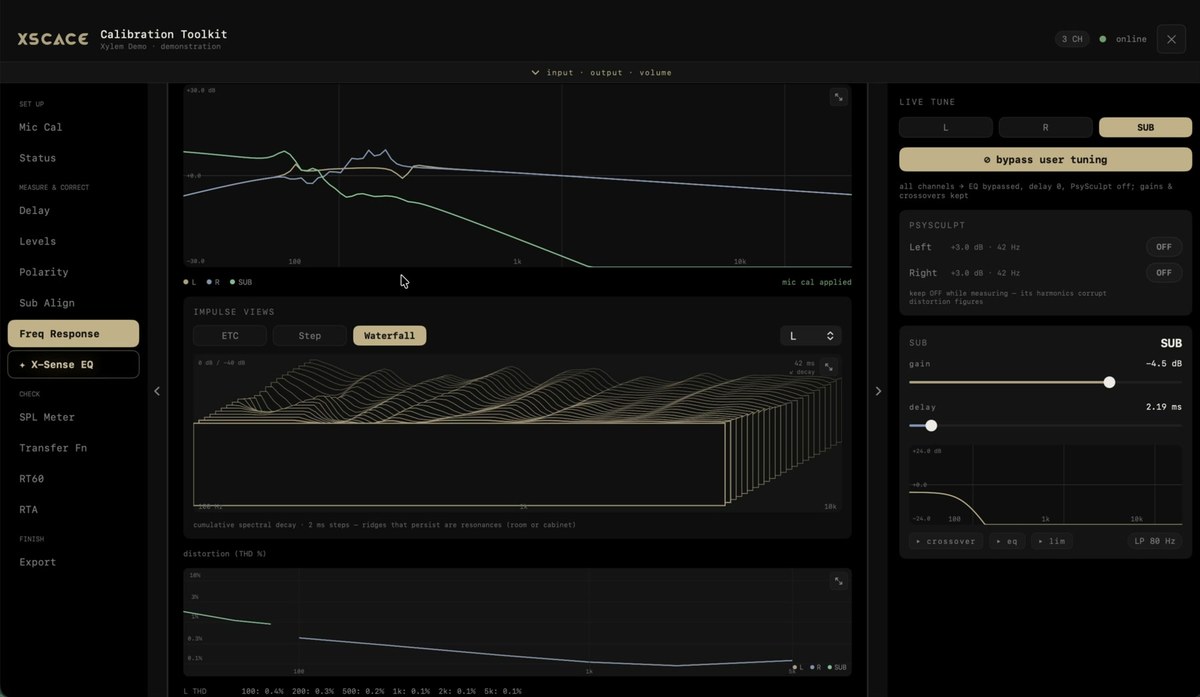
An eleven-instrument calibration toolkit
X-Sense EQ, SPL Meter, Delay, Levels, Polarity, Frequency Response, Sub Align, Transfer Function, RT60, RTA and Mic Cal. A single run yields distance, level, polarity and signal-to-noise for every channel, and any measurement can export the raw microphone capture as a 16-bit WAV — so a disputed result can be taken apart offline rather than argued about.
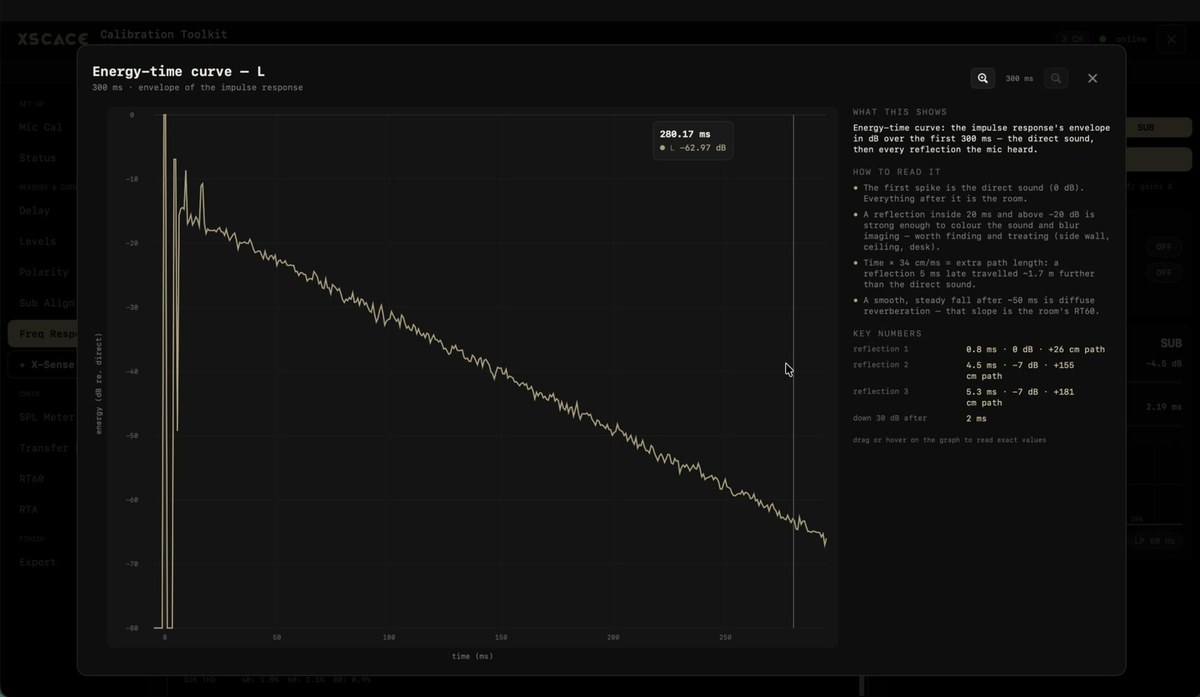
It refuses rather than guesses
A measurement tool that returns a confident wrong number is worse than one that returns nothing. RT60 follows ISO 3382-1 practice — Lundeby truncation, a minimum 12 dB fit span, an r² ≥ 0.90 quality gate — and where a room will not support a defensible reading, it says so and tells you which way to move: raise the level, or quieten the room.
Proving the room, not just tuning it
Tuning a Xylem is one thing; being able to show a client what the finished room achieved is another. Studio's CEDIA RP32 verification checklist handles the second. CEDIA/CTA-RP22 defines four objective performance levels a room can be designed to, and CEDIA RP-32 defines the repeatable procedures for verifying whether it reached one. Set the target level and the room volume on the Export page and every parameter is marked pass or fail against RP22's table for that level, each row naming the instrument behind it.
Interchannel level after trims and interchannel time, polarity, sub integration, background noise floor as an NCB rating, in-room bass extension at −3 dB, response below the transition frequency, early reflections against the direct sound and reflection decay time to ISO 3382-1 T20 — all judged, all printed into the client PDF as its own section, with the verdict stated without softening. Rows needing a test the current version does not run are marked not measured rather than assumed, and the document is explicit that this is measurement to RP32 practice rather than a certification.
Where the Xylem is the right answer — and where it is not
It is not the right amplifier for every job. It earns its place when:
- The room needs site-specific EQ — hard surfaces, low ceilings, awkward geometry
- Subwoofers need real crossover management and sub-satellite integration
- Several speakers need sample-accurate time alignment
- The brief is hospitality or commercial, where one program is deployed identically across many identical rooms
- The integrator specifies at a level where manufacturer-defined tuning is a limitation rather than a convenience
For a straightforward stereo zone in a furnished room with no acoustic problems to solve, a fixed-DSP amplifier will do the job and cost less to commission. Specifying a Xylem there buys capability that will never be used.
The preset library
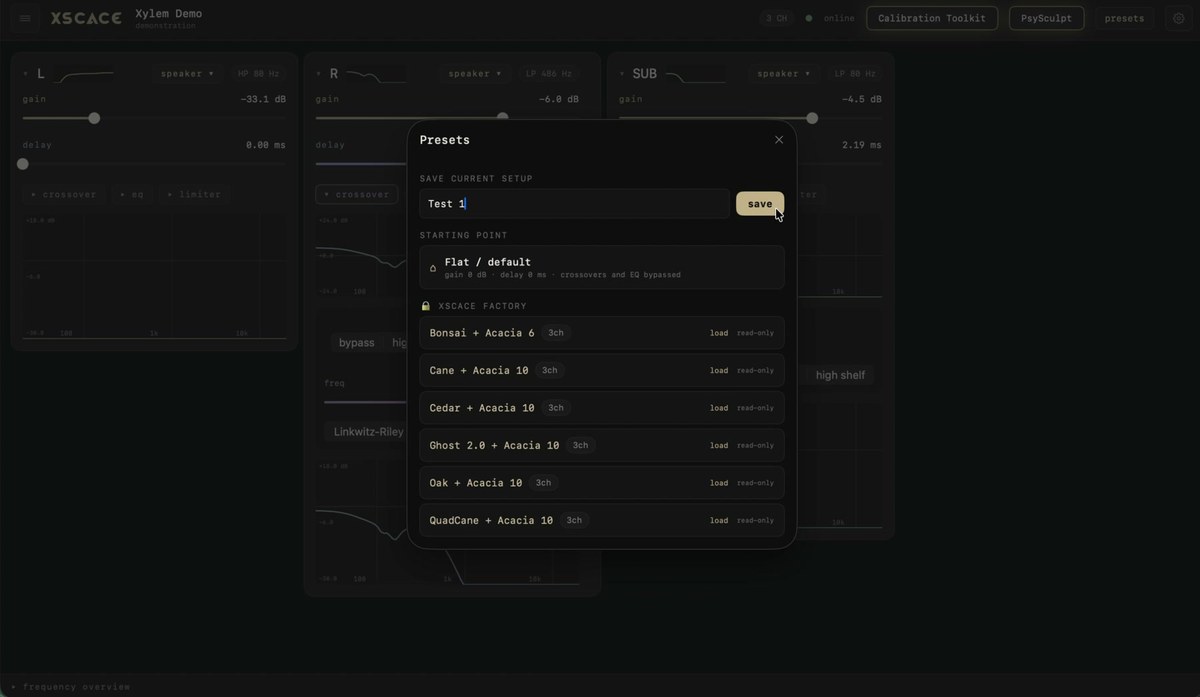
Factory presets cover the XSCACE passive range — Bonsai, Cane, Camphor, Juniper, Ghost, Cedar and the Acacia subwoofers — each tuned to that speaker's driver and enclosure, limiter threshold included.
The presets are a starting point rather than a ceiling: site-specific adjustment, room correction and crossover refinement are expected, and every parameter stays editable after the preset is loaded.
Specifications for each model are on the Xylem 2, Xylem 3 and Xylem 4 pages. XSCACE Studio is a free download, and the PsySculpt write-up goes further into the psychoacoustics. For pricing and availability in your territory, speak to your regional distributor.
See it in Dubai
Xylem is on Stand B-15 at the High End & Smart Home Show 2026, 24–26 September, at the Radisson RED Hotel in Dubai Silicon Oasis, with Miantic AV MENA. Bring a room you think is difficult and we will measure it on the stand.
What a tuned Xylem hands over: download a sample XSCACE Studio calibration report (PDF, 14 pages) — the applied tuning per channel, PsySculpt settings, measurement results, CEDIA RP32 verification, room acoustics and graphs. Generated in demo mode on a Xylem Demo device, with synthesised figures.