Contents5 sections
Turn any system down and the bass goes first, then the air. The recording has not changed; your hearing has. Equal-loudness compensation is the DSP function that puts back what the ear stops hearing at low level, and PsySculpt™ is XSCACE's implementation of it, running inside the Xylem DSP amplifier series on every channel, all the time.
This article explains what equal-loudness compensation is, how PsySculpt does it on the Xylem's Analog Devices ADAU1701 processor, what it does not do, and where room correction actually happens in an XSCACE system.
Why hearing is not flat: the Fletcher–Munson problem
In 1933 Fletcher and Munson measured how loud a tone had to be at each frequency to sound as loud as a 1 kHz reference. The result, refined today as the ISO 226:2003 equal-loudness contours, shows that the ear's sensitivity is strongly level-dependent. At 40 phon — quiet listening — a 60 Hz tone needs roughly 15 dB more acoustic energy than a 3 kHz tone to sound equally loud. At 85 dB SPL the contours flatten out and the difference nearly vanishes.
The practical consequence is familiar to anyone who has mixed at reference level and then listened late at night: the balance that was right at 85 dB sounds thin and dull at 55 dB. Nothing in the loudspeaker or the room has changed. The listener's ear has moved along the contours, and a fixed frequency response cannot follow it.
A passive speaker cannot correct this. A static tone control cannot either, because the correction needed depends on how loud the programme is at that moment. It has to be measured continuously and applied continuously, which is a DSP job.
How PsySculpt works on the Xylem
PsySculpt is a signal chain in the Xylem's ADAU1701 SigmaDSP, running at 48 kHz with 28-bit audio and 56-bit intermediate precision. The topology, in order:
- Level detector — a log-decay peak detector tapped off the input measures programme level continuously, with a 10 ms hold.
- Loudness stage — pre-compensation, low and high shelving filters with corners at 60 Hz and 7 kHz, then post-compensation. The detector's output sets how much lift the shelves apply.
- Dynamic bass — a level-tracked bass stage (200 Hz low-pass, centred at 60 Hz, 2:1) that compresses rather than clips as the system is pushed.
- Harmonic generator — synthesises bass overtones so small drivers convey a fundamental they cannot physically reproduce.
- Ceiling — a hard-clip limiter ahead of the converters, so nothing downstream ever sees an overload.
- Bypass — one switch in XSCACE Studio takes the whole chain out of the signal path.
At reference level the detector reports a high programme level and the shelves sit flat: PsySculpt applies nothing. As the level falls, the low shelf lifts by up to about 13 dB at 20 Hz and the high shelf by up to about 7 dB at 20 kHz, with the midrange between 200 Hz and 5 kHz left alone. The correction follows the ISO 226 contours rather than a fixed loudness button, which is why the balance set at reference holds at a whisper.
Nothing is added that was not in the recording. The shelves restore the perceived balance the ear has lost; they do not invent bass or air.
What PsySculpt is not: room correction
PsySculpt corrects for the listener's ear, not for the room. It has no microphone and no knowledge of the room's modes or reflections. Room correction in an XSCACE system is measured and applied in XSCACE Studio, the Mac and Windows application that configures the Xylem over the network.
XSCACE Studio measures the room from a microphone at the listening position: RT60 reverberation time, delay and arrival time per channel, levels, polarity and frequency response. X-Sense EQ runs a guided correction — sweeps from up to three listening positions, corrective parametric EQ fitted to a chosen sound profile, and a verification pass that overlays before, target and after. That is where standing waves, hard-surface brightness and sub-satellite integration are dealt with.
The two are complementary. Room correction gives you a flat in-room response at reference level; PsySculpt keeps that balance perceptually flat as the volume moves. One is measured once at commissioning; the other runs on every note.
Which products include PsySculpt
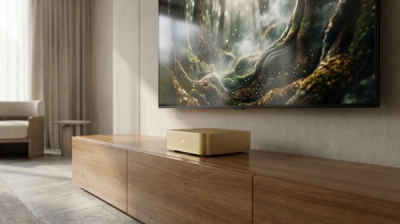
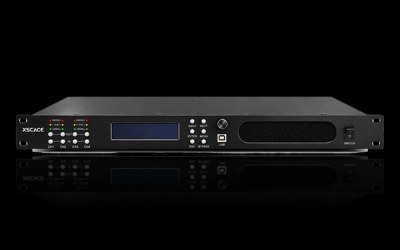
PsySculpt runs on the Xylem 2, Xylem 3 and Xylem 4 DSP amplifiers — 400 W total in a 218 × 193 × 64 mm aluminium chassis, configured from XSCACE Studio over the LAN and stored on the amplifier so the configuration survives a power cut. It works with any speaker the Xylem drives, XSCACE or otherwise, because it acts on the listener’s hearing rather than on a particular driver.
PsySculpt on the Xylem 2, 3 and 4:
- Processor: Analog Devices ADAU1701 SigmaDSP, 48 kHz, 28-bit audio / 56-bit intermediate, 50 MIPS
- Reference: ISO 226:2003 equal-loudness contours
- Shelf corners: 60 Hz low-pass, 7 kHz high-pass, lift scaled to programme level
- Detector: log-decay peak, 10 ms hold, latency under 1 ms
- Bypass: single switch in XSCACE Studio; setting stored on the amplifier
For integrators
Commission the room in XSCACE Studio first — routing, polarity, the factory preset for each speaker model, then delay, levels and X-Sense EQ from the listening position. Leave PsySculpt engaged. The client's late-evening listening will then sound like the system you tuned, instead of a thinner version of it, and you will not be asked back to add bass to a system that measured flat.
See the Xylem 2, Xylem 3 and Xylem 4 pages for specifications, and the XSCACE Studio guide for the full calibration toolkit.