Contents3 sections
Heat is the primary cause of premature speaker failure — not age, not cone fatigue, not mechanical wear. In residential and commercial architectural installations, in-ceiling speaker chassis heat management is the engineering problem that most manufacturers choose not to solve. The speaker sits inside a wall or ceiling cavity with zero airflow, thermally isolated from the room on one side and insulation on the other. Unlike a floor-standing speaker with open ports and circulating air, the in-ceiling driver has nowhere to send excess thermal energy. Every watt that does not become sound becomes heat — and that heat has only one path: back into the driver itself.
XSCACE engineered the AeroFrame Chassis™ to solve this problem at the source. Rather than treating the enclosure as a passive housing — something that simply holds the driver in place — we designed it as an active thermal management component. The enclosure is the heatsink. Understanding why this matters requires a short examination of how heat destroys speakers, and why the conventional chassis materials most manufacturers use make that destruction inevitable.
Why Standard Architectural Speaker Chassis Fail Over Time
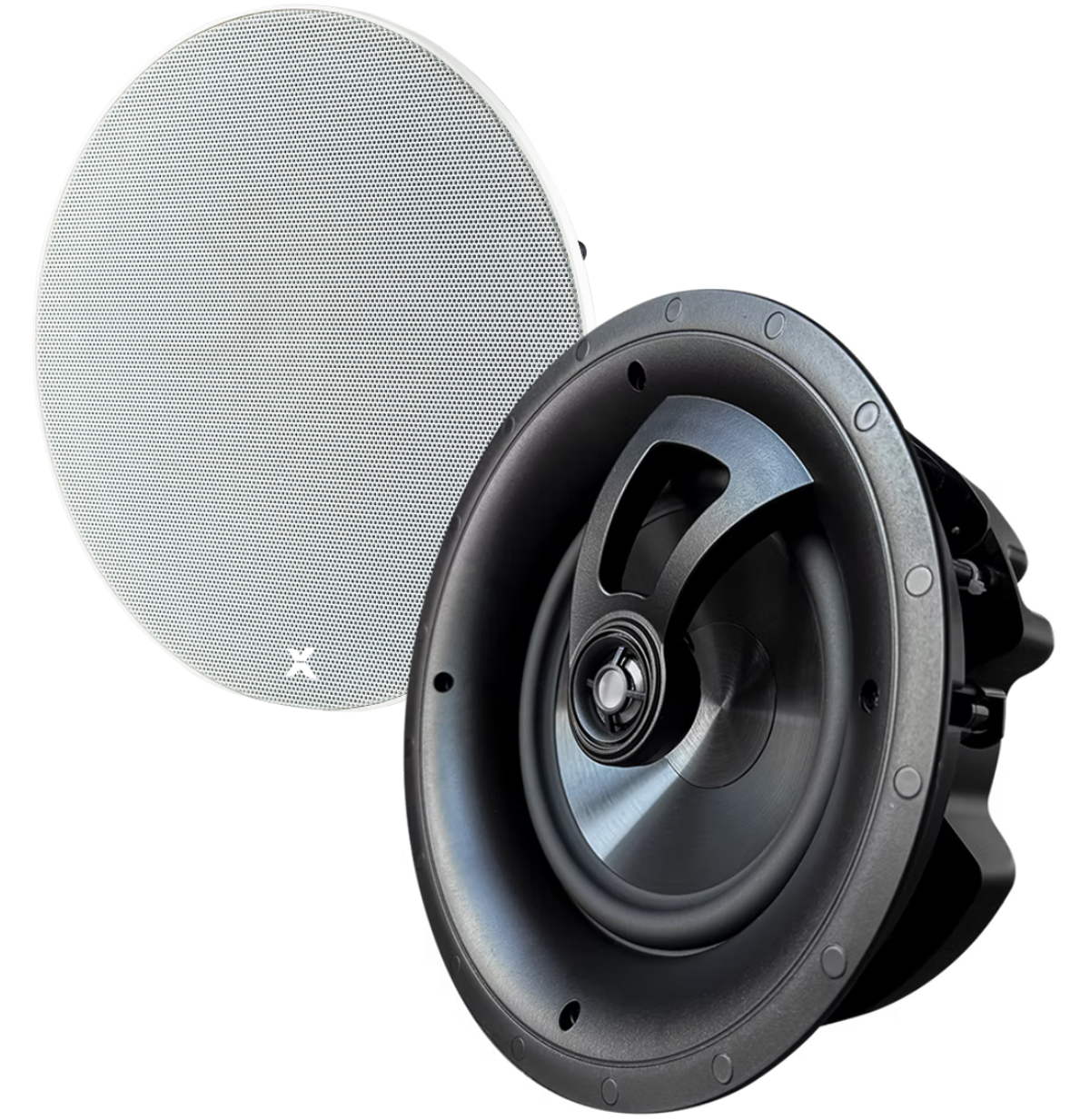
Most in-ceiling speakers are built around stamped steel baskets or injection-moulded polymer chassis. These are the lowest-cost manufacturing options, and they are thermally catastrophic in a sealed cavity environment. The physics are straightforward: thermal conductivity of injection-moulded polymer sits around 0.2 W/m·K. Stamped steel reaches approximately 50 W/m·K. 6061 aluminium alloy conducts heat at roughly 167 W/m·K — more than 800 times more efficiently than polymer, and over three times more efficiently than steel.
In a polymer chassis, heat generated at the voice coil has nowhere to go. It accumulates around the motor structure, raising the local temperature of the magnet assembly, the adhesives bonding the voice coil former, and the surround attachment points. Prolonged exposure above operating temperature thresholds accelerates magnet demagnetisation — a permanent reduction in the magnetic field strength — and causes adhesive creep and eventual delamination. The voice coil begins to sag off-axis. The surround separates from the cone edge. Sensitivity drops. Distortion rises. The speaker that measured 88dB on day one now struggles to reach 84dB.
Steel chassis conduct heat better than polymer, but they introduce a different failure mode: oxidation. In humid environments — coastal installations, bathrooms, outdoor-adjacent cavities — a steel basket begins to corrode within the first few years. Rust adds mass to the basket, alters resonance behaviour, and eventually compromises the structural rigidity that keeps the motor assembly aligned. Steel also acts as an inadvertent antenna for transformer interference, adding low-level hum to sensitive systems. The visible symptoms of thermal failure in a standard chassis include driver cone sag, adhesive delamination at the surround or dust cap, voice coil rub on the pole piece, and permanent sensitivity loss that no amount of signal processing can recover.
The AeroFrame Chassis™: 6061 Aerospace Aluminium as Passive Heatsink
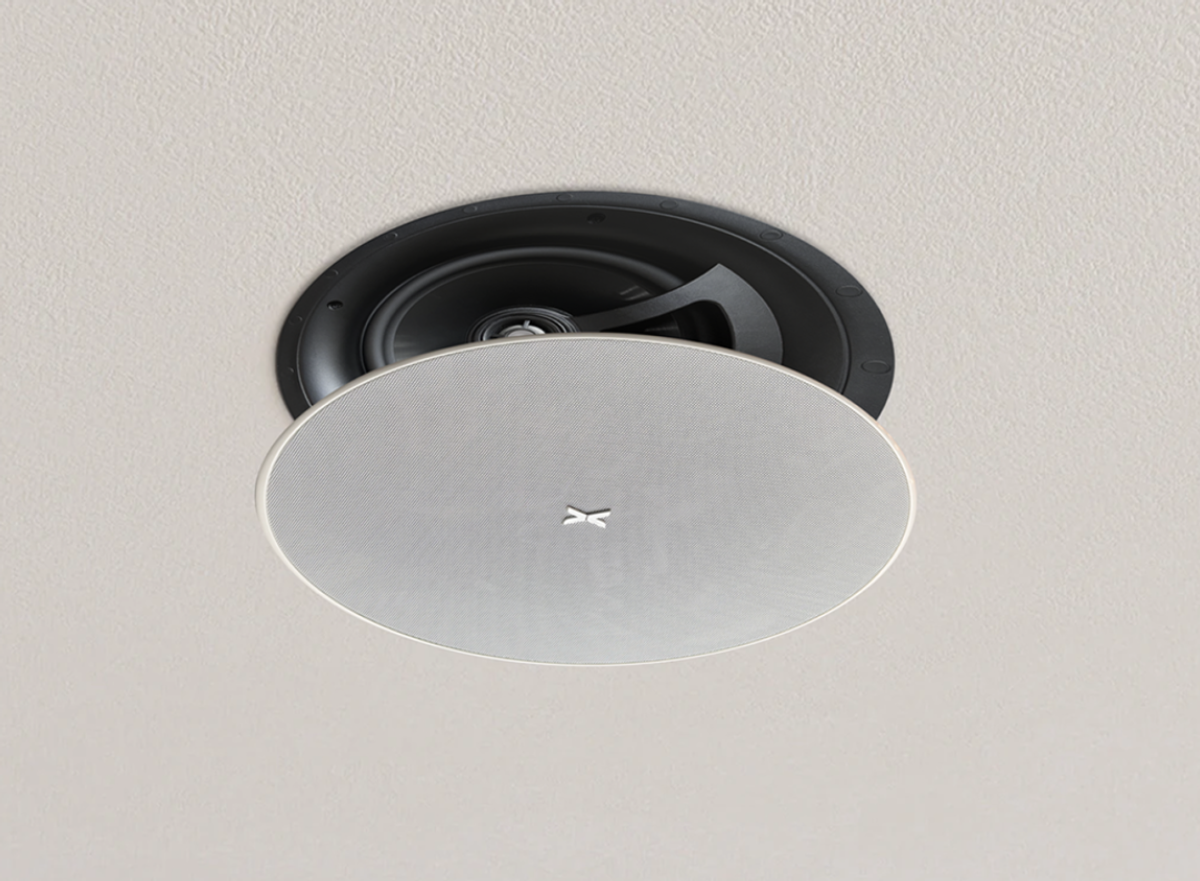
XSCACE machines the AeroFrame Chassis™ from 6061 aluminium — the same alloy series used in aircraft structural components, bicycle frames, and precision optical instruments. The choice is deliberate and specific: 6061 aluminium offers the thermal conductivity of a heatsink material combined with the structural rigidity to hold motor geometry under thermal cycling. This is not a chassis that happens to be made of aluminium. It is a heatsink that happens to hold a speaker driver.
The geometry of the AeroFrame Chassis™ is designed with the same principles applied to electronic heatsinks: maximised surface area, deliberate thermal paths, and contact surfaces that couple efficiently to surrounding installation materials. Heat generated at the voice coil during normal operation conducts through the motor structure — the pole piece, top plate, and yoke — into the aluminium chassis body. From there, it dissipates through the chassis mounting flange into the baffle material, ceiling substrate, or plaster. The installation itself becomes part of the thermal system. The speaker is no longer fighting the heat. It is routing the heat away.
At sustained listening levels in a residential installation, the thermal delta between a polymer chassis and the AeroFrame Chassis™ is significant enough to be measured at the magnet assembly. The polymer chassis traps heat at the source. The AeroFrame Chassis™ moves it. That difference — maintained over thousands of hours of cumulative operation — is the difference between a speaker that degrades and one that performs identically in year ten as it did in year one.
Longevity and the Case for Precision Machining
Thermal management is only one dimension of why XSCACE machines — rather than stamps or moulds — the AeroFrame Chassis™. Precision CNC machining delivers geometric tolerances that casting and stamping cannot approach, and those tolerances directly affect acoustic performance over time. The measurable advantages of the machined aluminium chassis include:
- ±0.02mm tolerances on motor alignment — the voice coil gap is held to specification from first use through decades of thermal cycling
- Consistent voice coil gap geometry even at operating temperature — aluminium's thermal expansion is predictable and accounted for in the machined dimensions
- No chassis deformation under sustained high-temperature operation — the structural rigidity of 6061 aluminium far exceeds both polymer and stamped steel at elevated temperatures
- Natural magnetic shielding — aluminium does not interact with transformer fields the way steel does, eliminating a common source of low-level hum in multi-component installations
- Surface quality — raw machined aluminium carries no visible parting lines, injection witness marks, or weld seams; the finish is the result of process precision, not post-process cosmetic treatment
- 25+ year design lifespan when properly installed — the chassis material does not degrade, corrode, or creep under the mechanical and thermal loads of residential or commercial use
The AeroFrame Chassis™ does not operate in isolation. It is co-designed with XSCACE's PowerDense Dynamics™ voice coil technology — a voice coil architecture that generates less heat per unit of acoustic output through a tighter winding geometry and optimised former material. The two systems are complementary: the PowerDense Dynamics™ voice coil reduces the thermal load at the source, and the AeroFrame Chassis™ dissipates what remains. Neither technology reaches its full potential without the other. Together, they address the thermal problem from both ends simultaneously — less heat generated, and more heat moved.
This thermal architecture is implemented across the XSCACE product line. The Acacia 6 — rated from 45Hz to 300Hz with a sensitivity of 84dB — and the Acacia 10 — extending down to 35Hz at 88dB — both carry the AeroFrame Chassis™ as a core structural and thermal component, not as an optional upgrade.
For AV integrators and architects specifying systems into high-end residential projects, the AeroFrame Chassis™ changes the calculus on maintenance cycles. A system built on polymer or steel chassis in a thermally sealed cavity typically shows measurable performance degradation within five to seven years under regular use. A system built on AeroFrame Chassis™ with PowerDense Dynamics™ voice coils is engineered to hold its specification — within ±0.5dB of original sensitivity — across the full design lifespan of the installation. That is not a marketing claim. It is a consequence of the thermal physics we chose to solve rather than ignore.
We could have built XSCACE speakers the conventional way — stamped steel basket, polymer cone former, sealed in an enclosure that traps heat until failure becomes inevitable. Most manufacturers do exactly that, because the bill of materials is lower and the degradation happens slowly enough that the customer rarely connects the symptom to the cause. The AeroFrame Chassis™ exists because we chose not to. It is more expensive to machine than to stamp.
It requires tighter process control. It demands that every tolerance in the motor assembly be held to a specification that polymer tooling cannot achieve. We made those choices because we believe that a speaker installed in a home or commercial space should perform on the day it is removed as well as the day it was installed — and the only way to guarantee that is to solve the thermal problem properly, at the chassis level, from the beginning.