Contents7 sections
The 38% rule says the main listening seat should sit at 38% of the room’s length from the front wall. It is the only commonly quoted position that never lands on a pressure maximum of the first four axial room modes — which is exactly what it is for.
The rule circulates widely and is rarely explained. What follows is the arithmetic behind it, checked rather than repeated, along with the two other placement rules people ask about and where each one actually comes from.
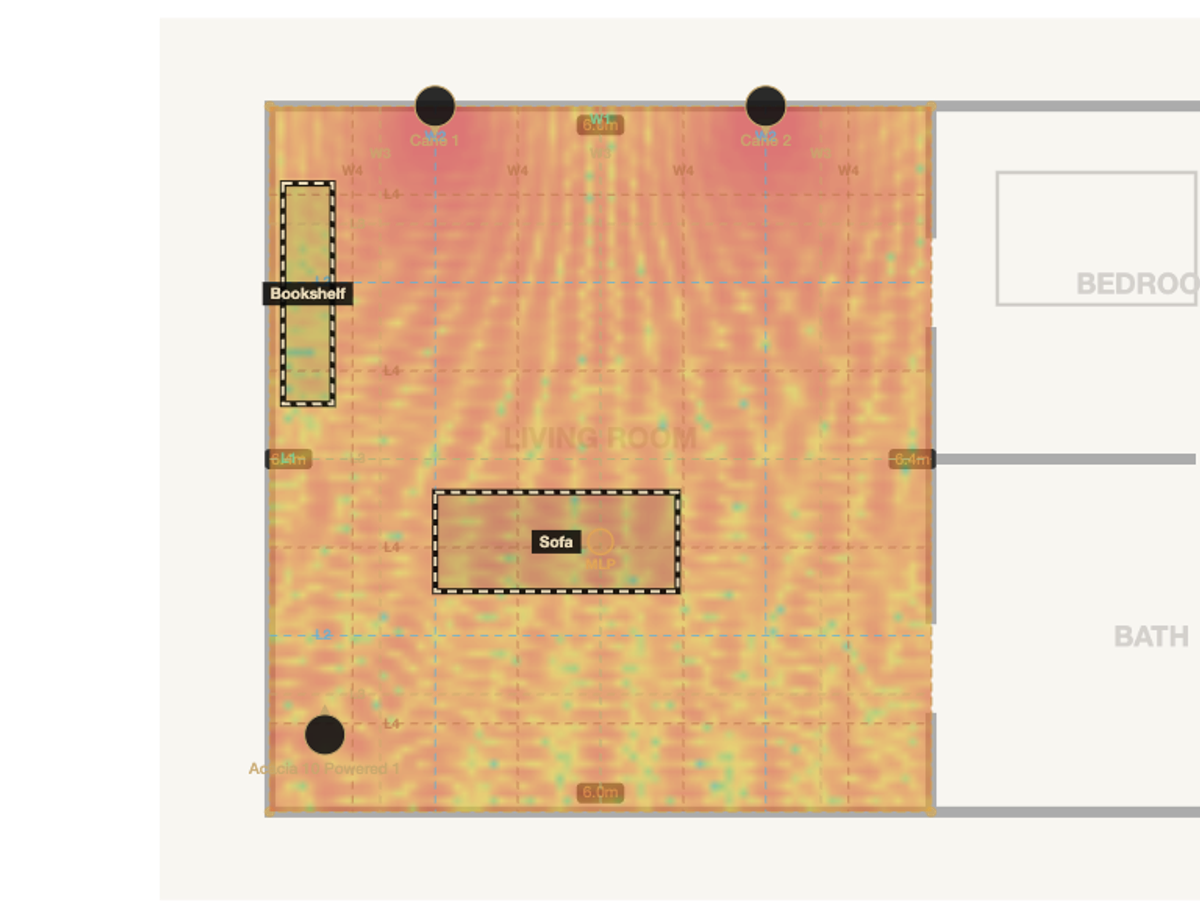
Where the 38% figure comes from
A rectangular room resonates at frequencies set by its dimensions. Along the length, those axial modes fall at multiples of c ÷ 2L — the speed of sound divided by twice the room length. In a 6 m room that is 28.6 Hz, 57.2 Hz, 85.8 Hz and 114.3 Hz.
Each mode has a standing wave along the length, and the pressure at any point follows cos(nπx ÷ L), where x is the distance from the wall. Sit at a maximum of that curve and the corresponding frequency is exaggerated. Sit at a null and it disappears. Neither is what you want; you want a seat that is not at a maximum for any of the low modes, because those are the ones that make bass boom or vanish.
Working out the pressure at the positions people actually recommend gives a clear answer.
| Position (of room length) | Worst of modes 1–3 | Worst of modes 1–4 | Worst of modes 1–5 |
|---|---|---|---|
| 25% — the quarter rule | 0.71 | 1.00 | 1.00 |
| 33% — the one-third rule | 1.00 | 1.00 | 1.00 |
| 38% — the 38% rule | 0.90 | 0.90 | 0.95 |
| 50% — dead centre | 1.00 | 1.00 | 1.00 |
Read the middle column. At a quarter of the room length you sit exactly on a maximum of the fourth mode. At a third, on the third. Dead centre, on the second and fourth at once — which is why the middle of the room is the worst seat in it, despite feeling symmetrical.
38% is the only one of the four that never reaches 1.00. That is the whole rule. It is not a magic number and nothing special happens at exactly 38% — it is a compromise position that dodges the peaks of the first several modes at the same time.
The practical range is wider than the number suggests
Solving for the position that minimises the worst of the first four modes gives a band running from roughly 20% to 40% of the room length, not a single point. Anywhere in that band avoids the strongest peaks; 38% sits near the top of it and is easy to remember.
That matters in real rooms, where the sofa goes where the sofa goes. Being at 34% instead of 38% costs almost nothing. Being at 50% costs a great deal.
What is the 1/3 rule for speaker placement?
The one-third rule places the speakers about a third of the way into the room from the front wall, and sometimes the listener at the opposite third. It is aimed at a different problem: distance from the boundary behind the speaker, which determines how strongly the wall reinforces the bass and where the first cancellation notch falls.
It is sound advice for the speakers and poor advice for the seat. As the table shows, a listening position at exactly one third sits on a maximum of the third mode. Use thirds for the loudspeakers, and 38% for the chair.
What is the golden rule for home theatre?
Two different things travel under this name. The first is the golden ratio applied to room dimensions — proportions near 1 : 1.6 : 2.6 for height, width and length — which spreads the modal frequencies out instead of stacking them on top of each other. That is a decision made when the room is built, not when the furniture arrives.
The second is the equilateral triangle for stereo: the two speakers and the listener forming equal sides, which puts the speakers at roughly 30° either side of centre. For cinema layouts the equivalent reference is the Dolby angle set, which the planner draws to the seating position — covered in the Floorplan Sound Simulation guide.
The mistakes these rules exist to prevent
Placement questions almost always trace back to the same handful of errors:
- Seating dead centre along the room’s length, which is a maximum for every even mode at once.
- Pushing the sofa against the back wall, where pressure is at a maximum for every mode without exception — the single worst seat in any room.
- Treating the 38% figure as exact and rebuilding a room around it, when the useful band is 20–40%.
- Applying the one-third rule to the listening seat rather than to the speakers.
- Fixing a modal problem with EQ. A null cannot be equalised — adding gain at a frequency the room is cancelling just heats the amplifier.
Is 7.1 better than Dolby Atmos?
They answer different questions. 7.1 adds two more speakers around the listener on the same plane; Atmos adds height, and places sounds as objects rather than fixed channels. For a room where the seating is fixed and the ceiling is reachable, height contributes more than extra surrounds — which is why a 5.1.4 is generally preferred over a 7.1 at the same channel count.
The placement rules above still apply either way. Height channels do not rescue a listening position at 50% of the room length.
Checking it in your own room
If you would rather not measure it out by hand, the speaker placement calculator returns the 38% seat for your room length, together with the separation that holds the 45–60° window at that distance.
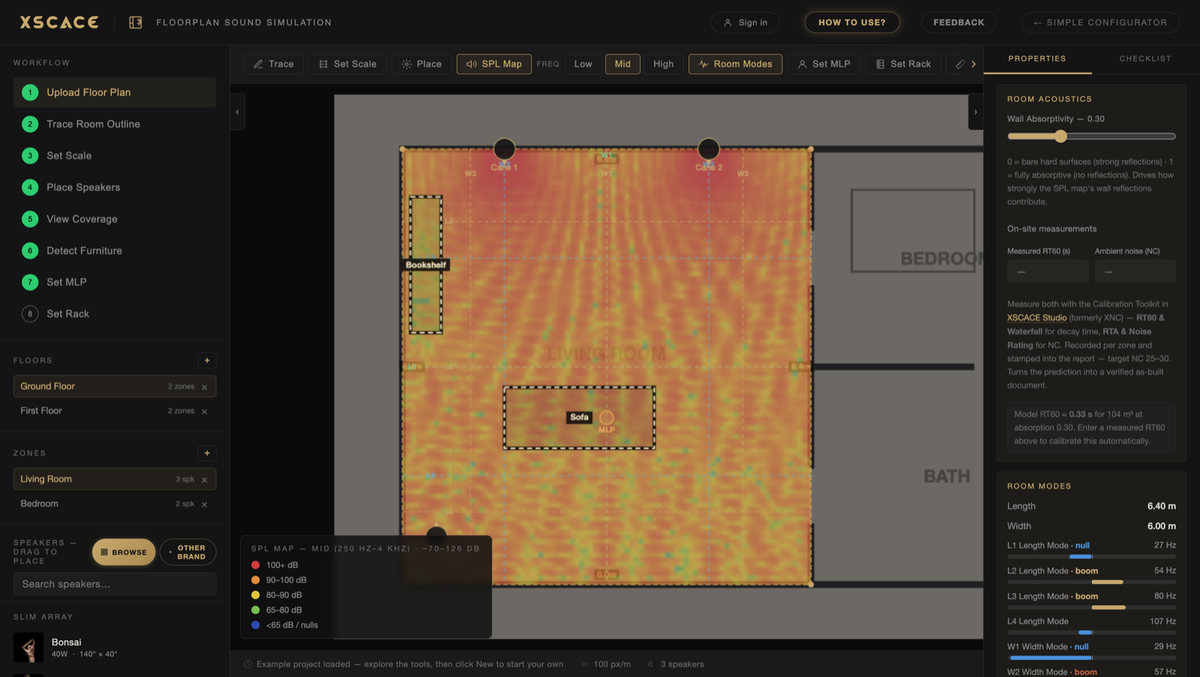
The arithmetic here assumes a rectangular room with rigid walls, which no real room is. Openings, glazing and soft furnishing all move the answer. XSCACE Floorplan Sound Simulation computes the modes from a traced plan and shows where they fall, so the 38% starting point can be checked against the room actually being built rather than an idealised box. The method is described in the guide.
The rule for the subwoofer is the mirror of this one, and the two are constantly confused. A seat wants a position where no mode peaks; a subwoofer wants a position where the mode it is trying to kill has zero pressure, because a driver on a pressure zero cannot excite that mode at all. That is worked through in our guide to subwoofer placement.