Contents8 sections
A room mode calculator tells you which bass notes a room will exaggerate and which it will swallow, before a single speaker is specified. Type in three dimensions and the physics is settled: a 6.0 × 4.5 × 2.6 m room resonates at 28.6 Hz along its length, 38.1 Hz across its width and 66.0 Hz between floor and ceiling, and forty-one modes in all sit below its 151 Hz Schroeder frequency. None of that changes with the speaker you buy. It is the room talking, and it talks loudest exactly where music has its foundation.
Every frequency the room will fight you on
Enter the three dimensions and every axial, tangential and oblique mode to fourth order is calculated, then judged three ways — how evenly the modes are spaced, where they stack on top of each other, and whether the distribution passes the Bonello criterion. All of it below the Schroeder frequency, because that is the region where the room, not the treatment, is deciding the answer.
| Frequency | Type | nx, ny, nz | To next mode |
|---|---|---|---|
| 28.6 Hz | Axial | 1, 0, 0 | 9.5 Hz |
| 38.1 Hz | Axial | 0, 1, 0 | 9.5 Hz |
| 47.6 Hz | Tangential | 1, 1, 0 | 9.5 Hz |
| 57.2 Hz | Axial | 2, 0, 0 | 8.8 Hz |
| 66.0 Hz | Axial | 0, 0, 1 | 2.7 Hz |
| 68.7 Hz | Tangential | 2, 1, 0 | 3.2 Hz |
| 71.9 Hz | Tangential | 1, 0, 1 | 4.3 Hz |
| 76.2 Hz | Tangential | 0, 1, 1 | 0.0 Hz |
| 76.2 Hz | Axial | 0, 2, 0 | 5.1 Hz |
| 81.4 Hz | Oblique | 1, 1, 1 | 0.0 Hz |
| 81.4 Hz | Tangential | 1, 2, 0 | 4.3 Hz |
| 85.8 Hz | Axial | 3, 0, 0 | 1.5 Hz |
| 87.3 Hz | Tangential | 2, 0, 1 | 6.6 Hz |
| 93.8 Hz | Tangential | 3, 1, 0 | 1.4 Hz |
| 95.2 Hz | Oblique | 2, 1, 1 | 0.0 Hz |
| 95.3 Hz | Tangential | 2, 2, 0 | 5.5 Hz |
| 100.8 Hz | Tangential | 0, 2, 1 | 4.0 Hz |
| 104.8 Hz | Oblique | 1, 2, 1 | 3.4 Hz |
| 108.2 Hz | Tangential | 3, 0, 1 | 6.1 Hz |
| 114.3 Hz | Axial | 0, 3, 0 | 0.0 Hz |
| 114.3 Hz | Axial | 4, 0, 0 | 0.4 Hz |
| 114.7 Hz | Oblique | 3, 1, 1 | 0.0 Hz |
| 114.7 Hz | Tangential | 3, 2, 0 | 1.2 Hz |
| 115.9 Hz | Oblique | 2, 2, 1 | 2.0 Hz |
What a room mode actually is
Sound reflects off every hard surface. When a wavelength fits exactly between two parallel walls, the outgoing wave and the returning one line up and reinforce each other, and the room holds that note like an organ pipe. That is a room mode — a standing wave at a frequency the room prefers.
The consequence is not subtle. At a mode frequency there are places in the room where the pressure is at a maximum and the note booms, and places where the two waves cancel and the note is barely there at all. Those quiet places are pressure nulls, and for the first mode along any dimension the null sits exactly at the midpoint. In that 6 m room, the 28.6 Hz mode is inaudible to anyone sitting 3 m from either end wall — the single most common reason a subwoofer measures fine and sounds absent.
Axial, tangential and oblique modes
Modes are classified by how many pairs of surfaces the wave bounces between, and the class determines how much you need to care:
- Axial — between one pair of parallel surfaces. Length, width or height. These are the strongest, because the wave only loses energy at two surfaces per round trip.
- Tangential — between two pairs, involving four surfaces. Conventionally about 3 dB weaker than axial.
- Oblique — between all three pairs, involving all six surfaces. About 6 dB weaker again, and rarely worth chasing individually.
The calculator above evaluates all three classes to fourth order in each axis and colours them accordingly. The common advice to "just work out the axial modes" is a reasonable first pass, but it misses the reason many rooms have a problem: a single axial mode is manageable, whereas an axial and two tangential modes landing on the same frequency is the one-note boom that no amount of absorption fully removes.
How to calculate room modes by hand
Every mode of a rectangular room comes from one equation, where c is the speed of sound (343 m/s at 20 °C), L, W and H are the dimensions in metres, and nx, ny and nz are whole numbers starting at zero:
f = (c / 2) × √((nx/L)² + (ny/W)² + (nz/H)²)
Set two indices to zero and it collapses to the familiar axial case, f = c / 2d. For a 6 m length: 343 / 12 = 28.6 Hz, and the harmonics at 57.2 Hz, 85.8 Hz and so on. Set two indices non-zero and you have a tangential mode: for length and width together, (343/2) × √((1/6)² + (1/4.5)²) = 47.6 Hz. Doing this by hand for one axis takes a minute. Doing it for every combination up to fourth order means 124 calculations, which is the reason the tool exists.
The Schroeder frequency: where modes stop mattering
Modes exist at every frequency, but above a certain point there are so many packed so closely together that they overlap into a statistical average rather than individual resonances. That crossover is the Schroeder frequency:
f = 2000 × √(RT60 / V)
For the 70.2 m³ example at an RT60 of 0.4 s, that is 151 Hz. The distinction matters because it splits the problem in two. Below Schroeder, the room is a small number of discrete resonances and the fix is geometry — where the sources go, where the seats go, what the dimensions are. Above it, the room is diffuse and the fix is absorption. Bass traps in a room with a badly spaced modal distribution are treating a symptom; the shape is the cause.
Reading the result: spacing, stacking and Bonello
A list of frequencies is not a verdict, so the calculator judges the distribution three ways:
- Widest modal gap — the largest stretch below Schroeder with no mode in it. A wide gap is heard as a hole, and it is the one problem absorption genuinely cannot solve: you cannot absorb your way to support at a frequency the room does not resonate at.
- Mode stacking — modes landing within 1.5% of each other pile their energy onto one frequency. This is what a bad dimension ratio actually does. A room exactly twice as long as it is wide puts its second length mode precisely on its first width mode.
- Bonello criterion — the count of modes in each third-octave band must not fall as frequency rises, and a band containing coincident modes needs five or more modes to carry them without an audible peak.
Those three are computed from your dimensions rather than looked up in a table of preferred ratios. A ratio table can only tell you whether your room happens to be one of a handful somebody published; it says nothing about the room you actually have, and it cannot account for the ceiling height you are stuck with.
What to change when the numbers are bad
While the drawing can still move, the dimensions are the strongest lever available and the cheapest. Raising a ceiling by 100 mm moves every height mode and every tangential and oblique mode that involves height — often enough to break up a stack that would otherwise need a wall of bass trapping to tame. Change one dimension in the calculator and watch the stack figure and the widest gap respond.
Once the shell is fixed, the modes are fixed too, and the remaining leverage is positional: putting sources and seats where the troublesome modes have nulls, and keeping them away from the corners where every mode has a maximum. That is a different calculation, and it is the one the subwoofer placement calculator performs — a modal summation at a specific seat for a specific source position, searching a grid for the flattest result.
Room modes and in-ceiling speakers
Architectural speakers sit in a boundary, which changes the picture in two ways worth knowing. A speaker mounted flush in the ceiling is at a pressure maximum for every height mode, so it drives them at full strength — there is no "move it off the boundary" option available. That is an argument for settling the modal picture at design stage rather than hoping to correct it later.
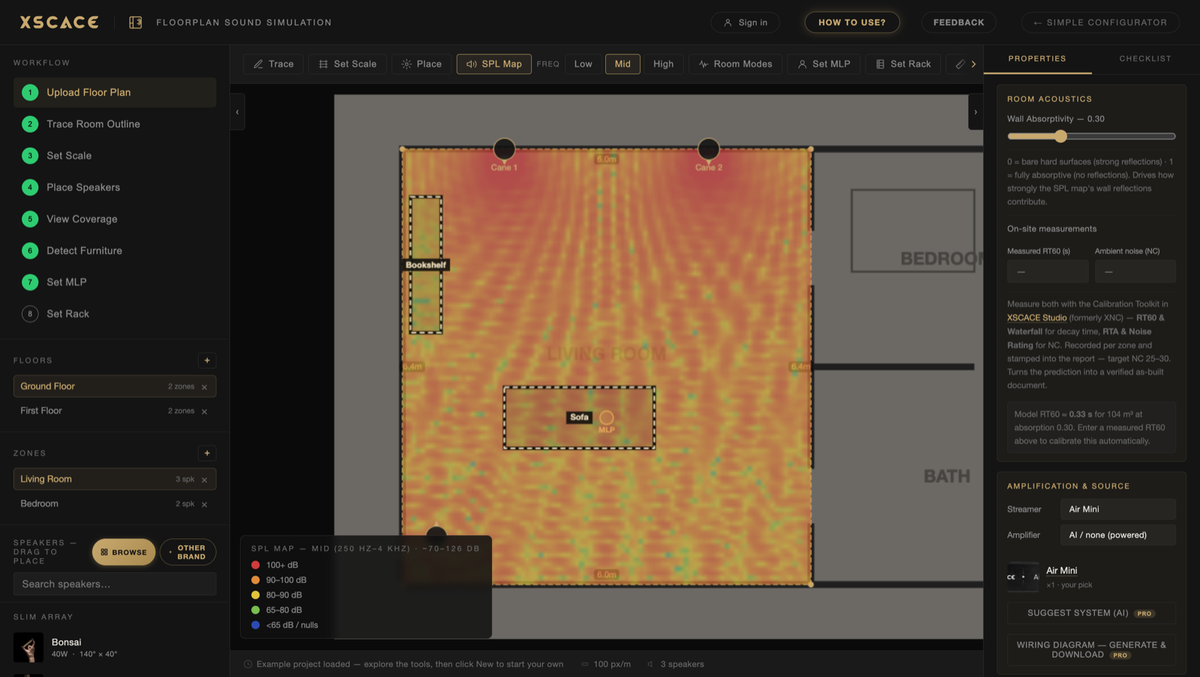
It also cuts the other way. Because the position is fixed by the architecture, the variables that remain are how many speakers, how they are spaced, and where the low frequencies are handled from. Spacing and count are worked out in the speaker placement calculator, and both can be modelled against a traced plan of the actual room in Floorplan Sound Simulation rather than assumed. XSCACE amplification with onboard DSP, such as the Xylem series, gives you parametric correction for the peaks that remain — with the caveat that equalisation can reduce a modal peak and can never fill a modal null, because there is no energy at that frequency to raise.
The short version
Room modes are the frequencies a room resonates at, set entirely by its dimensions and fixed the moment the shell is built. Below the Schroeder frequency they are individually audible, and geometry decides the outcome; above it, treatment does. Calculate them while the dimensions can still change, and you are choosing the problem. Calculate them afterwards, and you are only naming it.