Contents5 sections
Premium speaker brands are easy to list and hard to compare. Most buying guides line up a floorstanding tower next to a flush-mounted ceiling speaker, score them against the same criteria and declare a winner — which tells you nothing, because the two were never solving the same problem. The premium speaker brands worth shortlisting fall into three distinct groups, and the right group depends almost entirely on which constraint is hardest in your brief: the room, the furniture, or the architecture.
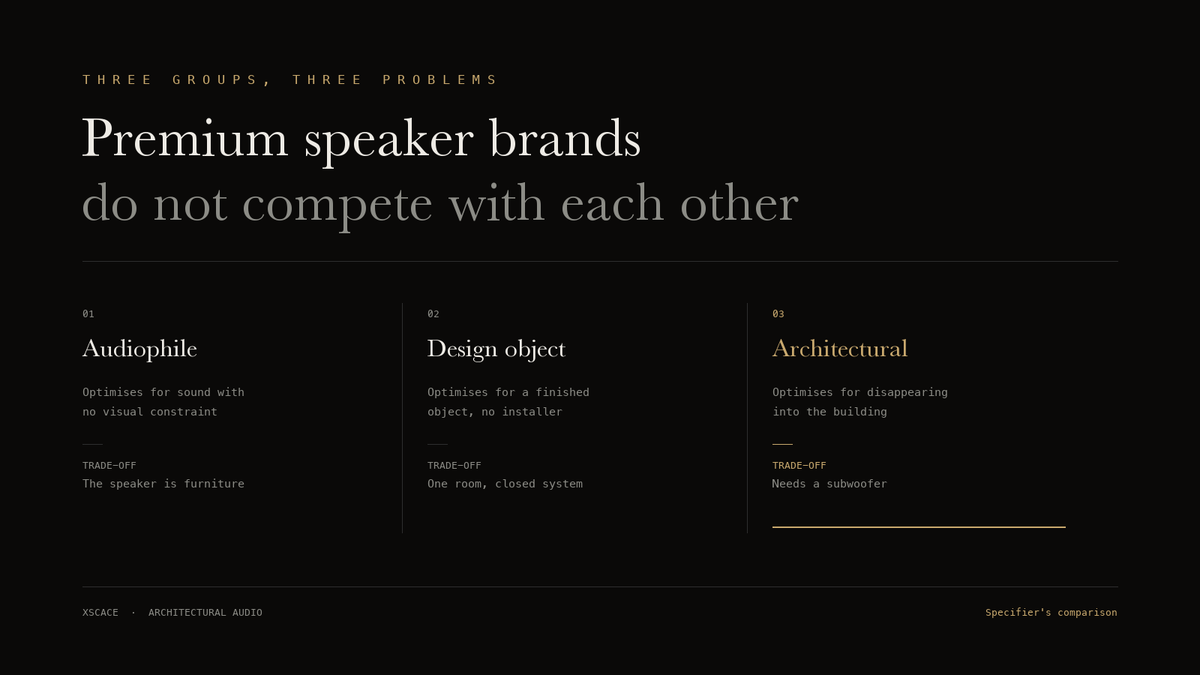
The three groups premium speaker brands fall into
Before comparing a single specification, work out which group you are actually shopping in. A brand that is excellent in one group is usually irrelevant in another, and most disappointing installations are a group error rather than a brand error.
| Group | What it optimises for | Representative brands | The trade-off you accept |
|---|---|---|---|
| Audiophile loudspeakers | Sound quality with no visual constraint | Bowers & Wilkins, Dynaudio, Sonus faber, Focal, KEF | The speaker is furniture. It occupies floor space and dictates the layout. |
| Design-object systems | A finished object requiring no installation | Bang & Olufsen, Devialet | A closed ecosystem that rarely scales past a room or two. |
| Architectural / custom install | Disappearing into the building fabric | Sonance, James Loudspeaker, Origin Acoustics, XSCACE | Cabinet volume is constrained, so deep bass needs a subwoofer. |
When a competing premium speaker brand is the better answer
This is the section manufacturer comparisons leave out. There are projects where XSCACE is the wrong specification, and saying so upfront is considerably cheaper than a return.
- A dedicated two-channel listening room. If nothing in the brief prevents floorstanding speakers, a pair from Bowers & Wilkins, Dynaudio or Sonus faber will outperform any flush-mounted architectural speaker at a comparable budget. Cabinet volume is physics, and an architectural speaker does not have it.
- One room, no installer, no equipment rack. Bang & Olufsen and Devialet sell a finished object that works out of the box. An architectural system needs amplification, cable routed before plaster, and a commissioning visit.
- A North American project that needs the deepest local support network. Sonance effectively created the architectural speaker category and has dealer and service density in the United States that a younger brand cannot claim.
- A commercial cinema requiring certified calibration to a distribution standard. That is a different product class with different documentation obligations, and an architectural range is not the right tool.
XSCACE is the right answer in one specific case: when the visual constraint is the hardest constraint in the brief, and the speaker has to survive an architect's review as an object rather than be forgiven as equipment.
How XSCACE compares on the numbers that matter
Architectural speakers are usually sold with adjectives. These are the published figures a specifier can check against a drawing before anything is ordered.
| Model | Depth | Bandwidth | Sensitivity | Max SPL | Room guidance |
|---|---|---|---|---|---|
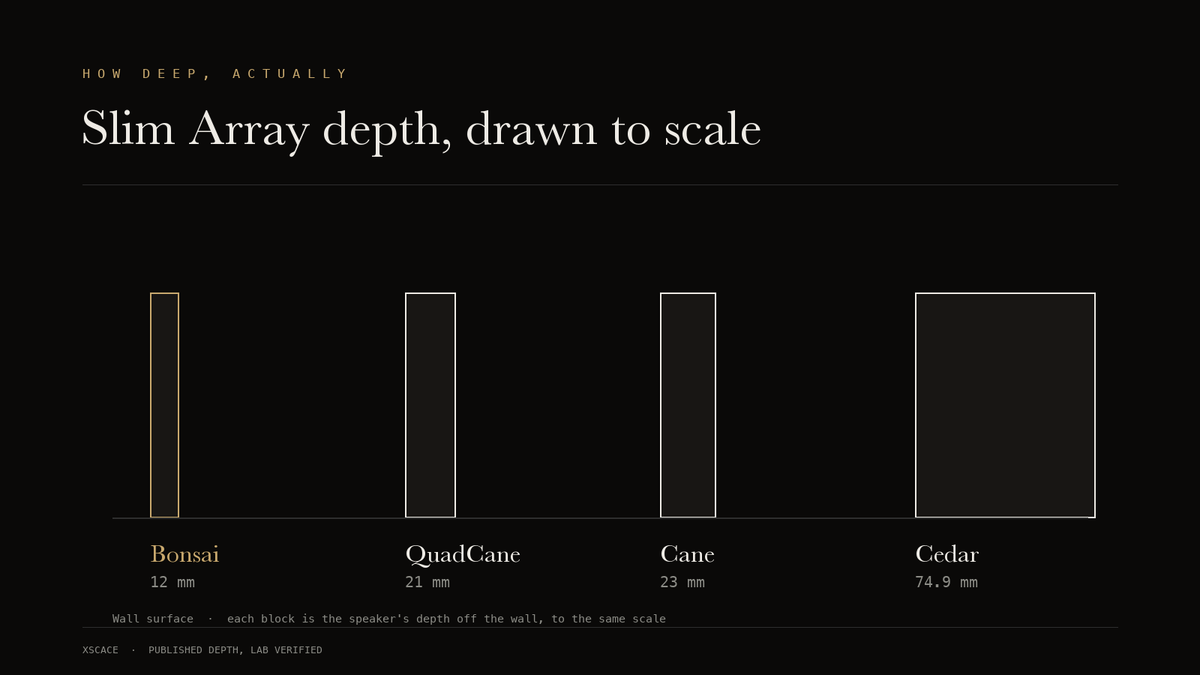
| Bonsai | 12 mm (0.47 in) | 300 Hz – 18 kHz (–6dB) | 86 dB | 103 dB | Up to 15 × 15 ft |
| QuadCane | 21 mm (0.83 in) | 150 Hz – 20 kHz (±3dB) | 95 dB | 116 dB | Up to 30 × 30 ft |
| Cane | 23 mm | 150 Hz – 20 kHz (±3dB) | 92 dB | 110 dB | Up to 20 × 20 ft |
| Ghost 2.0 (in-ceiling) | 188 mm rear depth | 80 Hz – 20 kHz (–3dB) | 92 dB | 112 dB | Up to 20 × 20 ft |
| Aspen 8 (in-ceiling) | 121 mm rear depth | 40 Hz – 22 kHz (±3dB) | 89 dB | 111 dB | Up to 25 × 25 ft |
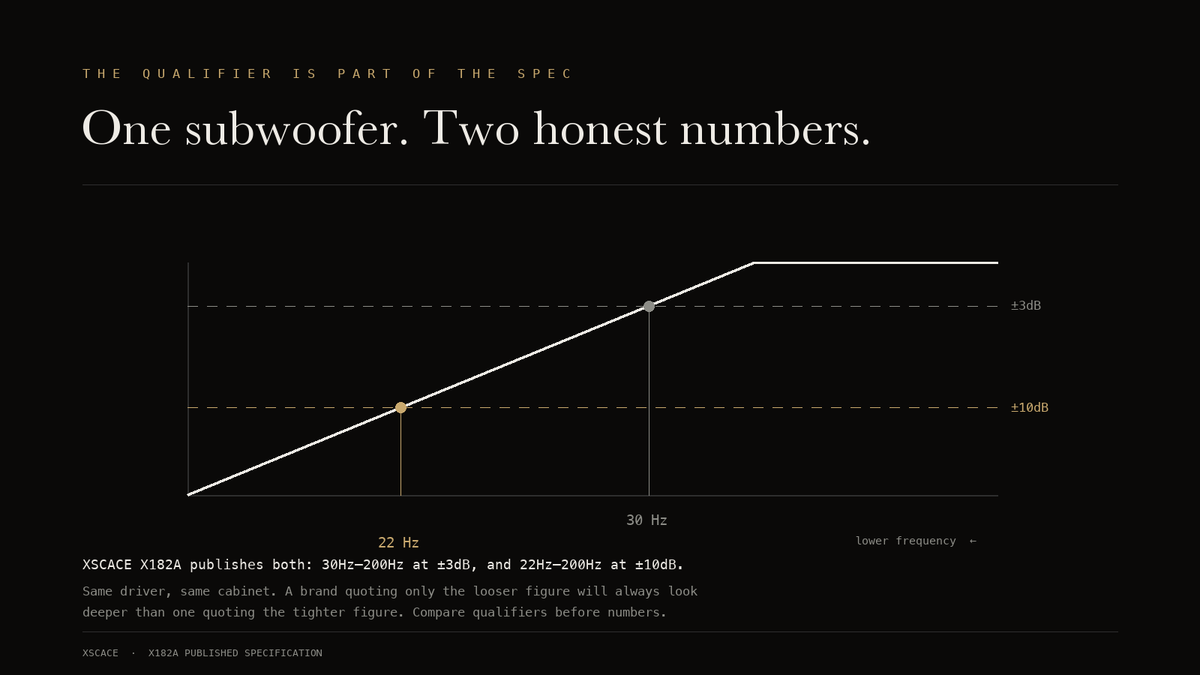
| X182A (outdoor sub) | 806 mm cabinet | 30 Hz – 200 Hz (±3dB) | 100 dB | 134 dB | Outdoor, to roughly 60 × 60 ft |
The Bonsai is 12 mm deep, 22 mm wide and 90 mm tall — a surface-mount speaker about the size of two credit cards stacked on edge — rated 40 W RMS with distortion of ≤0.2% at 1 W/1 m. It is the shallowest model in the range and the reason most architects encounter the brand at all. Aluminium-bodied models are anodised in any RAL colour rather than painted, typically on a 45-day lead.
Note what the bandwidth column concedes. The Bonsai starts at 300 Hz and the Cane and QuadCane at 150 Hz. Those are not full-range speakers, and no amount of specification writing changes that — a subwoofer is part of the design, not an upsell.
What to ask any premium speaker brand before you specify
- Ask for the bandwidth qualifier, not just the range. "20 Hz – 20 kHz" means nothing without ±3dB or –6dB beside it, and a ±3dB figure cannot be compared with a –6dB one.
- Ask for the cut-out diameter and rear clearance in millimetres, and check them against the actual ceiling void before the plasterboard goes up. This is the single most common cause of a speaker that cannot be installed.
- Ask whether the finish is painted or anodised. Paint on a grille closes acoustic apertures and changes the measured response; anodising is part of the metal and does not.
- Ask whether sensitivity is quoted at 1 W/1 m or 2.83 V/1 m. On a 4-ohm speaker those two figures differ by 3 dB, which is the difference between a brand looking better than another and actually being louder.
- Ask who commissions the system and whether a measured room-correction pass is included or billed separately. A calibrated average speaker beats an uncalibrated excellent one every time.
Those five questions eliminate most of a shortlist in an afternoon. For the engineering detail behind them, see how to compare architectural speaker brands, and for the drawing-stage checklist, how to specify architectural speakers.
Brands that plaster over entirely sit in their own category, covered separately in hidden, concealed and invisible speakers versus ultra-slim.
Luxury speaker brands for architectural projects: the shortlist
Once the group is settled, the luxury speaker brands genuinely competing for an architectural specification are a short list, and they separate on distribution and finish rather than on frequency response.
- Sonance — the broadest architectural catalogue and the strongest North American support network.
- James Loudspeaker — custom-built to order, strong where a non-standard size or shape is required.
- Origin Acoustics — invisible and in-ceiling ranges built around installer speed.
- XSCACE — the shallowest surface-mount profiles in the group at 12 mm, any RAL finish anodised rather than painted, and distribution focused on India, the Middle East and South-East Asia.
If you are at the stage of proving coverage rather than choosing a badge, the floor-plan sound simulation tool will take a plan, place speakers on it and return a coverage map and a bill of quantities you can put in front of a client. The full Slim Array range carries the dimensions and cut-out data referenced above.