Contents3 sections
Physics does not negotiate. Hoffman's Iron Law states that in any loudspeaker design, engineers can optimise only two of three variables: low-frequency extension, efficiency, and enclosure size. Achieve all three simultaneously, and you have violated thermodynamics. This constraint has defined — and limited — architectural audio for decades, which is why understanding how architectural speakers achieve deep bass requires understanding the law they are fighting against. XSCACE's Nano Resonance™ technology is our engineering response to that constraint, and it shapes every in-ceiling and in-wall speaker we build from our Toronto headquarters.
Hoffman's Iron Law and Why It Matters for Architectural Audio

The resonant frequency of a loudspeaker driver is determined by three physical parameters: cone mass, the combined compliance of the spider and surround, and the volume of air trapped in the enclosure behind the cone. Lower the resonant frequency — which is what you need for bass — and you must either increase cone mass, increase compliance, or increase enclosure volume. All three changes carry penalties. A heavier cone is harder to accelerate, reducing efficiency. Greater compliance means a softer suspension, which limits excursion control at high output levels. A larger enclosure is, by definition, larger — incompatible with in-ceiling or in-wall installation.
Traditional in-ceiling speaker designers resolve this tension by prioritising two variables: efficiency and small size. The result is a speaker that installs neatly into a 150mm ceiling cutout and plays at reasonable volume levels from a modestly powered amplifier — but whose bass response rolls off somewhere above 80Hz. You hear the upper bass frequencies, the body of a kick drum, the fundamental of a male voice. You do not hear the room-filling low end that makes music feel physical. The sonic compromise is baked into the physics, and most manufacturers simply accept it.
This is the compromise that defines most architectural audio: thin speakers that sound thin. Flush-mounted, invisible, and acoustically hollow. The homeowner who upgrades from a pair of bookshelf speakers to an in-ceiling system often finds themselves missing the very bass weight that made their old speakers satisfying. The AV integrator who specifies these speakers frequently adds a subwoofer as a matter of course, knowing the in-ceiling drivers alone will not carry the load.
The Nano Resonance™ Approach: Sacrificing Efficiency Deliberately
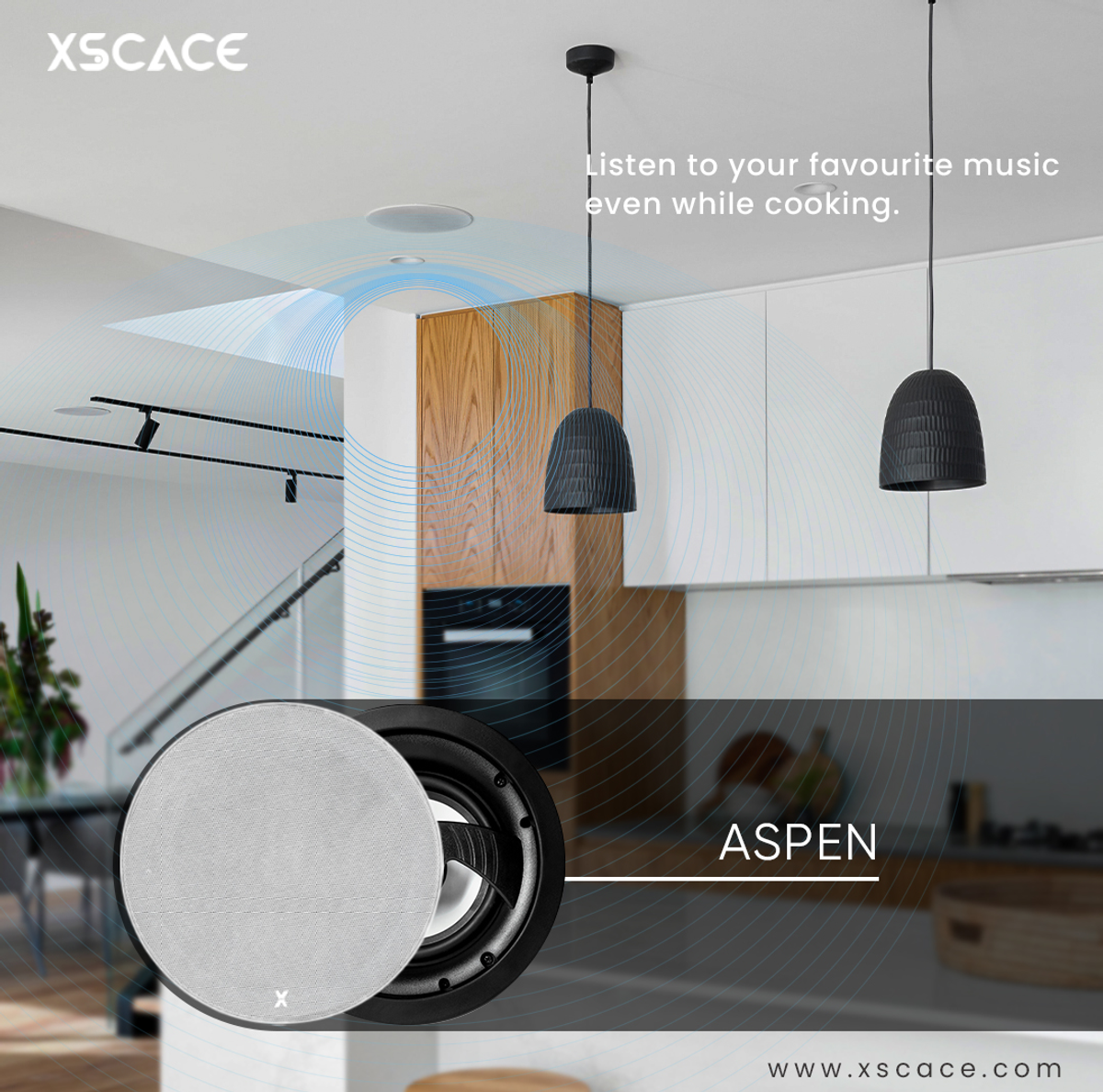
XSCACE made a different trade. We kept the small enclosure — because in-ceiling installation demands it — and we kept low-frequency extension, because that is the entire acoustic problem worth solving. What we gave up, deliberately and precisely, was efficiency.
The engineering method is heavier cone mass. By increasing the mass of the cone assembly beyond what a conventional in-ceiling driver carries, we push the resonant frequency lower — into the range where in-ceiling speakers have historically had nothing to offer. This is not a shortcut or a marketing reframe. It is a conscious, quantified choice to move along Hoffman's Iron Law curve in a direction most architectural audio manufacturers have avoided.
A heavier cone requires significantly more power to accelerate to useful output levels. This is the direct consequence of trading efficiency for extension. It is also why Nano Resonance™ cannot function in isolation — it requires a complementary voice coil architecture capable of handling the increased thermal and mechanical demands. XSCACE's PowerDense Dynamics™ voice coil engineering exists specifically to service this requirement: a voice coil wound with higher conductor density to convert amplifier power into cone motion more effectively under the conditions that Nano Resonance™ imposes. The two technologies are inseparable in practice.
The result is an in-ceiling speaker that reaches frequencies typically achieved only by large floor-standing woofers. We are not stretching a driver beyond its design intent — we are designing the driver with this frequency range as the primary engineering target, then engineering everything downstream to support it. This is the difference between a compromise and a specification.
What This Means in a Real Room
The abstract physics translates into concrete performance differences that homeowners and integrators notice immediately. In a typical listening room, Nano Resonance™-equipped speakers produce:
- Genuine low-frequency presence from a flush-mounted ceiling installation — no floor-standing cabinets, no visible speaker grilles, no acoustic compromise visible to the room
- No separate subwoofer required for music listening in most rooms — the in-ceiling drivers carry the frequency range that makes music feel complete and physical
- Consistent performance across typical room sizes — from 20 sq m bedrooms to 60 sq m open-plan living areas — without the room-mode sensitivity that plagues single-point subwoofers
- Phase-coherent bass from flush-mounted drivers — the low frequencies arrive at the listening position from the same spatial location as the midrange and high frequencies, preserving the stereo image that a separate subwoofer can smear
- Controlled, accurate low end rather than room-shaking resonance — Nano Resonance™ is engineered for extension and precision, not for maximum output at a single frequency
- Invisible installation without acoustic compromise — the architectural constraint and the sonic specification are no longer in conflict
For rooms that require extension below 45Hz — large home theatres, dedicated listening rooms, or spaces where the client listens to music with significant sub-bass content — XSCACE's Acacia 6 subwoofer (45Hz–300Hz, 84dB) and Acacia 10 subwoofer (35Hz–300Hz, 88dB) extend the system's low-frequency capability without requiring any compromise to the in-ceiling installation. The in-ceiling drivers handle everything above their bandwidth; the Acacia series fills what remains. This is additive extension, not compensation for a deficiency.
In practice, XSCACE integrators report that Nano Resonance™-equipped in-ceiling speakers satisfy the majority of residential music listening installations without any subwoofer at all. For clients who stream background music through a distributed audio system, the in-ceiling drivers alone produce a frequency balance that sounds complete. For clients who sit down to listen critically, the option to add Acacia-series subwoofers provides a path to reference-level performance — still installed without visible cabinetry, still flush with the architecture.
The "invisibility" of architectural speakers has always carried a sonic cost. Flush-mounted, grille-covered drivers installed into ceilings and walls have been the visual solution and the acoustic compromise simultaneously — a trade that clients accepted because no alternative existed. Nano Resonance™ is XSCACE's engineering answer to that cost: a technology designed not to paper over Hoffman's Iron Law, but to navigate it deliberately, sacrificing the variable that modern amplification can compensate for, and retaining the variables that cannot be recovered downstream. The result is a speaker that earns its installation — invisible without being inaudible.