Contents6 sections
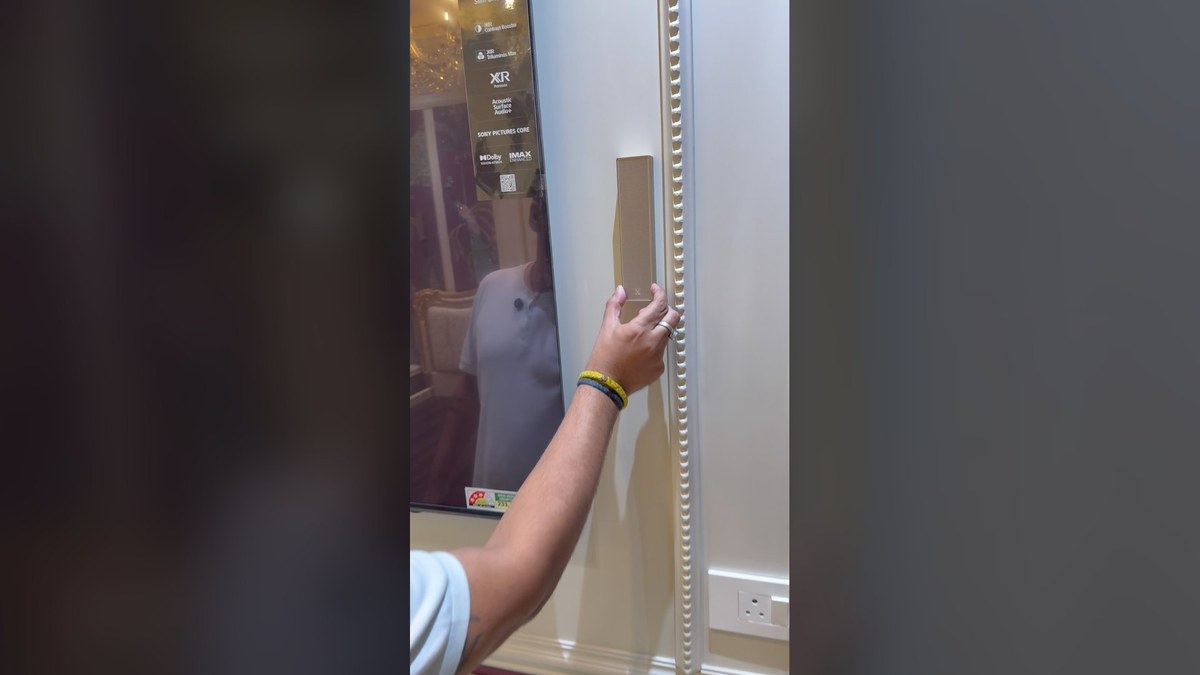
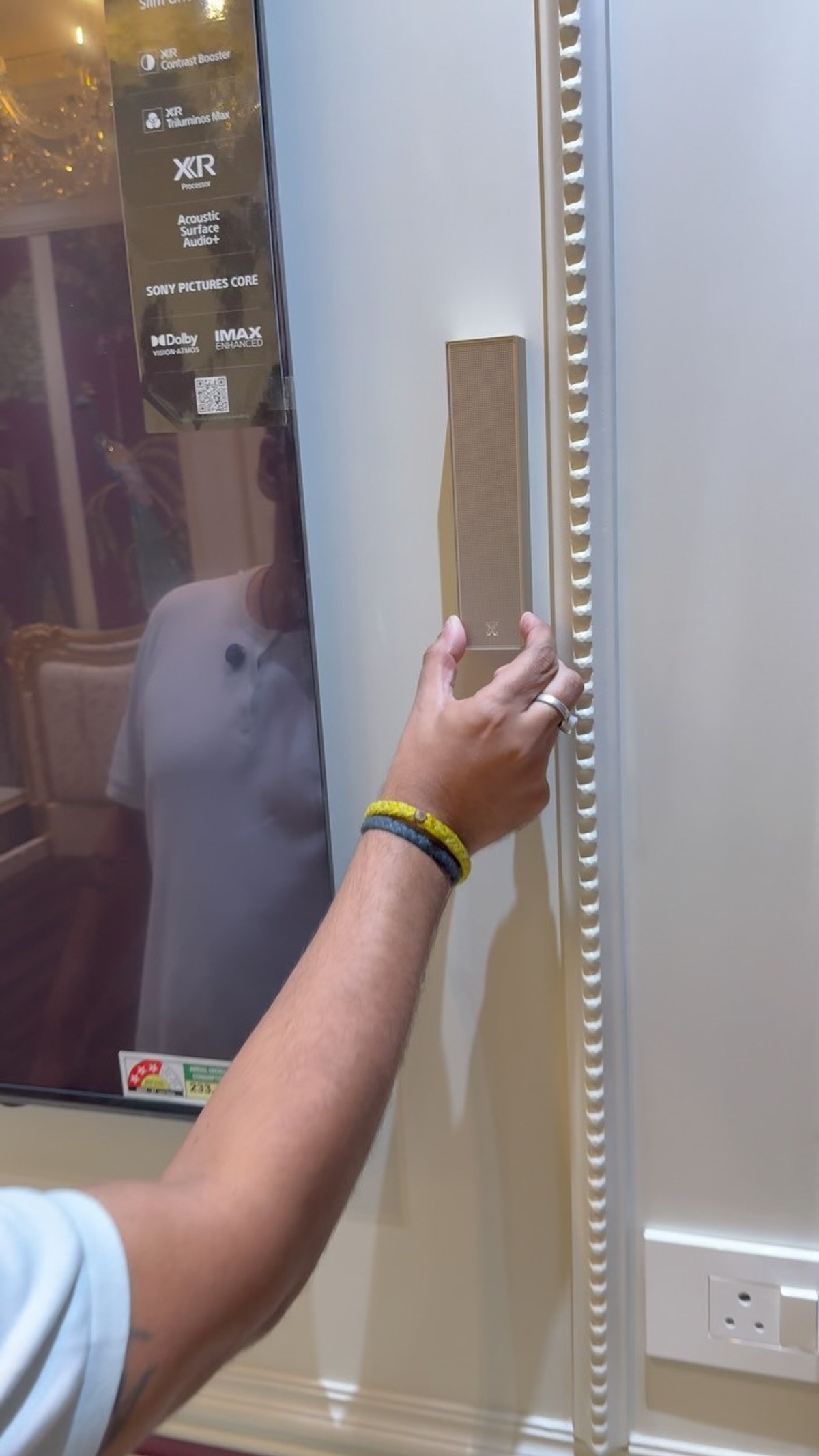
When people search for the smallest speakers for home, they are usually asking two questions at once: how small can a speaker get, and will a room still sound full when it does. Karan Sethi answered the first in two words. In an Instagram reel posted on Qube Designs, the studio he founded, he reaches up beside a television and touches an XSCACE Cane on a moulded wall panel, captioned simply: “Smallest speakers.”
Qube Designs is a luxury interior design studio working in more than twenty cities, with around 437,000 followers on Instagram and, by the studio’s own account, a feature in Forbes India this year. When a studio of that reach puts a speaker in front of its audience without a brief or a script, it is worth looking at what it chose and why.
What the reel shows
The setting tells you most of what you need. A large television on a cream wall, a classical bead-moulded pilaster beside it, and between the two, at roughly the height of the screen’s upper third, a single Cane in matte champagne. It sits on the flat field of the panel and stops short of the moulding. There is no bracket visible, no cable, and no box on the floor.
The comments did the rest. Most were some version of the same question: which brand is it. A smaller number came from people who already own XSCACE speakers and said so. That pattern is the point of an architectural speaker. The first reaction should be that you cannot tell what it is.
Why Cane, and why it reads as small
Cane is not the smallest speaker XSCACE makes; Bonsai is. But Cane is the one people meet most often beside a television, because it is the size at which a slim array starts to carry a living room on its own. The figures are from the published specification:
- Size: 183.5 mm tall, 43 mm wide and 23 mm deep. Weight 200 g.
- Drivers: 4 power-dense custom woofers in a slim array.
- Power: 50 W RMS, 60 W peak, 8 ohms. Sensitivity 92 dB. Maximum SPL 110 dB.
- Response: 150 Hz to 20 kHz (±3 dB). Dispersion 140° horizontal by 25° vertical.
- Mount: keyhole wall mount on a finished panel, no cut-out.
- Finishes: matte champagne, black and white, or a custom RAL colour to match the wall.
- Recommended room: up to about 20 by 20 feet. Living rooms, meeting rooms, lobbies.
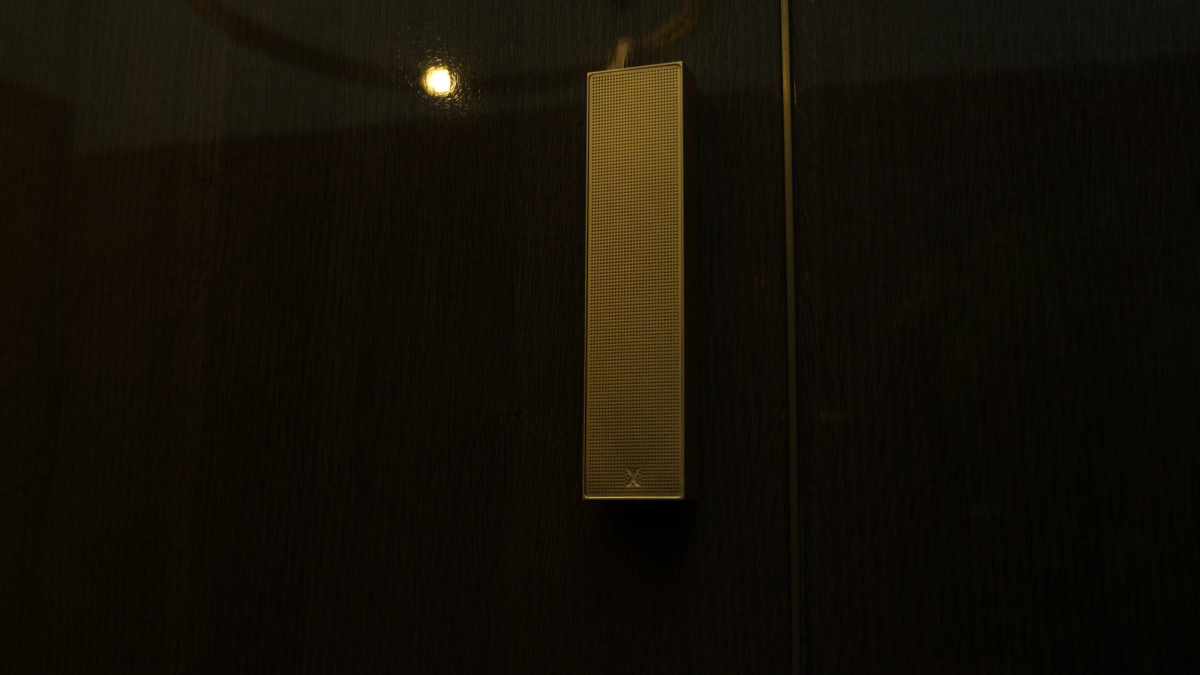
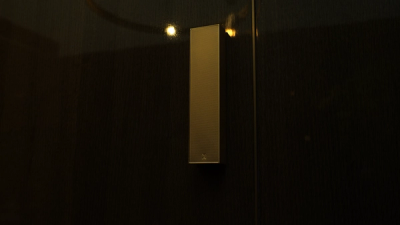
Two numbers explain why it reads as small in a room. At 23 mm deep it projects less from the wall than the moulding beside it in the reel. And at 92 dB sensitivity it reaches a comfortable listening level on modest amplifier power, so it does not need a large cabinet behind it to fill a space. Every 3 dB of sensitivity is worth a doubling of amplifier power, which is why a speaker this thin can carry a television and music in a living room without strain.
How small do the smallest speakers for home actually go?
Across the XSCACE slim array range the answer runs from a hundred grams to a speaker for an open-plan floor. Choosing between them is a question of the room, not of looks, since all three share the same profile and finishes:
- Bonsai: 90 × 22 × 12 mm, 40 W RMS, 86 dB, 300 Hz to 18 kHz. Rooms up to about 15 by 15 feet: bedrooms, studies, dressing rooms. Always paired with a subwoofer.
- Cane: 183.5 × 43 × 23 mm, 50 W RMS, 92 dB, 150 Hz to 20 kHz. Rooms up to about 20 by 20 feet: living rooms and media walls like the one in the reel.
- QuadCane: 763 × 43 × 21 mm, 100 W RMS, 95 dB, 150 Hz to 20 kHz. Rooms up to about 30 by 30 feet: open-plan spaces, restaurants and terraces.
For a sense of Bonsai in a finished apartment, the Trevoc Royal Residences case study shows it on the wall panels of four rooms, with the coverage and reverberation predictions behind a room like the living room in this reel. For a larger space, QuadCane does the same job at four times the driver count.
What designers look for in a speaker beside the screen
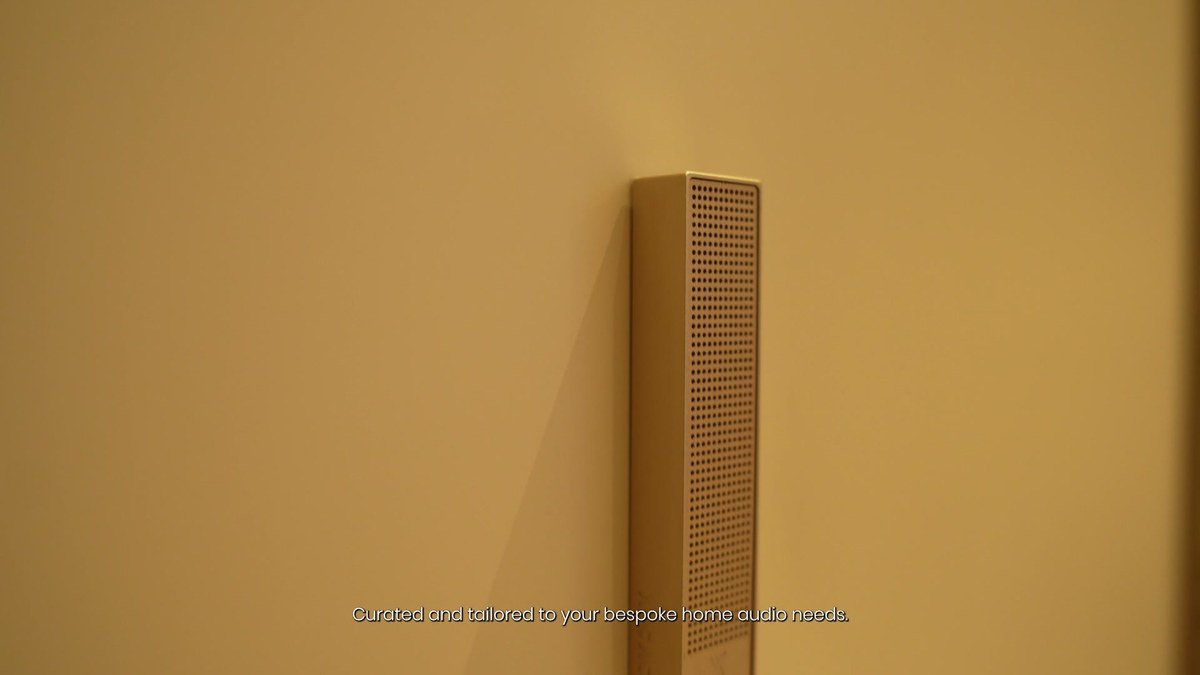
A reel from a design studio is not a review, and it would be wrong to read a technical verdict into two words. What it does show is the set of things an interior designer weighs before a speaker is allowed onto a wall they have drawn:
- It must not interrupt the architecture. Here the speaker sits in the flat field of the panel and leaves the moulding alone.
- It must take the finish of the wall, not ask the wall to take its finish. Champagne on cream reads as hardware.
- It must go on after the interior is finished. A keyhole mount means no chasing, no cut-out and no re-plastering.
- It must still sound like the room deserves the screen. That part is acoustic, and it is decided before the speaker is fixed, not after.
How a room like this is planned
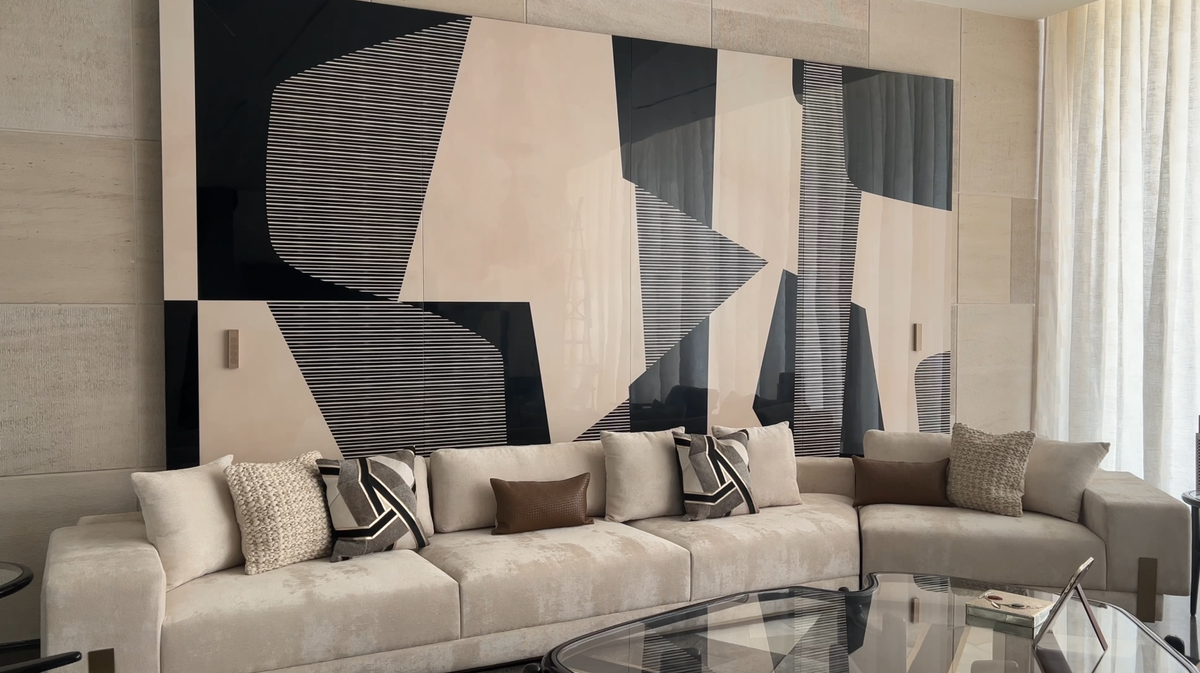
For a living room built around a large screen, the useful work happens before installation. In Floorplan Sound Simulation the room is traced to scale, the speakers are placed where the joinery allows, and the planner predicts coverage, speech clarity and reverberation for the seats that matter. A Cane pair either side of the screen is normally paired with a subwoofer such as the Acacia 10 Powered, since Cane hands the bass below 150 Hz to it. To see the systems XSCACE would put in a room like this one, pick the living room in Room Solutions.
Seen by the people who specify rooms
Qube Designs joins a growing list of designers, architects and editors who have shown XSCACE in their own words, from Architectural Digest to the studios and installers on the testimonials wall on our home page. The common thread is not volume. It is that nobody could see where the sound was coming from.
Pricing is quoted by the authorised XSCACE distributor for each territory, against the room and the finish. To ask about Cane for a project, find your distributor.