Contents6 sections
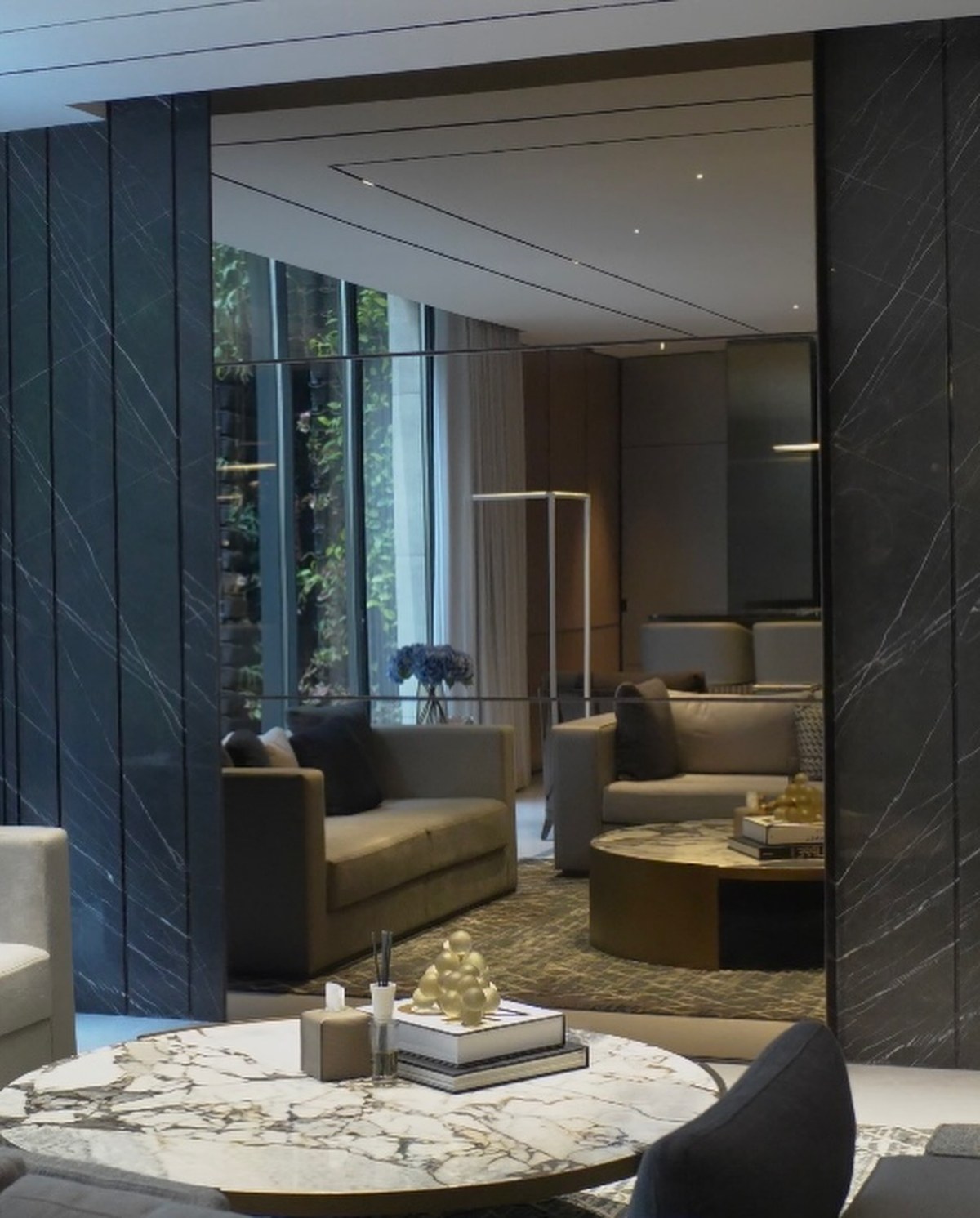
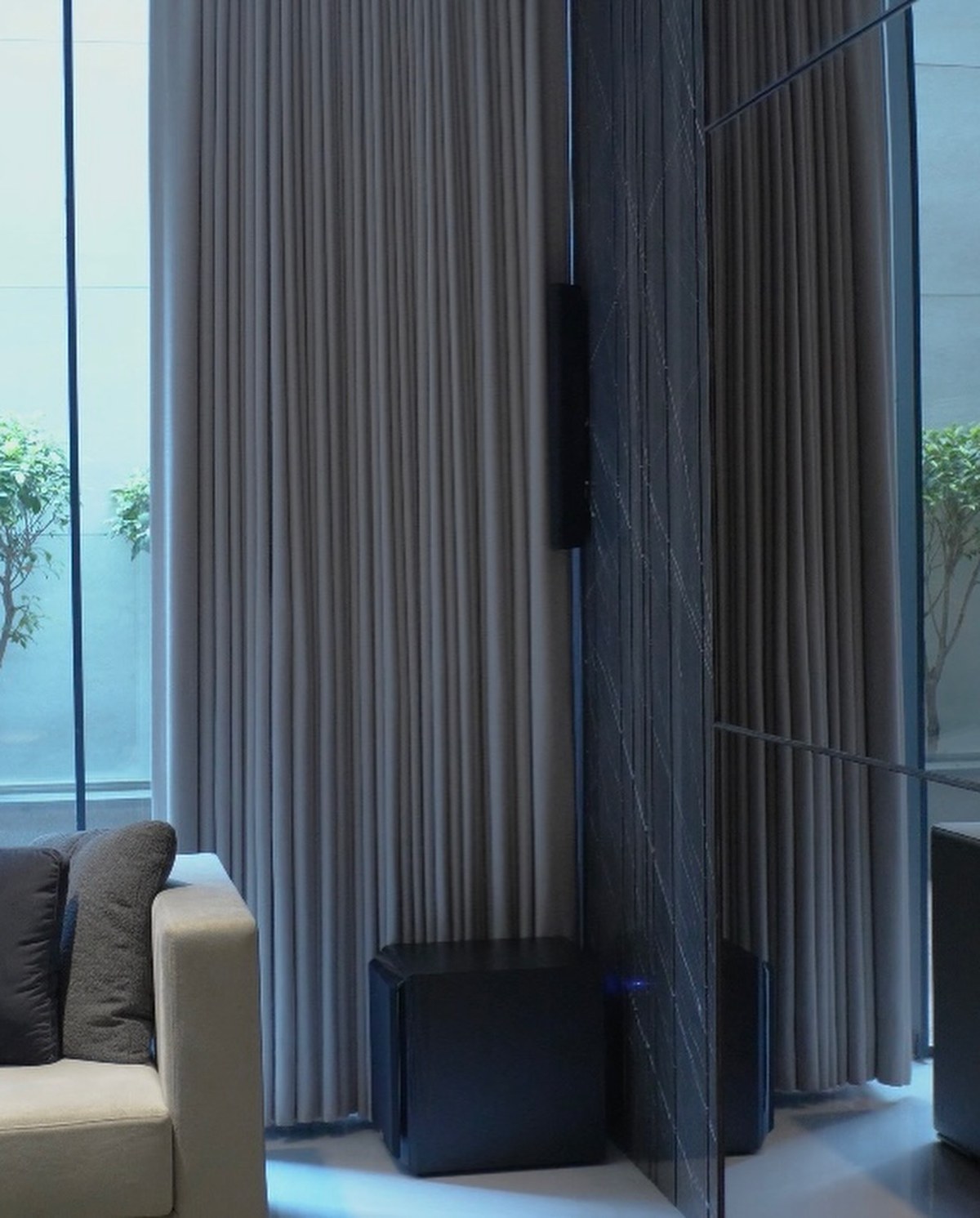
A formal reception lounge with floor-to-ceiling glass, book-matched grey-veined marble, and hotel-lobby-grade furnishing needed a speaker built for a room that regularly holds more people than a private living room — sound that stays clean and controlled across a crowd, not just at one seat. Cedar was specified here instead of the thinner Cane or Bonsai, mounted on a dark grey marble panel beside ribbed bronze wood-slat cladding.
Case Study at a Glance
- Room: formal reception lounge, hotel-lobby scale
- Product: Cedar (74.9mm, 100W RMS, 96dB)
- Mounting surface: dark grey book-matched marble + bronze wood-slat cladding
- Finish: black aluminium
- Goal: higher-output coverage for a larger, higher-traffic space
When a room outgrows the thinnest options
Not every room should default to the thinnest possible speaker — a large reception lounge with hard marble and glass surfaces benefits from the additional headroom a deeper enclosure like Cedar provides, because harder surfaces reflect more sound energy and a system pushed near its limit in that environment sounds strained well before a system with more reserve capacity does. The 62.9mm of extra depth over Cane bought meaningful acoustic capability that mattered more here than the last few millimetres of visual disappearance would have.
Why Cedar over a thinner speaker
Cedar trades depth for output: at 74.9mm, it's considerably deeper than Cane's 23mm or Bonsai's 12mm, but that extra enclosure volume delivers 100W RMS and 96dB sensitivity against Cane's 50W/92dB — meaningfully more headroom for a larger reception space with harder, more reflective marble and glass surfaces that can otherwise make a room sound bright and fatiguing at volume.
4Ω impedance and amplifier sizing
Cedar runs at 4Ω impedance rather than the 8Ω common across XSCACE's thinner models, which changes the amplifier math — a 4Ω load draws roughly double the current of an equivalent 8Ω load at the same voltage, so the amplifier driving it needs to be rated for 4Ω operation specifically, not just have spare wattage in reserve.
The system
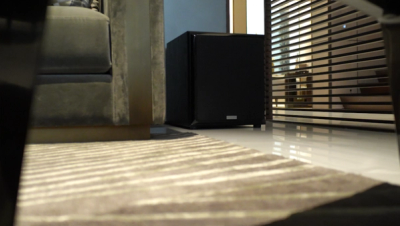
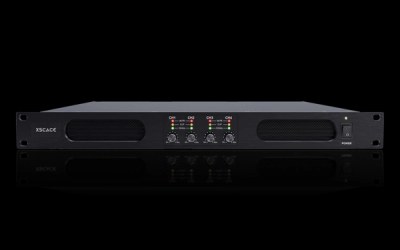
A Lucifer 4 four-channel amplifier (250W RMS per channel into 8Ω, correspondingly higher into 4Ω) drives the Cedar array, with a Juniper subwoofer (350W RMS, 25Hz–200Hz) extending low-frequency response across the reception space.
How this room was planned, controlled and calibrated
Every XSCACE installation follows the same three stages: planned in the simulator, controlled from the app that matches the hardware, and calibrated with measurement. A commercial room is judged on consistency — the table by the window should hear what the table by the bar hears.
Planned
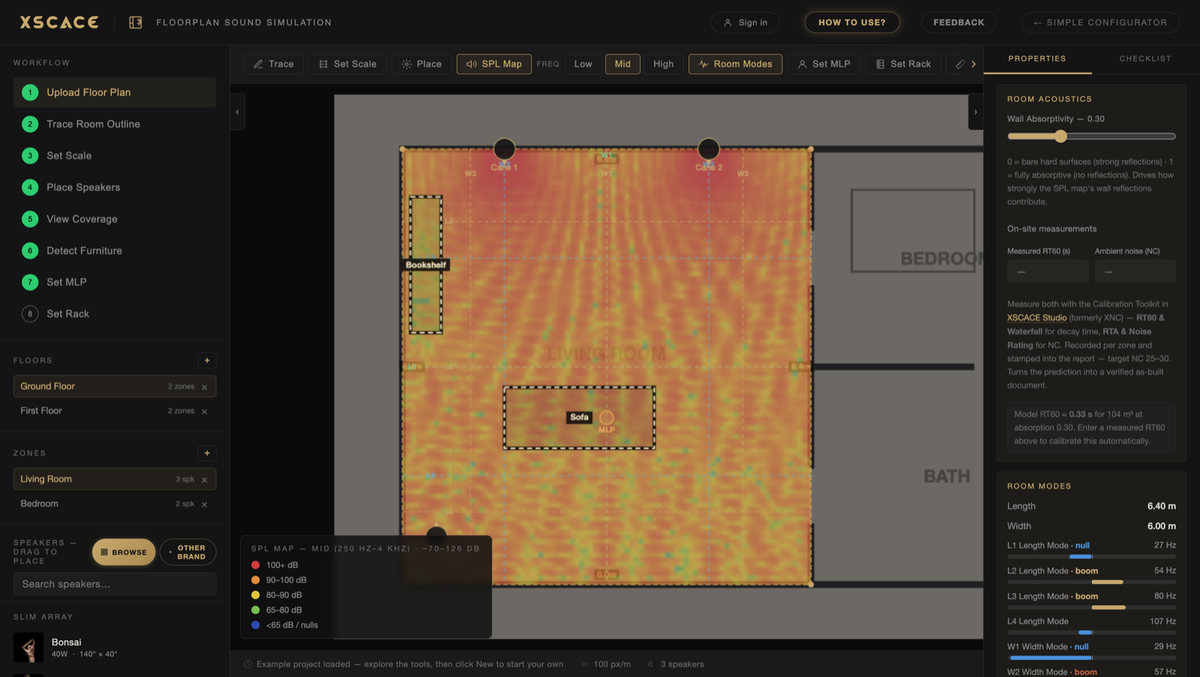
XSCACE Floorplan Sound Simulation takes a plan from trace to bill of quantities in the browser. For a room like this the outputs that matter are:
Coverage checked table by table, so no seat is the bad seat
Room modes located before the fit-out covers the structure
A bill of quantities the operator can price against
Controlled
The amplifier is configured and controlled from XSCACE Studio on macOS — routing matrix, per-channel gain and delay, parametric EQ, crossovers and limiting, with network-wide discovery rather than one amplifier at a time.
Calibrated
The calibration toolkit inside XSCACE Studio measures what the room actually does — eleven instruments covering SPL, delay, levels, polarity, frequency response, THD, sub alignment, transfer function, RT60, RTA and export, free on macOS. Here the ones that earn their place are:
RTA noise rating, NC-15 to NC-65, setting the level the system must clear once the room is full
SPL measured at each zone against the design target
RT60 to ISO 3382, showing whether hard surfaces need treating as well as covering
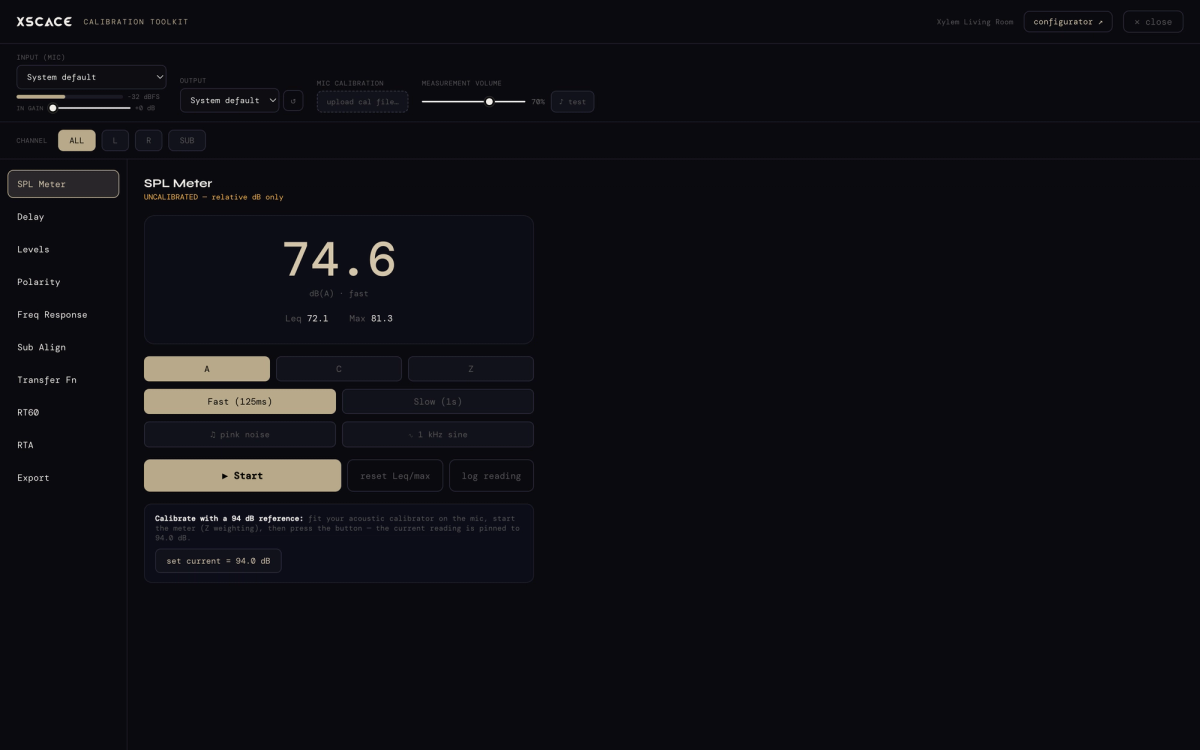
Cedar runs down to 100Hz against Juniper's 25Hz, and the two records recommend different crossover points (100Hz and 200Hz). Which suits the room is a measurement, not a preference.