Contents6 sections
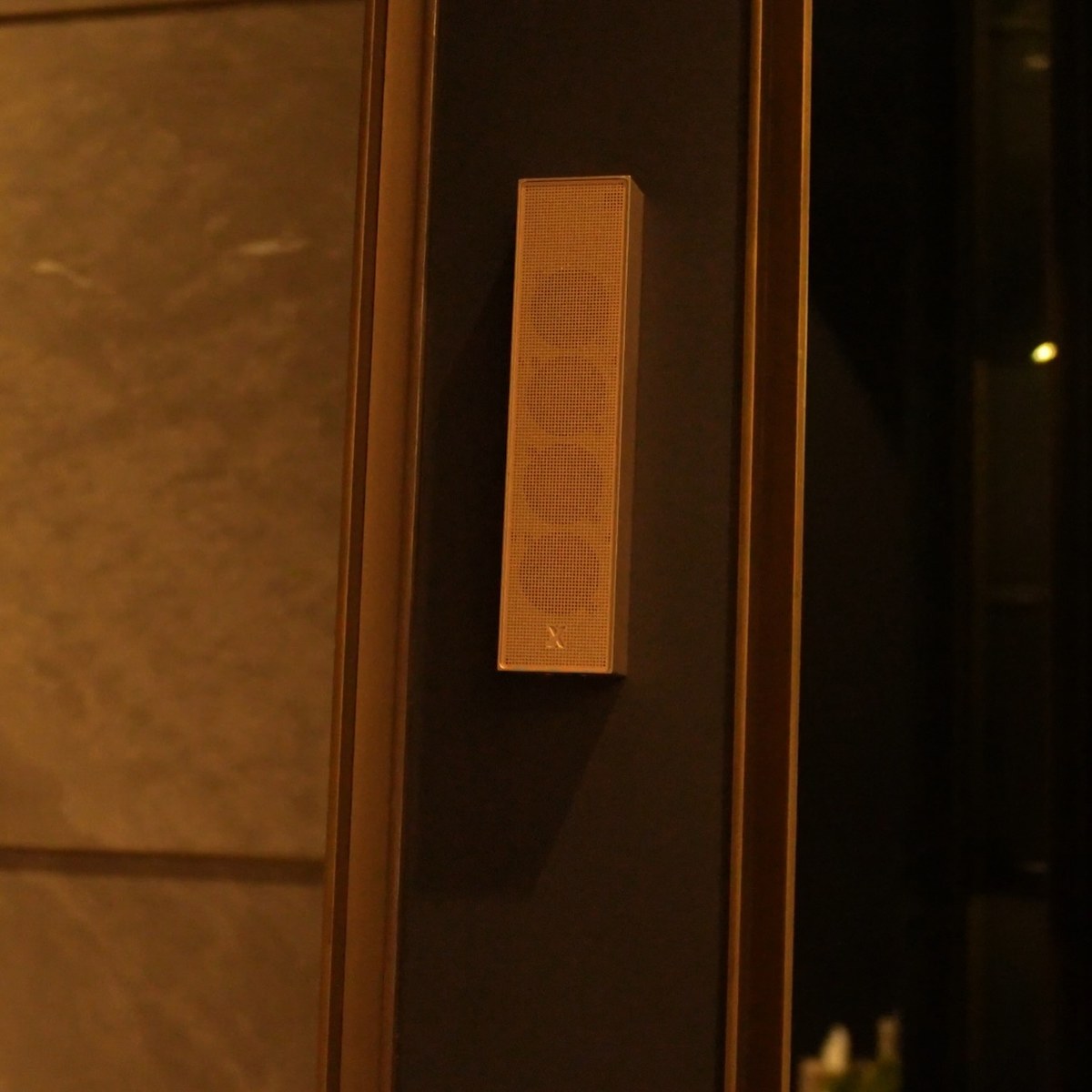
A private lounge entrance framed by a full-height glass sliding door, set into warm honey-toned oak trim, needed a speaker that would announce the room's sound before a guest even stepped through — without interrupting the glass itself or the book-matched marble feature wall visible beyond it. Cane was mounted directly onto the oak door jamb, blending with the trim's own colour.
Case Study at a Glance
- Space: private lounge glass-door entrance
- Product: Cane (23mm slim-array)
- Mounting surface: honey-toned oak door jamb
- Finish: champagne aluminium, matched to oak
- Goal: announce the lounge's sound before a guest steps through the door
Threshold audio as an extension, not a separate zone
An entrance speaker positioned at a threshold like this is usually wired into the same zone as the room beyond it, rather than treated as an independent zone with its own control — the intent is continuity, so a guest doesn't experience a volume or tonal drop-off crossing from the entrance into the lounge itself. That continuity is a wiring and zoning decision made at design stage, not something correctable after installation.
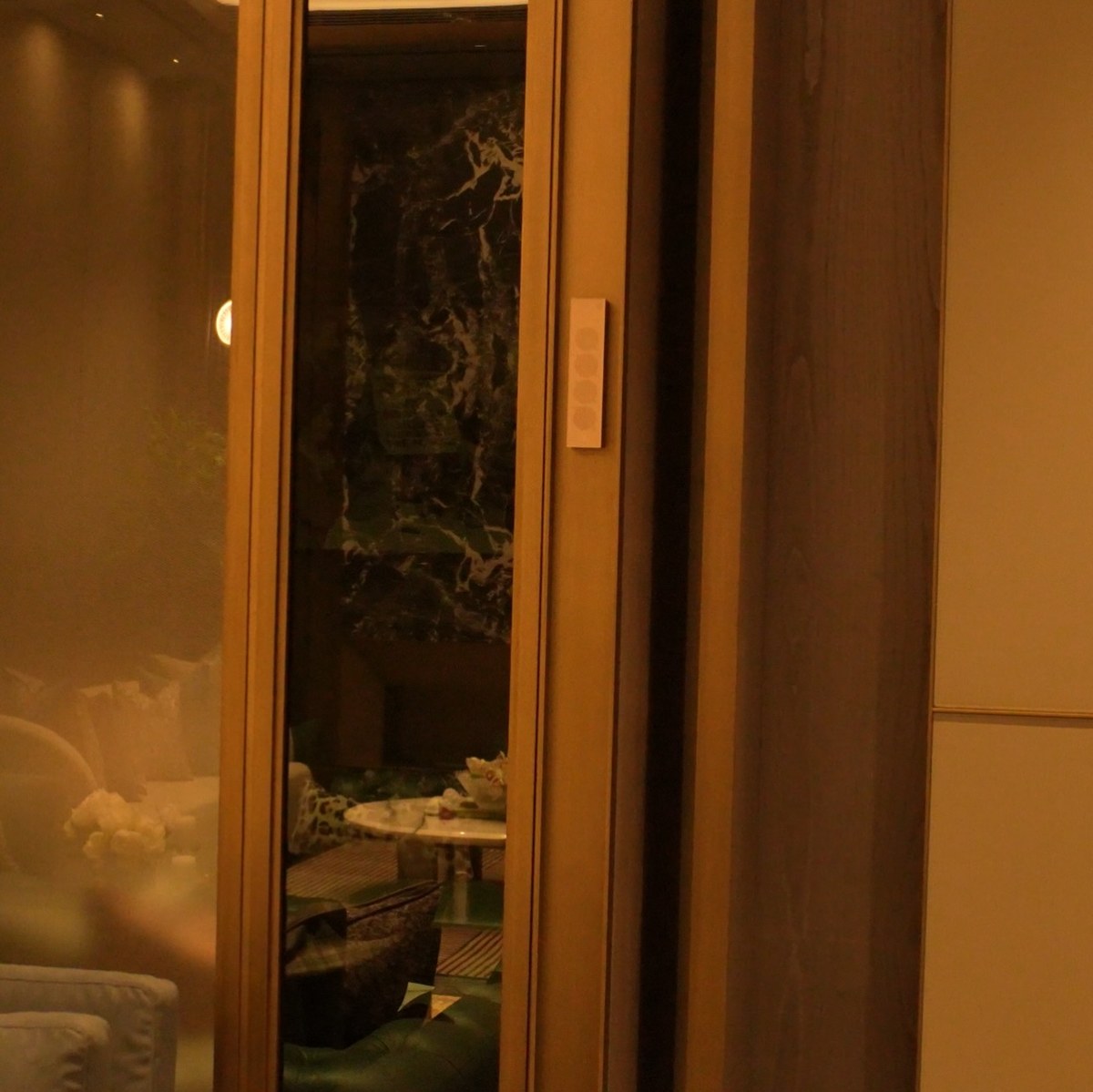
Blending into oak trim
Cane's champagne finish was chosen specifically to sit close to the warm-gold tone of the oak jamb, rather than the darker or cooler finish options — from a few feet away, the speaker reads as part of the door hardware rather than a separate fixture.
A threshold, not a room
An entrance or threshold zone like this doesn't need to deliver full-room coverage on its own — it's there to extend the sound of the lounge beyond the door itself. Cane's 92dB sensitivity gives it enough headroom to do that at modest power draw, without needing to be driven hard.
The system
An Air Amp drives the lounge's Cane speakers, with an Acacia 10 Powered subwoofer providing low-end fill for the main lounge space beyond the entrance.
Planned, controlled and calibrated in a reverberant space
Every XSCACE installation follows the same three stages: planned in the simulator, controlled from the app that matches the hardware, and calibrated with measurement. Lobbies are stone, glass and height — the least forgiving acoustic in a building, and the first thing a visitor experiences.
Planned
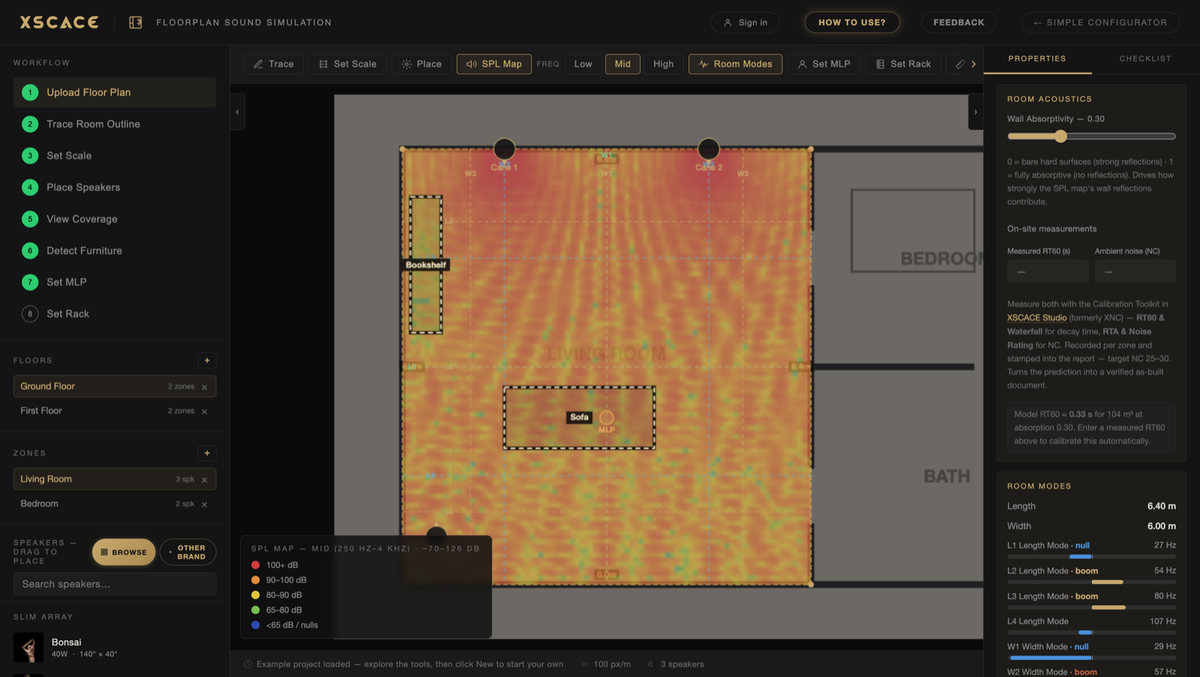
XSCACE Floorplan Sound Simulation takes a plan from trace to bill of quantities in the browser. For a room like this the outputs that matter are:
Coverage across the arrival path rather than a single point
Room modes and reflections located in a space with no absorption
A client-ready drawing for sign-off before the finishes go on
Controlled
Day-to-day control is XSCACE Controller on iOS and Android. It handles volume, EQ and grouping, and the streaming amplifiers also appear natively as AirPlay 2 and Spotify Connect targets, so the app is for control rather than for getting audio into the room.
Calibrated
The calibration toolkit inside XSCACE Studio measures what the room actually does — eleven instruments covering SPL, delay, levels, polarity, frequency response, THD, sub alignment, transfer function, RT60, RTA and export, free on macOS. Here the ones that earn their place are:
RT60 to ISO 3382, the defining number in a hard tall room
SPL along the arrival route
Frequency response, since reverberation colours tone as well as timing
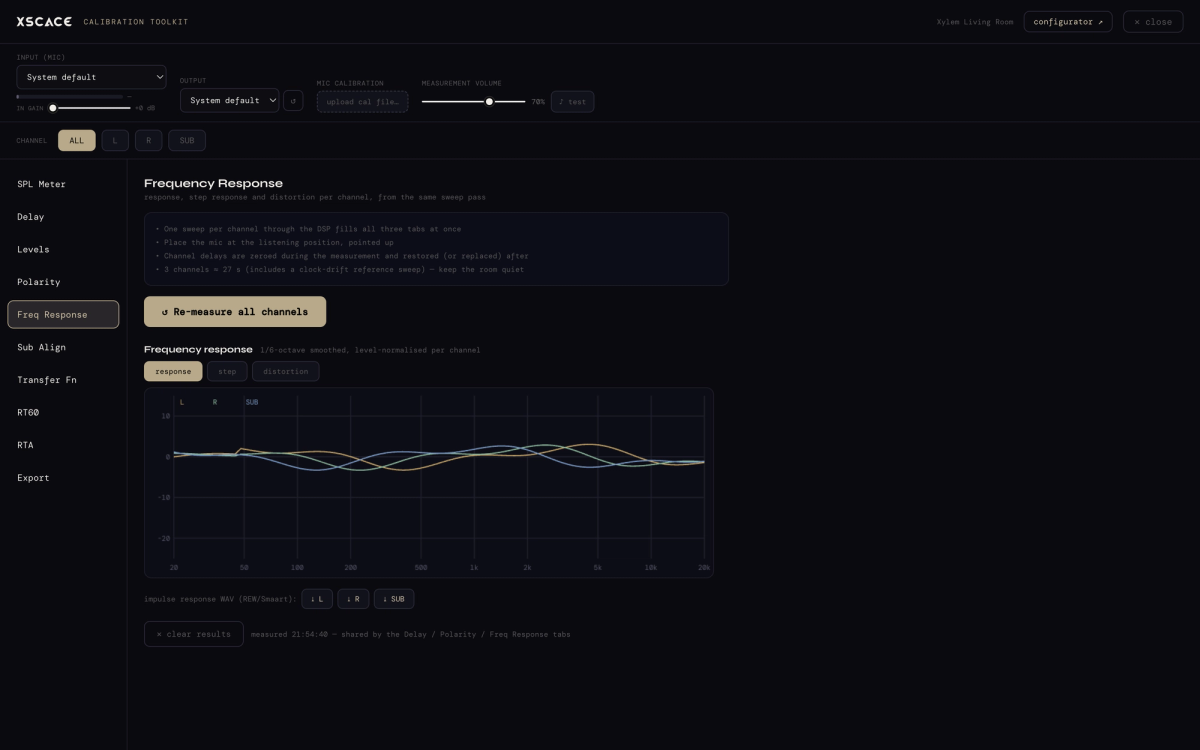
Cane runs down to 150Hz against Acacia 10 Powered's 35Hz, and the two records recommend different crossover points (200Hz and 300Hz). Which suits the room is a measurement, not a preference.