Contents7 sections
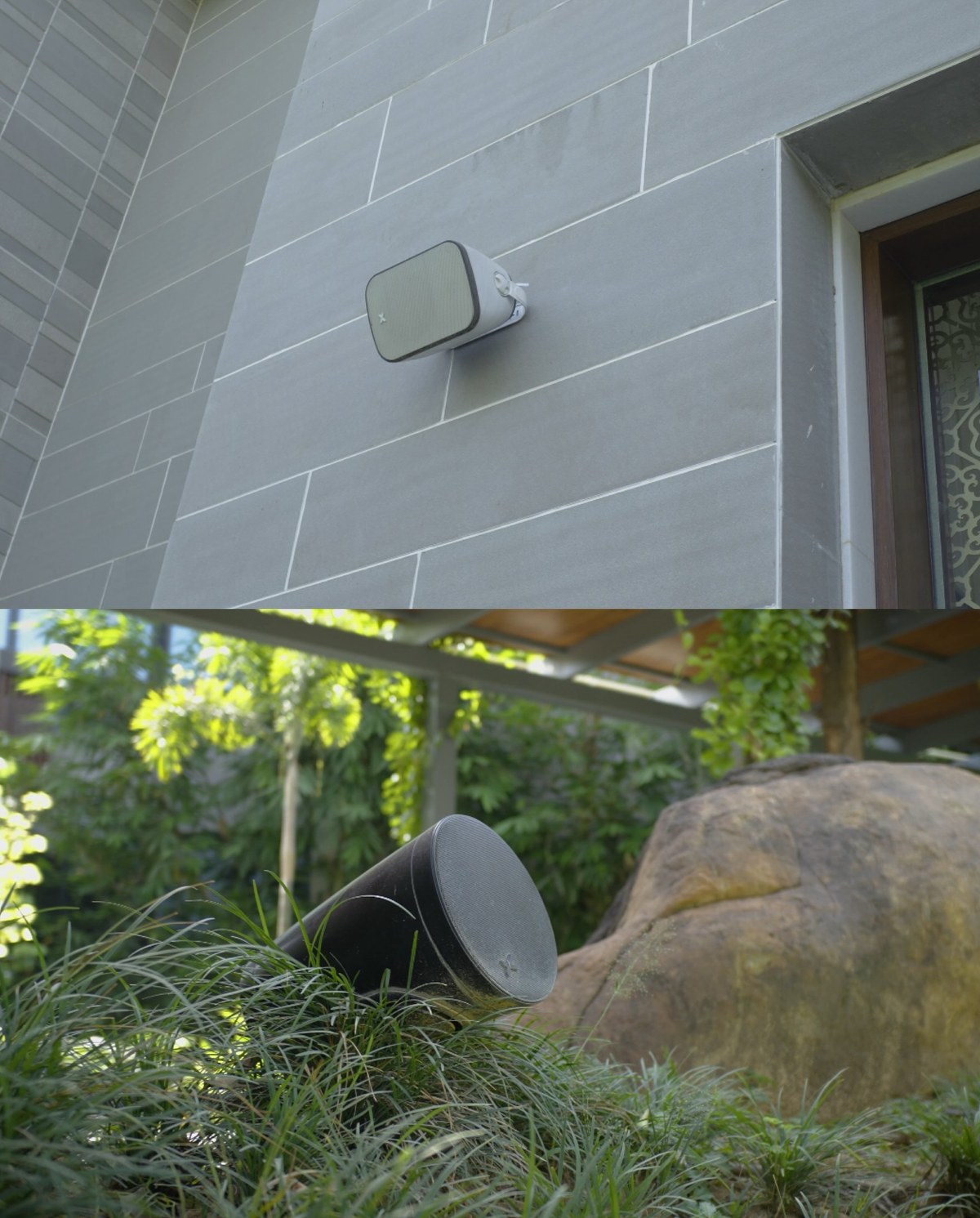
Outdoor garden audio has a placement problem indoor rooms don't: there's rarely a wall close enough to every part of a garden to rely on wall-mounted speakers alone, and a garden's landscaping — beds, rockery, planting — often needs to stay visually undisturbed. This install combined two different XSCACE Outdoor Series products to solve both halves of that problem: Camphor mounted on the home's stone facade near an entrance, and Spirea disguised as a landscape rock set directly into planting beds further from the house.
Case Study at a Glance
- Setting: landscaped garden — near-building wall and open lawn/planting
- Products: Camphor 6/8 (wall-mount) + Spirea (landscape rock)
- Mounting: stone facade wall + garden bed among planting
- Finish: white (Camphor) / natural stone-form (Spirea)
- Goal: full-property outdoor coverage without any visible speaker enclosure
Matching product type to distance from the building
The general rule this install follows — wall-mount near the building, landscape rock further out — isn't arbitrary. Running cable and power to a wall-mounted speaker near the house is straightforward; running it out to an isolated point in open lawn or garden bed is a bigger trenching job regardless of which speaker type sits at the end of it, so landscape rock speakers are typically reserved for spots that already need a run out that far, maximising the value of that cable trench.
Camphor: wall-mounted coverage near the building
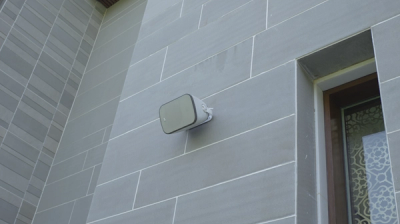
Camphor was mounted on a grey stone-tiled exterior wall near a window and door, in its white cabinet finish chosen to sit quietly against the pale stone tiling — a conventional outdoor wall-mount application, covering the immediate area around the entrance and covered walkway.
Spirea: a speaker disguised as a rock
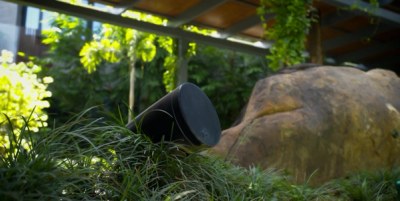
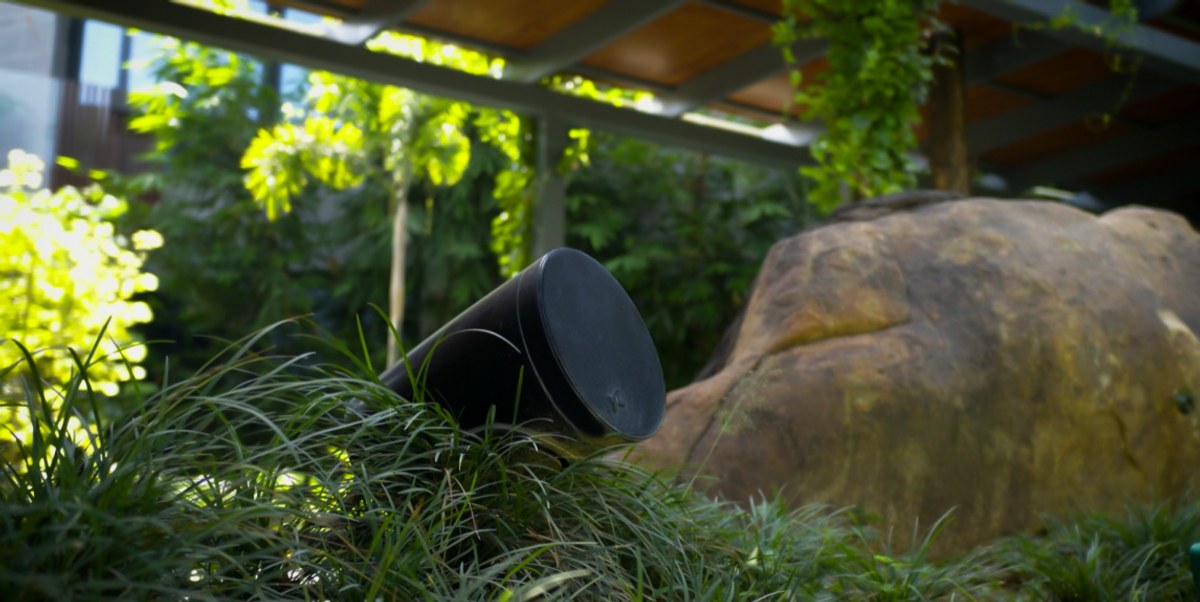
Further into the garden, away from any wall, Spirea took over — a landscape speaker built into a rock-form enclosure, placed directly among ornamental grasses beside a genuine boulder so it reads as part of the garden's own stonework rather than an electronic fixture. This solves the placement problem wall-mount speakers can't: coverage in the middle of a lawn or planted bed, with no visible enclosure at all.
Both IP66-rated for full outdoor exposure
Unlike XSCACE's slim-array indoor/covered-outdoor products, both Camphor and Spirea carry IP66 ingress protection and marine-treatable construction rated for full, permanent outdoor exposure — direct rain, humidity, and temperature swings — which is the right specification for anything not under a covered patio or roofline.
The system
Camphor 6 (70W RMS, 87dB, 37Hz–22kHz) covers the near-building zone, with Spirea (70W RMS, 87dB, 50Hz–22kHz) extending coverage out into the garden itself — both wired to a garden-zoned amplifier for independent volume control from the interior system.
Planned, controlled and calibrated without walls
Every XSCACE installation follows the same three stages: planned in the simulator, controlled from the app that matches the hardware, and calibrated with measurement. Outdoors there are no boundaries to reinforce anything, so level falls away with distance and coverage has to be designed rather than hoped for.
Planned
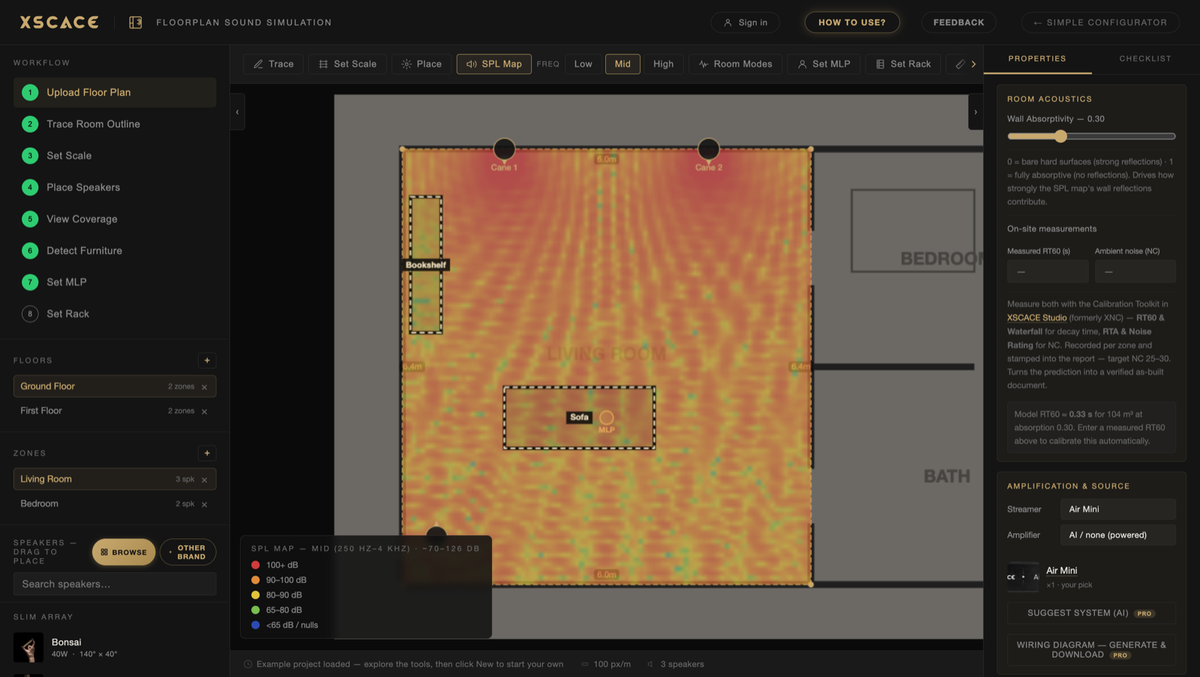
XSCACE Floorplan Sound Simulation takes a plan from trace to bill of quantities in the browser. For a room like this the outputs that matter are:
SPL coverage across the whole terrace or lawn, zone by zone
Source spacing set by the distance the level has to carry
Quantities and cable runs resolved before landscaping closes
Controlled
Which control app applies depends on the amplifier the speakers are driven from: XSCACE Controller for the Air streaming amplifiers, and XSCACE Studio for the Xylem, Root and Lucifer DSP amplifiers.
Calibrated
The calibration toolkit inside XSCACE Studio measures what the room actually does — eleven instruments covering SPL, delay, levels, polarity, frequency response, THD, sub alignment, transfer function, RT60, RTA and export, free on macOS. Here the ones that earn their place are:
SPL measured at the far edge of the listening area
Levels matched across sources so the garden reads as one system
RTA noise rating against traffic, water features and plant noise
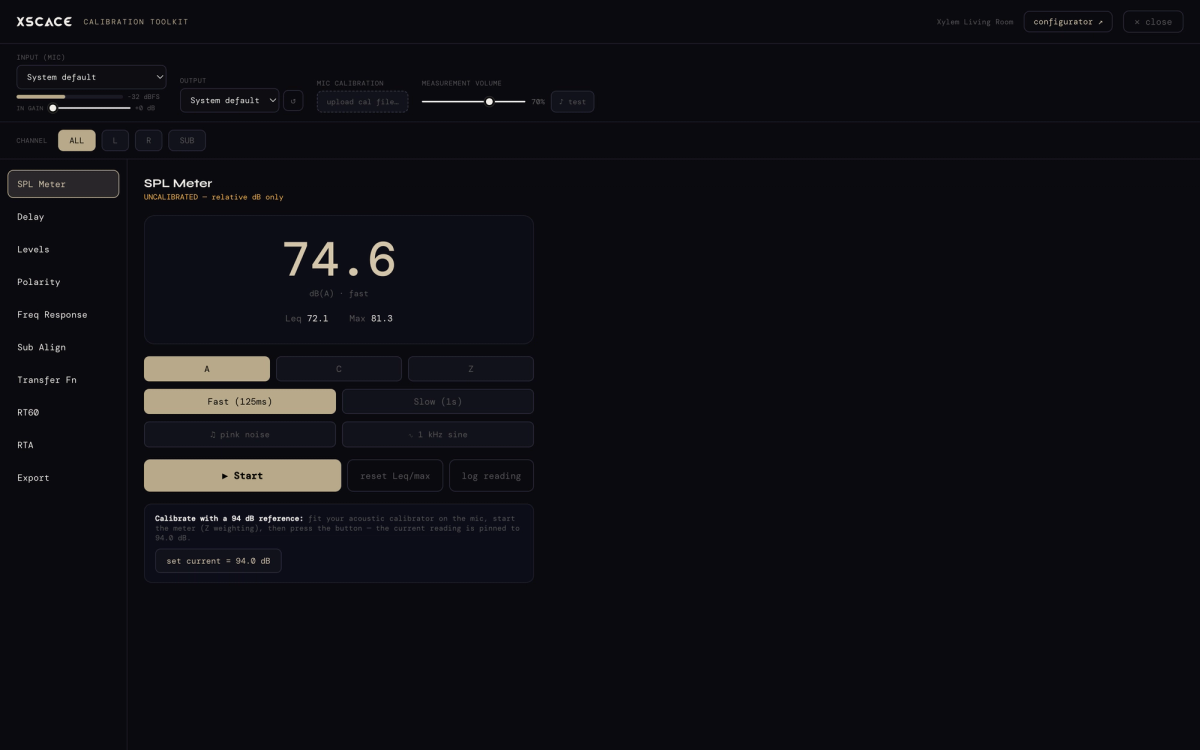
Camphor 6 publishes 87dB sensitivity and a 107dB maximum SPL — the figures the coverage prediction works from, and the ones the finished room should measure.