Contents6 sections
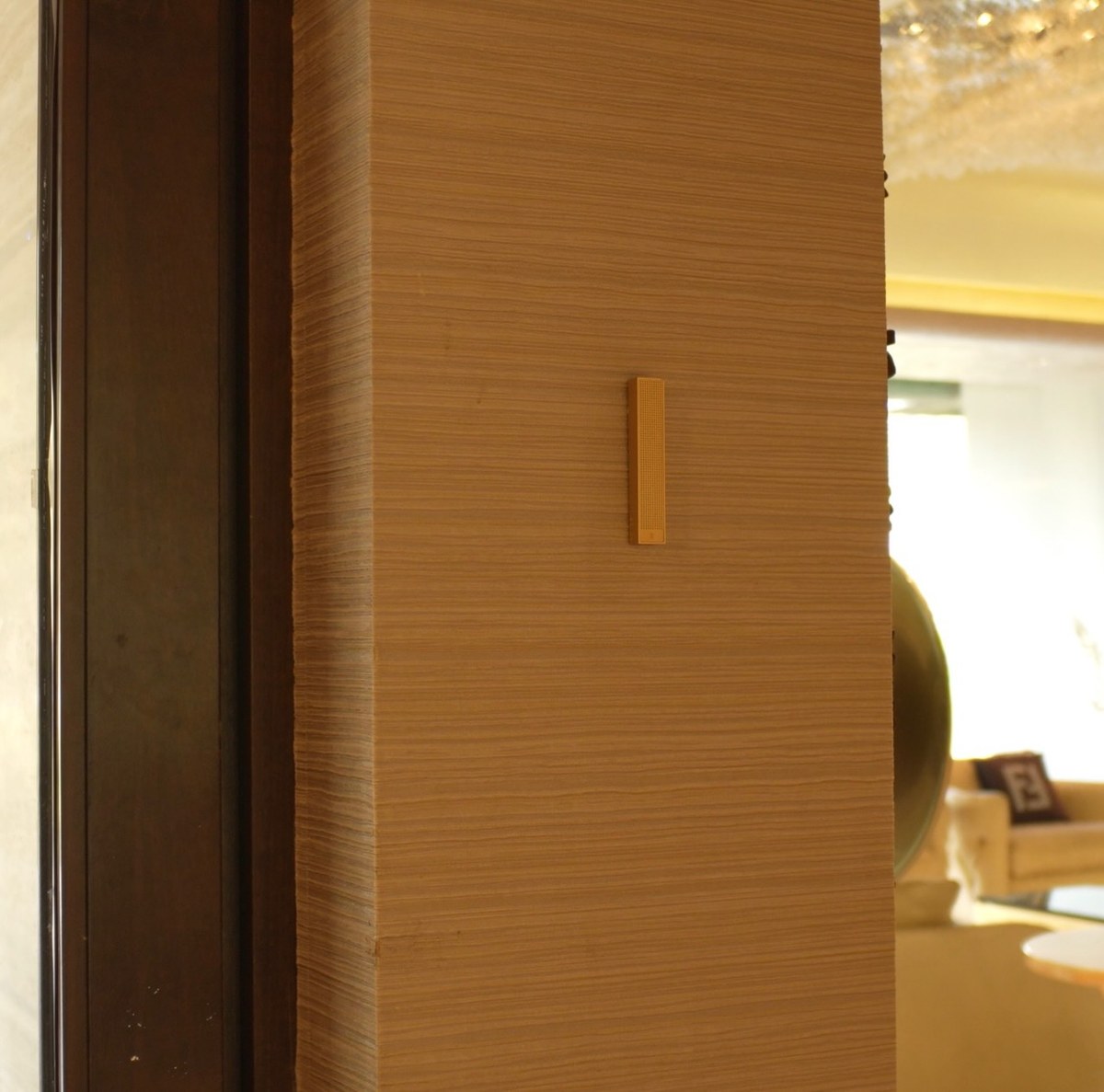
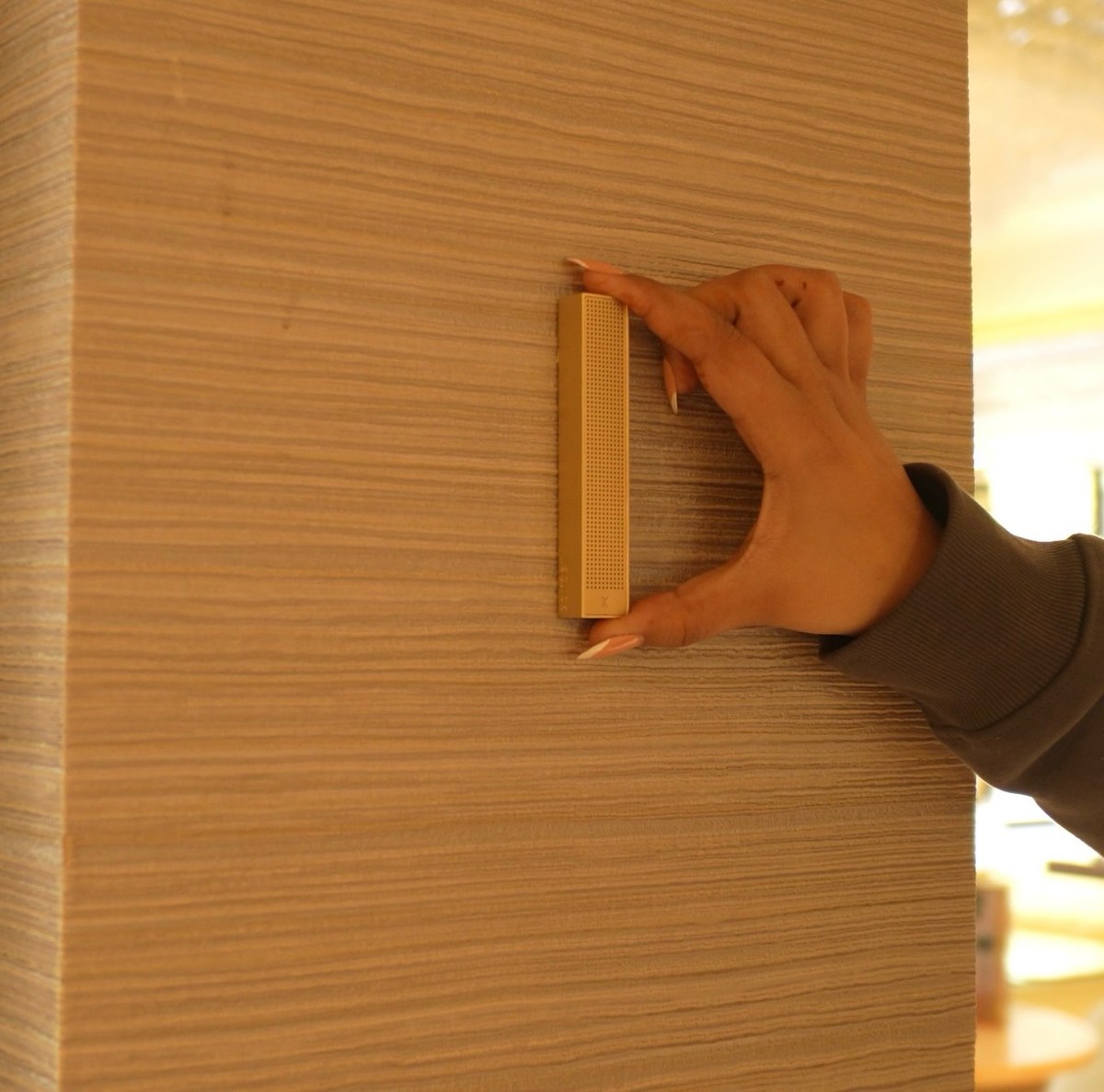
A formal living and bar lounge with a crystal chandelier, gold-leaf mirror, and monogrammed leather barstools is a room built from statement pieces — the challenge for any AV install here is contributing sound without adding another visual statement to compete with them. Bonsai was mounted on a horizontally-grained zebrawood pillar, chosen as a quiet surface in a room full of loud ones.
Case Study at a Glance
- Room: formal living and bar lounge
- Product: Bonsai (12mm slim-array)
- Mounting surface: horizontally-grained zebrawood pillar
- Finish: champagne / gold aluminium
- Goal: ambient coverage that doesn't compete with a chandelier and gold-leaf mirror
Ambient coverage versus a single critical listening seat
A bar lounge with a chandelier and mirror as its visual centrepieces is a room designed to be experienced from multiple positions at once — guests circulate rather than sit in one critical listening seat. That changes the acoustic brief from 'accurate stereo imaging at one chair' to 'even, unobtrusive coverage across the whole floor,' which is why Bonsai's modest, ambient-level output was the right call here rather than a higher-power speaker aimed at a single sweet spot.
Reading with the wood grain
Zebrawood's strong horizontal grain pattern is itself a decorative element, and Bonsai's slim vertical profile was oriented to run with the grain direction rather than against it, so the speaker's own lines don't fight the wood's natural pattern.
Coverage for a bar lounge
A living and bar lounge typically needs even ambient coverage rather than a single critical listening position — guests move between the bar, seating, and conversation areas — so Bonsai's modest 40W RMS and 86dB sensitivity suit background-level coverage across a social space better than a single higher-output speaker aimed at one seat.
The system
An Air Amp streams to the Bonsai wirelessly, paired with an Acacia 6 Powered subwoofer for low-end fill, keeping the electronics minimal in a room where every other object was chosen for its visual presence.
Planned, controlled and calibrated for a room that gets loud
Every XSCACE installation follows the same three stages: planned in the simulator, controlled from the app that matches the hardware, and calibrated with measurement. A bar room runs louder than the rest of the house and usually sits next to somewhere that must stay quiet.
Planned
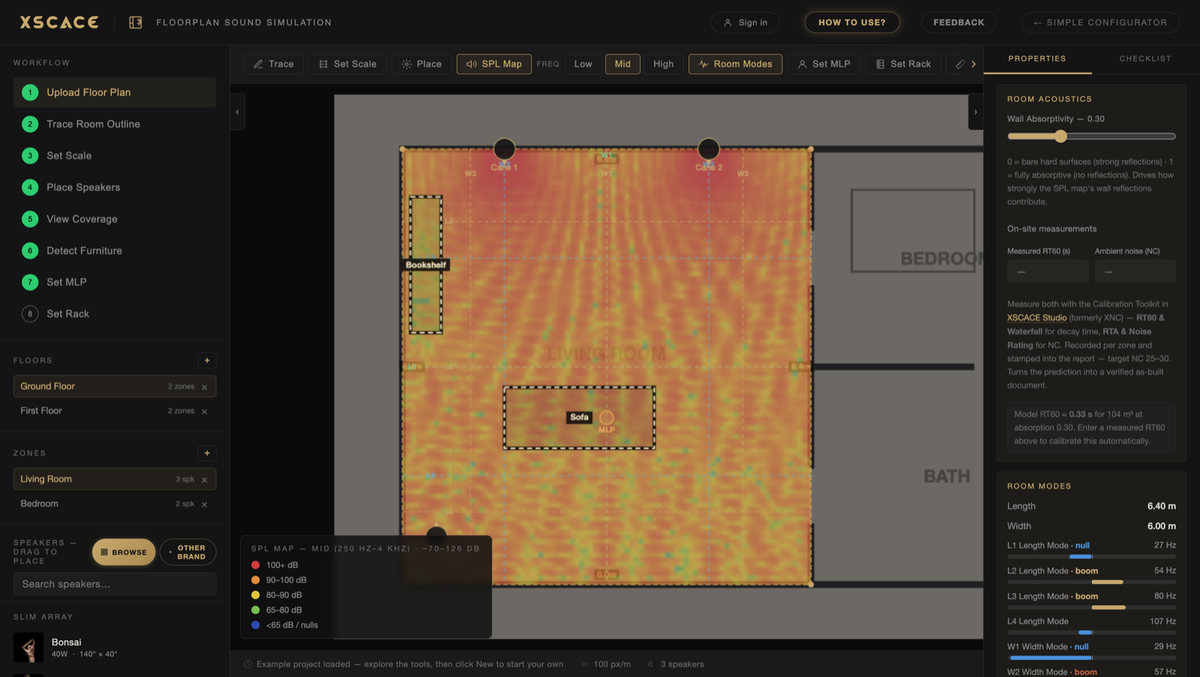
XSCACE Floorplan Sound Simulation takes a plan from trace to bill of quantities in the browser. For a room like this the outputs that matter are:
Coverage across standing positions, not seated ones
Room modes located, so bass is even rather than boomy in one corner
Placement checked against the structure the bass will otherwise excite
Controlled
Day-to-day control is XSCACE Controller on iOS and Android. It handles volume, EQ and grouping, and the streaming amplifiers also appear natively as AirPlay 2 and Spotify Connect targets, so the app is for control rather than for getting audio into the room.
Calibrated
The calibration toolkit inside XSCACE Studio measures what the room actually does — eleven instruments covering SPL, delay, levels, polarity, frequency response, THD, sub alignment, transfer function, RT60, RTA and export, free on macOS. Here the ones that earn their place are:
Sub Align, so the low end integrates instead of dominating
SPL at the positions people actually stand
THD measured as H2+H3 across 30Hz–5kHz, where a system driven hard shows strain
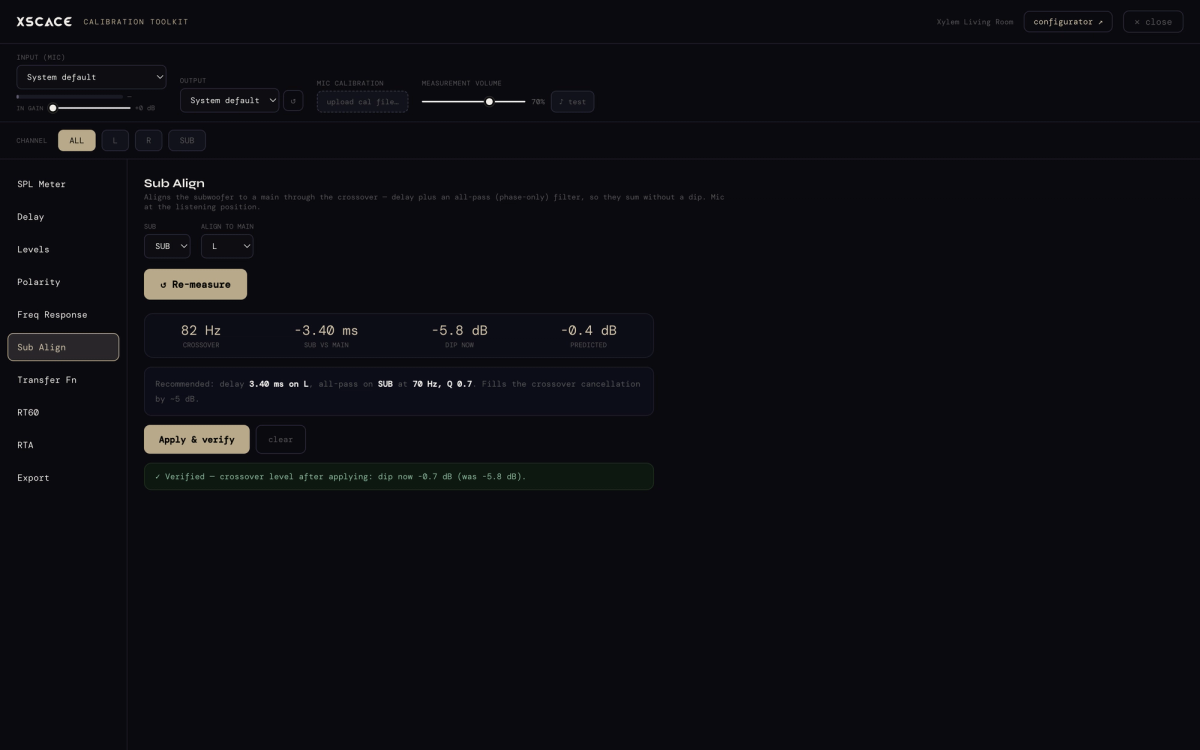
Bonsai runs down to 300Hz and Acacia 6 Powered reaches 35Hz, meeting at the 300Hz crossover both records specify — a number to verify by measurement rather than assume.