Contents6 sections
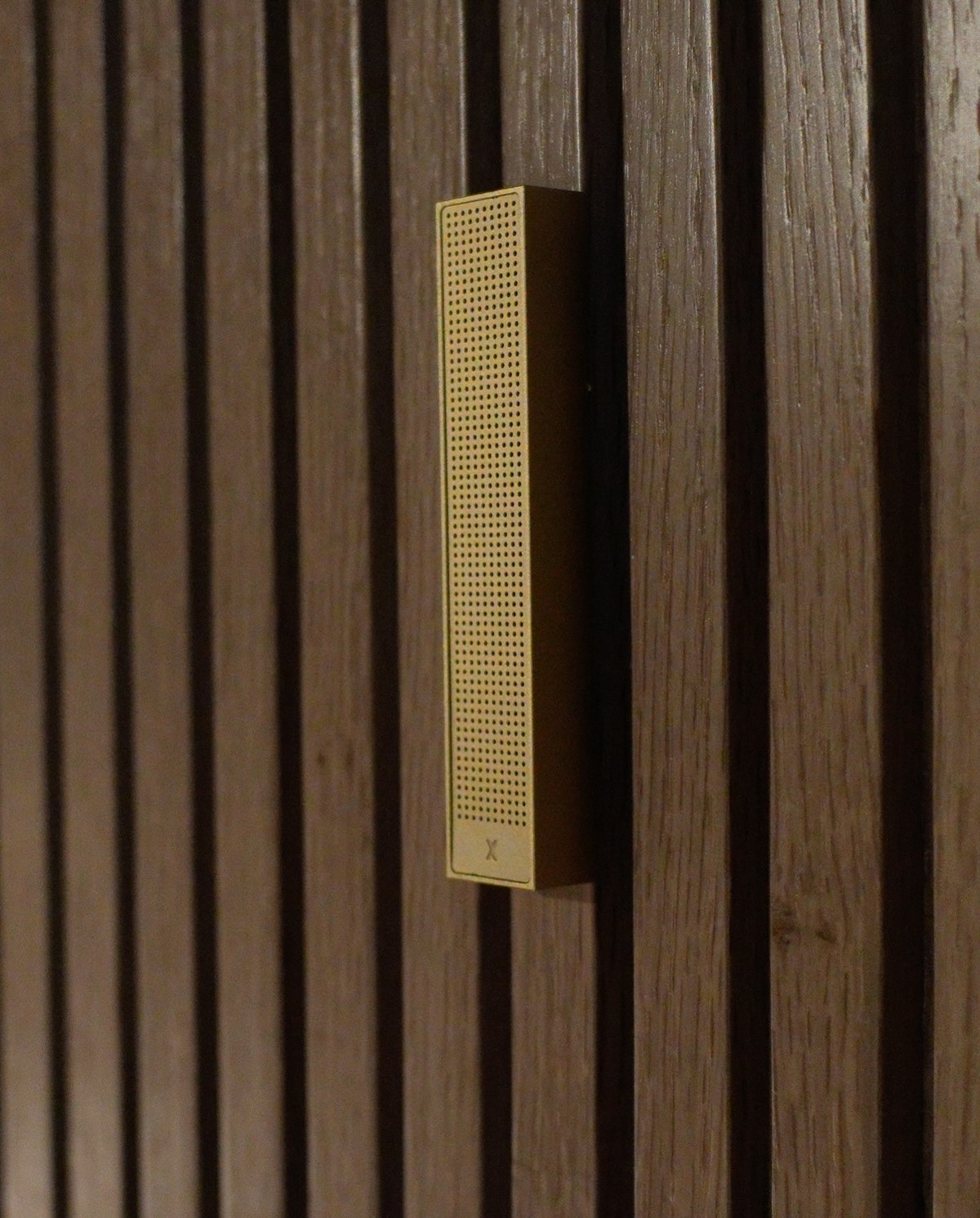
Fluted or reeded wood cladding is having a moment in luxury residential design — vertical slats catch light and shadow in a way flat panels can't. It's also one of the hardest surfaces to add a speaker to without ruining the rhythm: a rectangular grille breaks the vertical lines the wall was designed around. This foyer install solved that by choosing a speaker narrow enough to sit within a single slat's width.
Case Study at a Glance
- Room: foyer / stairwell entry
- Product: Bonsai (12mm slim-array)
- Mounting surface: fluted vertical wood-slat cladding
- Finish: champagne aluminium
- Goal: sound in a transitional space without breaking the wall's vertical rhythm
Why transitional spaces get simpler system design
Because a foyer is a pass-through rather than a destination, the system design here was deliberately simple: a single stereo pair driven directly off an Air Amp, no dedicated DSP zone, no separate subwoofer crossover to tune. That simplicity is itself a design decision — over-engineering a space nobody lingers in adds cost and complexity without a corresponding gain in experience, whereas the same budget is better spent on the rooms either side of the foyer where people actually sit.
Why Bonsai fits a fluted wall
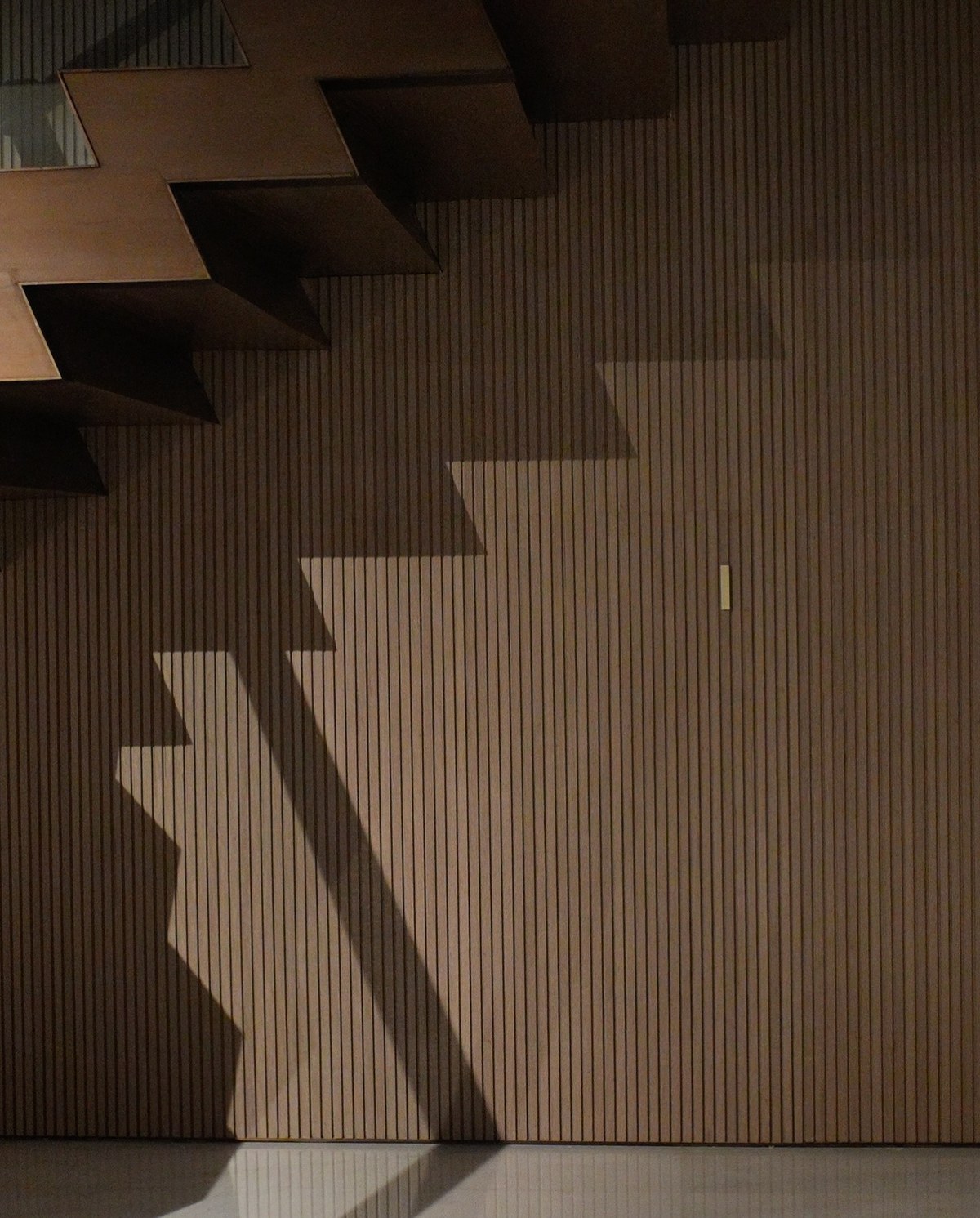
At just 22mm wide, Bonsai's footprint is close to the width of a single wood slat in most fluted panel systems, meaning it can be positioned to read as part of the rhythm rather than interrupting it. Its champagne aluminium finish was matched to sit near-invisibly against the dark stained wood, visible only as a slightly different texture up close.
Acoustic role in a foyer
A foyer or stairwell rarely needs high output — it's a transitional space, not a listening room — so Bonsai's 86dB sensitivity and 40W RMS ceiling is more than sufficient for ambient coverage, welcoming sound as you move through the space rather than a dedicated listening position.
The system
An Air Amp drives the passive Bonsai wirelessly, with an Acacia 6 Powered subwoofer positioned in an adjacent utility space to extend bass down to 35Hz for a fuller sound in a space with hard, reflective wood and stone surfaces.
Planned, controlled and calibrated in a reverberant space
Every XSCACE installation follows the same three stages: planned in the simulator, controlled from the app that matches the hardware, and calibrated with measurement. Lobbies are stone, glass and height — the least forgiving acoustic in a building, and the first thing a visitor experiences.
Planned
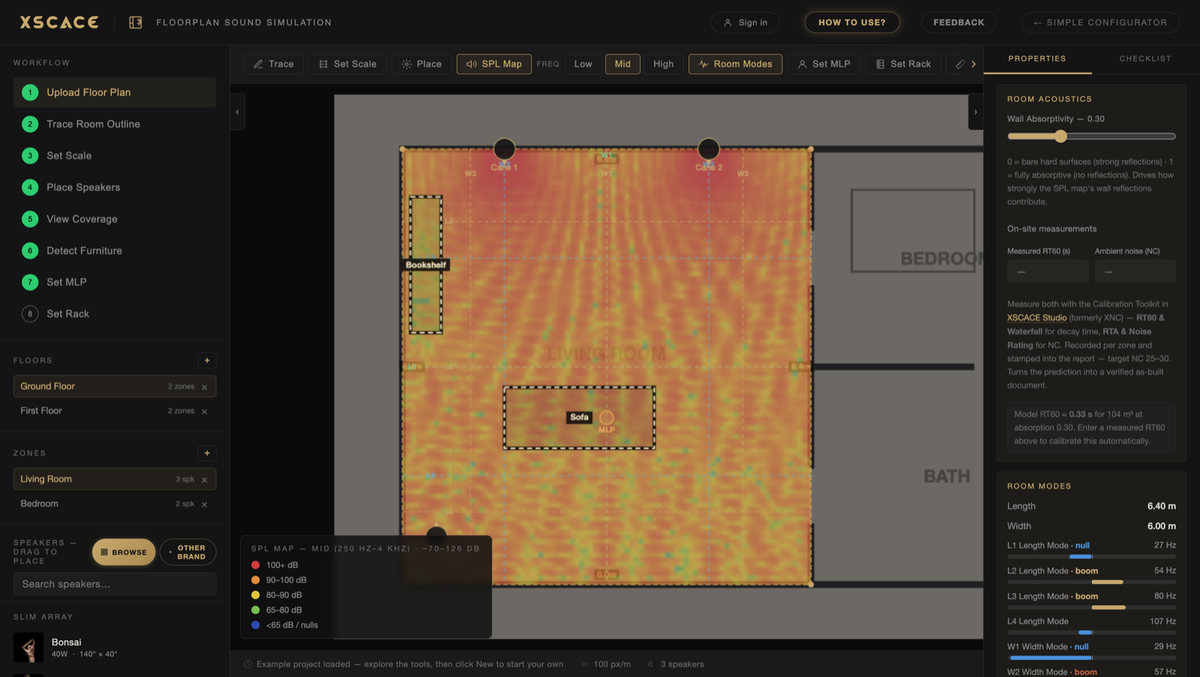
XSCACE Floorplan Sound Simulation takes a plan from trace to bill of quantities in the browser. For a room like this the outputs that matter are:
Coverage across the arrival path rather than a single point
Room modes and reflections located in a space with no absorption
A client-ready drawing for sign-off before the finishes go on
Controlled
Day-to-day control is XSCACE Controller on iOS and Android. It handles volume, EQ and grouping, and the streaming amplifiers also appear natively as AirPlay 2 and Spotify Connect targets, so the app is for control rather than for getting audio into the room.
Calibrated
The calibration toolkit inside XSCACE Studio measures what the room actually does — eleven instruments covering SPL, delay, levels, polarity, frequency response, THD, sub alignment, transfer function, RT60, RTA and export, free on macOS. Here the ones that earn their place are:
RT60 to ISO 3382, the defining number in a hard tall room
SPL along the arrival route
Frequency response, since reverberation colours tone as well as timing
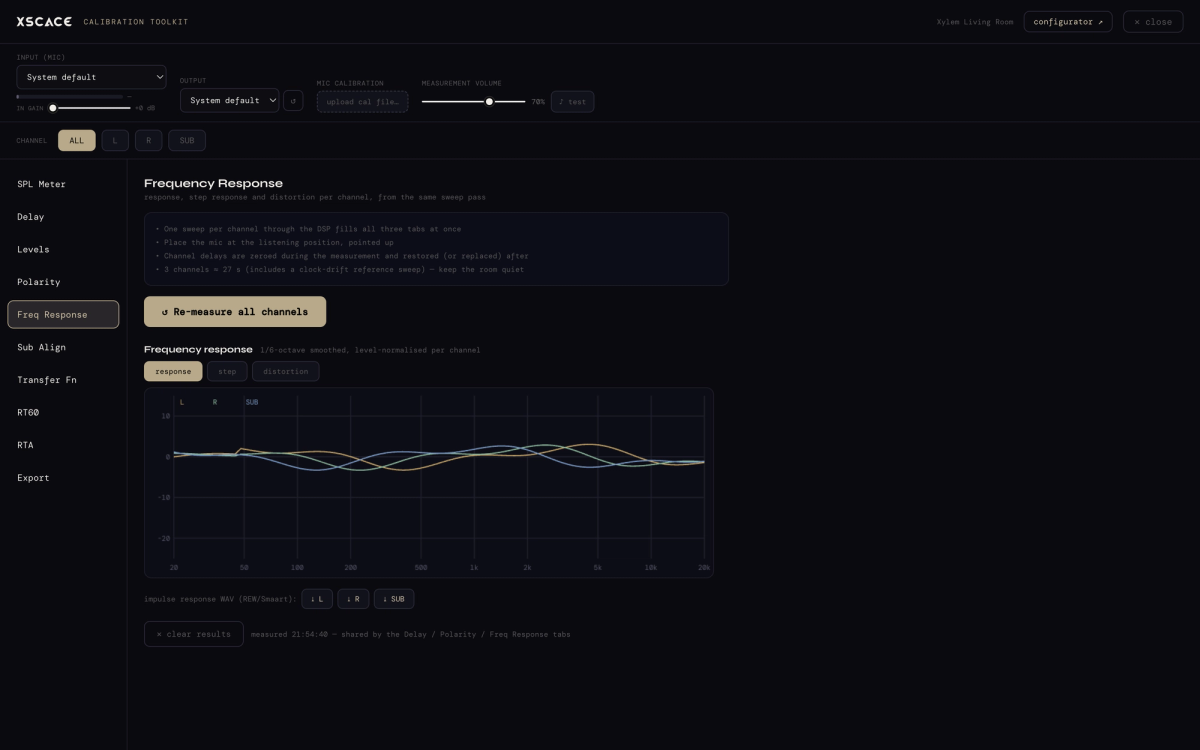
Bonsai runs down to 300Hz and Acacia 6 Powered reaches 35Hz, meeting at the 300Hz crossover both records specify — a number to verify by measurement rather than assume.