Contents3 sections
Sound does not simply leave a speaker cone and radiate perfectly into a room. At different frequencies, sound behaves differently — it diffracts around edges, reflects off the baffle surface, and changes directivity based on the relationship between wavelength and driver diameter. Managing these behaviours is the central engineering challenge of waveguide technology in-ceiling speakers, and it becomes exponentially harder when the enclosure depth is 12mm. Most architectural speaker manufacturers sidestep the problem entirely. At XSCACE, we built a proprietary solution — XS-Flow™ — specifically to address it.
The Diffraction Problem in Flush-Mounted Speakers
When a speaker is flush-mounted in a ceiling or wall, the baffle edge creates a phenomenon called diffraction. Sound bends around that edge and arrives at the listening position fractionally later than the direct sound — which means it arrives out of phase. The interference between the direct wave and the diffracted wave creates what acoustic engineers call a "baffle step": a frequency-dependent dip in the speaker's output response, typically occurring somewhere between 200Hz and 800Hz.
This range happens to sit squarely in the midrange frequencies where vocals, guitar, piano, and speech intelligibility live. A baffle step dip in this band doesn't simply make a speaker quieter — it makes it sound coloured, hollow, or "boxy". The character of the room seems to be bleeding into the sound of the speaker itself.
The standard industry response to baffle diffraction is equalisation applied after the fact — boosting or cutting frequencies in the amplifier's DSP to compensate for what the physical design failed to address. EQ can narrow the gap, but it cannot restore what diffraction destroys: the phase coherence between adjacent frequency bands. You can correct the amplitude response with EQ. You cannot correct the time-domain behaviour of a diffracted wave. The result remains audibly coloured no matter how sophisticated the signal processing behind it.
XS-Flow™: Internal Waveguide Geometry for Architectural Form Factors
XS-Flow™ is XSCACE's internal waveguide geometry system — the engineered shape of the acoustic cavity inside each speaker model. Rather than treating the enclosure as a box that happens to contain a driver, we engineer the internal cavity as an active participant in the acoustic output. Every surface, every angle, and every transition inside the enclosure is calculated to control how sound propagates before it leaves the speaker.
The three primary design goals of XS-Flow™ are controlled directivity, reduced diffraction artefacts, and phase-coherent output through the crossover region. Controlled directivity means the speaker delivers a consistent tonal balance across its coverage pattern — not just at the sweet spot directly below the driver, but across the full listening area. Reduced diffraction artefacts means less baffle-step colouration reaching the ear. Phase-coherent crossover behaviour means the transition from tweeter to woofer is seamless in both frequency and time.
Critically, the XS-Flow™ geometry is unique to each XSCACE product. In-ceiling, in-wall, and slim-array models each carry a different XS-Flow profile, because their installation geometry and listening distances differ. An in-ceiling speaker firing straight down at a 2.7m listening distance has different acoustic boundary conditions than an in-wall speaker firing horizontally across a room at 1.2m height. The waveguide geometry that optimises one scenario actively degrades performance in the other — which is why a single shared geometry across a product range is an engineering compromise rather than a solution.
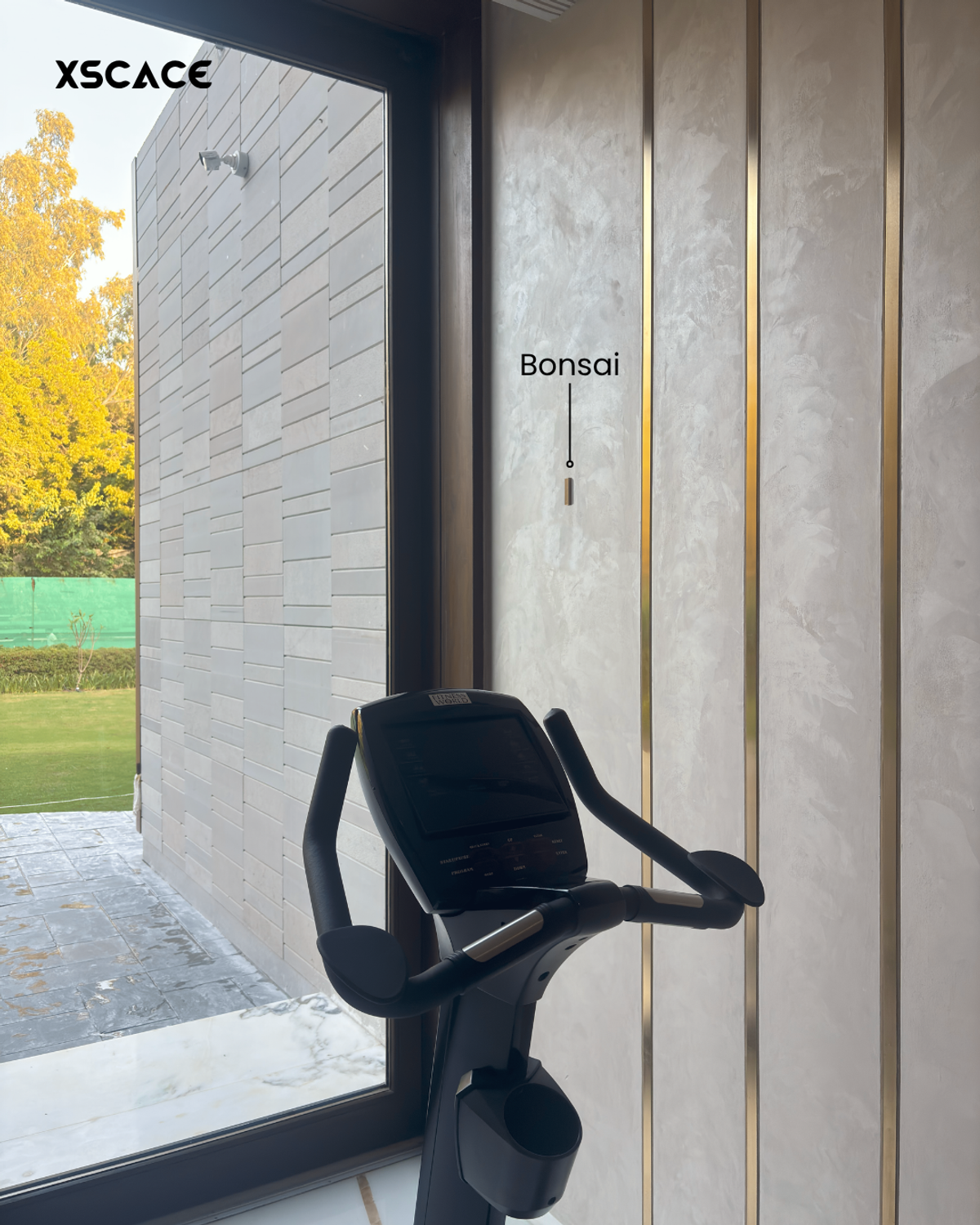
In the Bonsai slim-array — XSCACE's 12mm depth architectural speaker — XS-Flow™ is not a refinement. It is what makes the product possible. At 12mm of enclosure depth, there is almost no physical volume for sound to develop inside before it radiates into the room. Without waveguide geometry controlling that brief acoustic journey, the output would be dominated by cavity resonance — the thin, honky character that defines every mass-market ultra-slim speaker on the market. XS-Flow™ eliminates that resonance signature by managing how the pressure wave develops and exits the enclosure.
Coverage and Consistency in Multi-Speaker Installations
Architectural audio installations rarely involve a single speaker. In residential and commercial environments, multiple speakers are distributed across a space to achieve even coverage — and this is where waveguide geometry has practical consequences beyond a single speaker's measured response. When multiple speakers overlap in coverage, their outputs combine in the room. If each speaker's directivity is poorly controlled — radiating energy at angles it shouldn't — the overlap zones accumulate frequency response irregularities through comb filtering. The result is a room where some positions sound full and others sound thin, regardless of how the system is calibrated.
XS-Flow™ controlled directivity directly addresses multi-speaker installation performance. Because each speaker's coverage pattern is shaped by the waveguide geometry rather than left to propagate freely, XSCACE speakers integrate predictably in distributed systems. The practical outcomes for specifiers and integrators are measurable:
- Consistent tonal balance across a wide listening area — no acoustic sweet spot that degrades outside a narrow zone
- Reduced comb filtering when multiple speakers overlap coverage zones in open-plan spaces
- Phase-coherent output through the crossover band for natural stereo imaging in paired-speaker applications
- Even coverage distribution suited to multi-zone residential and commercial installations without localised hot spots
- Compatible with XSCACE amplifier DSP processing (PsySculpt™) for room-specific tuning on top of the waveguide-controlled baseline response
For AV integrators specifying slim-array systems, the Bonsai slim-array is the direct application of XS-Flow™ in its most demanding form factor. At 12mm depth — less than the thickness of a standard drywall sheet — the Bonsai must achieve what no other product in this physical class delivers: a full-range architectural sound signature that could be mistaken for a conventional in-ceiling installation. XS-Flow™ is the mechanism that closes that gap. Without it, the Bonsai would sound exactly like every other ultra-thin speaker panel: loud, harsh in the upper midrange, and resonant in the frequencies where cavity modes dominate.
The XSCACE speaker you specify at 12mm depth occupies less physical volume than a paperback book. It installs flush with a plaster ceiling, leaves no visible depth profile, and requires no bulkhead or cavity preparation beyond standard drywall. XS-Flow™ is why it sounds like a proper architectural speaker rather than a cavity resonator — and why specifying on depth alone misses what the engineering actually achieves.