Contents6 sections
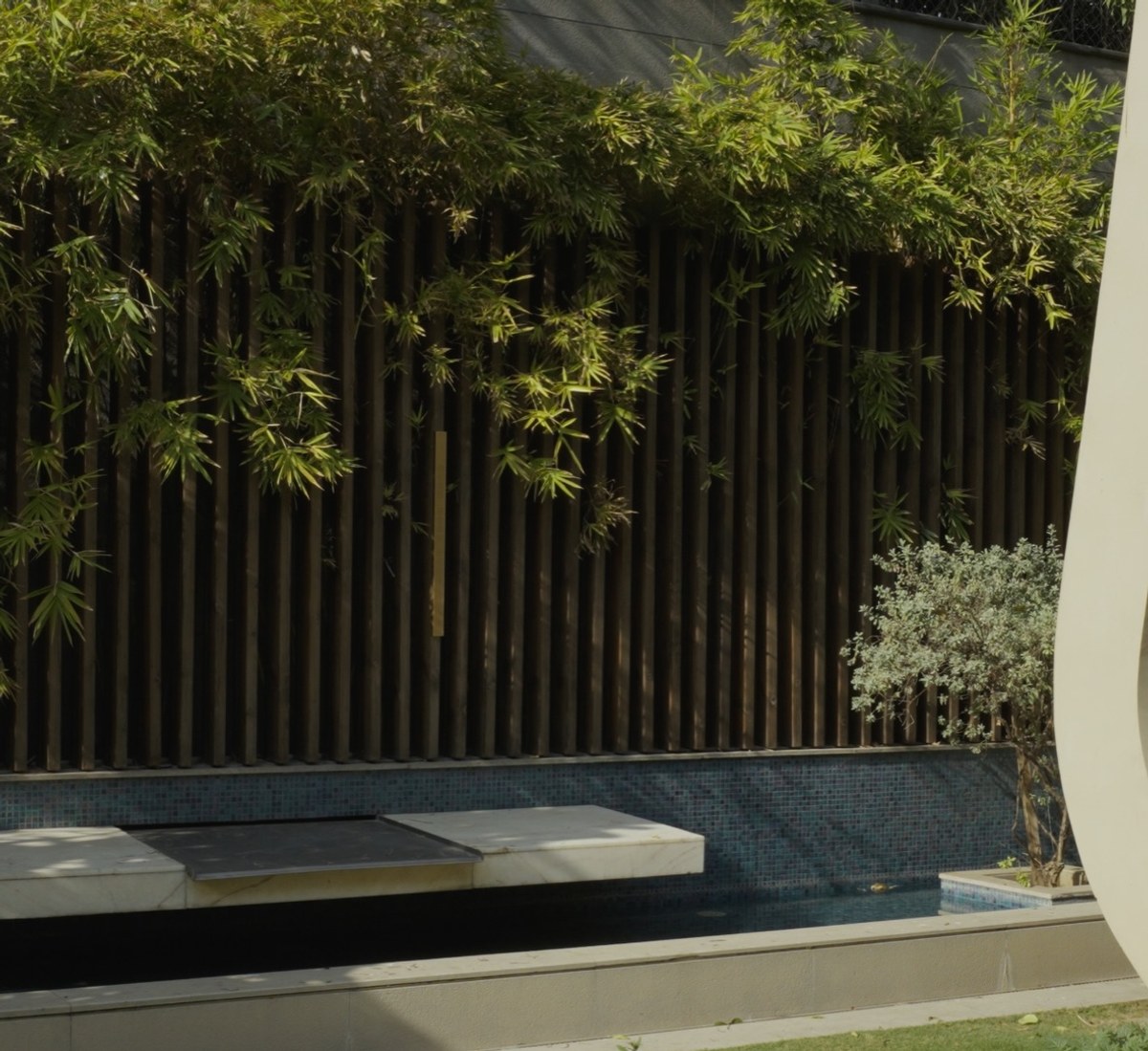
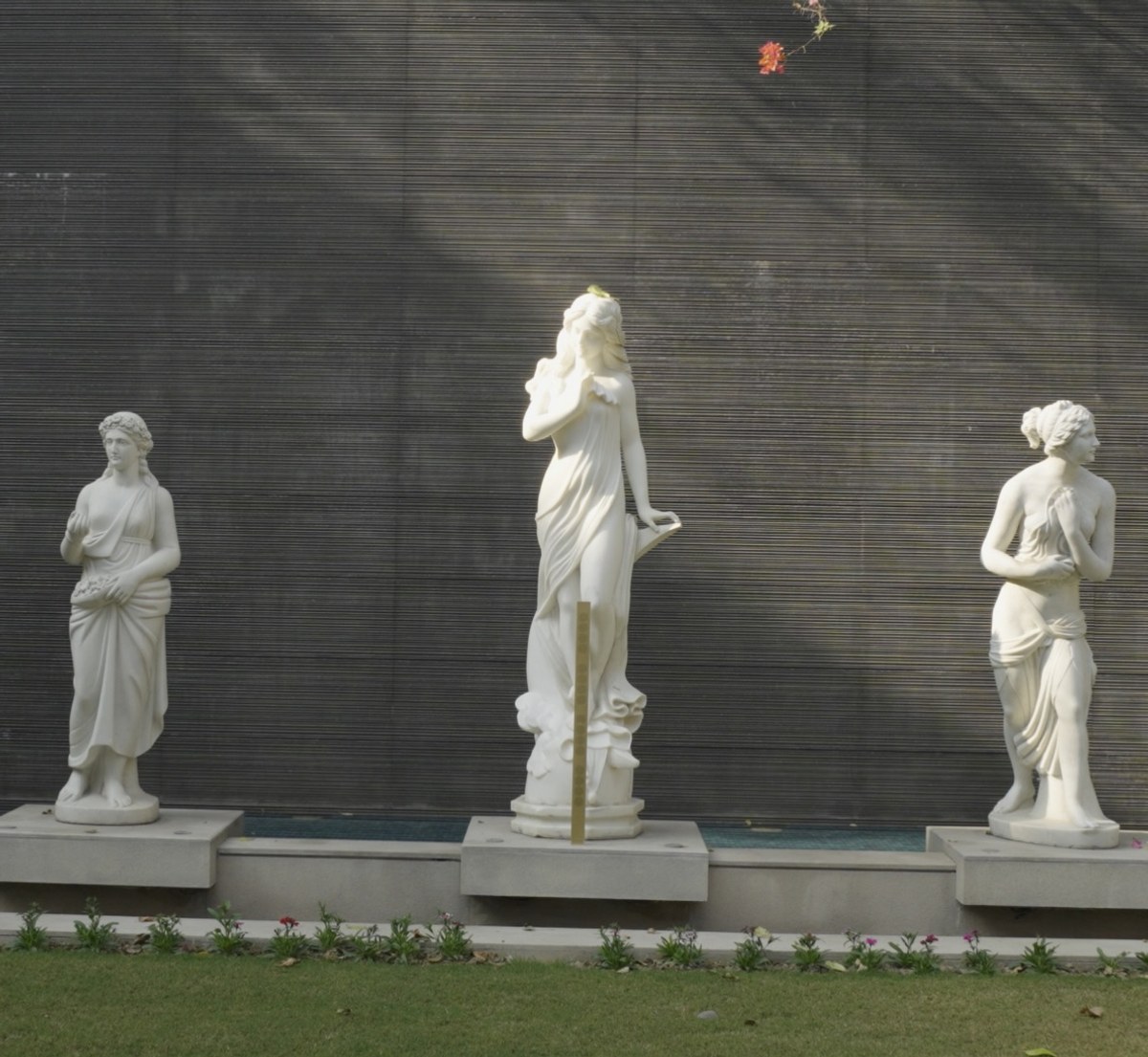
A poolside garden terrace lined with classical white marble statuary on stone plinths, backed by a bamboo privacy screen, is landscaping designed to read as a considered outdoor room in its own right — sound needed to match that level of intent rather than being an obvious add-on. Champagne-finish QuadCane was mounted on the dark vertical timber privacy fence, positioned to blend with the fence's own material rather than compete with the marble statues.
Case Study at a Glance
- Space: poolside garden terrace with classical marble statuary
- Product: QuadCane (21mm, 16-driver, 100W RMS, 95dB)
- Mounting surface: dark vertical timber privacy fence
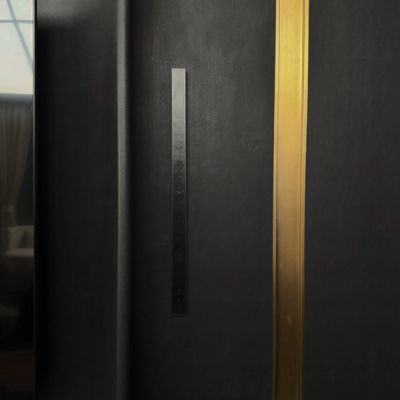
- Finish: champagne aluminium
- Goal: open-air coverage without competing with the terrace's marble focal points
Compensating for open-air acoustic loss
An open terrace with no ceiling or opposite wall loses acoustic energy to the open air in a way an enclosed room doesn't — there's nothing to reflect sound back toward the listener, so a speaker has to work harder for the same perceived loudness at a given distance. QuadCane's higher sensitivity (95dB vs. a typical slim-array's 86-92dB) and sixteen-driver output were specified here precisely to offset that open-air loss across the terrace's full landscaped length.
Positioning away from the visual centrepieces
With classical statuary as the terrace's clear focal points, the speaker placement deliberately avoided competing with them — the timber fence line, functional but visually secondary to the marble figures, was the natural mounting location.
Sound across an open landscaped area
Open-air terraces lose sound energy faster than enclosed rooms — there's no ceiling or opposite wall to reflect sound back — so QuadCane's higher 95dB sensitivity and 100W RMS handling over a single-driver alternative helps maintain coverage across the terrace's full landscaped length.
The system
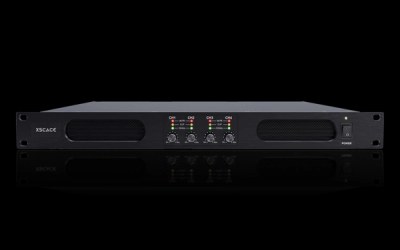
A Lucifer 4 amplifier drives the terrace's QuadCane array, sized for open-air coverage across the pool and garden zone.
Planned, controlled and calibrated without walls
Every XSCACE installation follows the same three stages: planned in the simulator, controlled from the app that matches the hardware, and calibrated with measurement. Outdoors there are no boundaries to reinforce anything, so level falls away with distance and coverage has to be designed rather than hoped for.
Planned
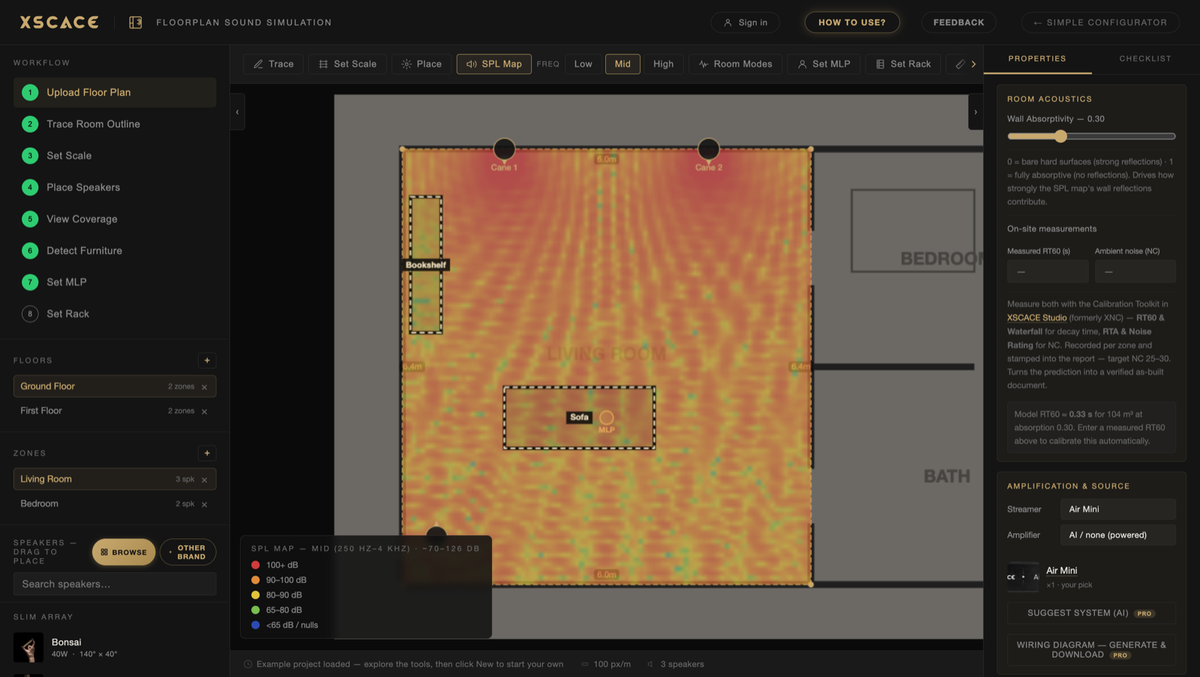
XSCACE Floorplan Sound Simulation takes a plan from trace to bill of quantities in the browser. For a room like this the outputs that matter are:
SPL coverage across the whole terrace or lawn, zone by zone
Source spacing set by the distance the level has to carry
Quantities and cable runs resolved before landscaping closes
Controlled
The amplifier is configured and controlled from XSCACE Studio on macOS — routing matrix, per-channel gain and delay, parametric EQ, crossovers and limiting, with network-wide discovery rather than one amplifier at a time.
Calibrated
The calibration toolkit inside XSCACE Studio measures what the room actually does — eleven instruments covering SPL, delay, levels, polarity, frequency response, THD, sub alignment, transfer function, RT60, RTA and export, free on macOS. Here the ones that earn their place are:
SPL measured at the far edge of the listening area
Levels matched across sources so the garden reads as one system
RTA noise rating against traffic, water features and plant noise
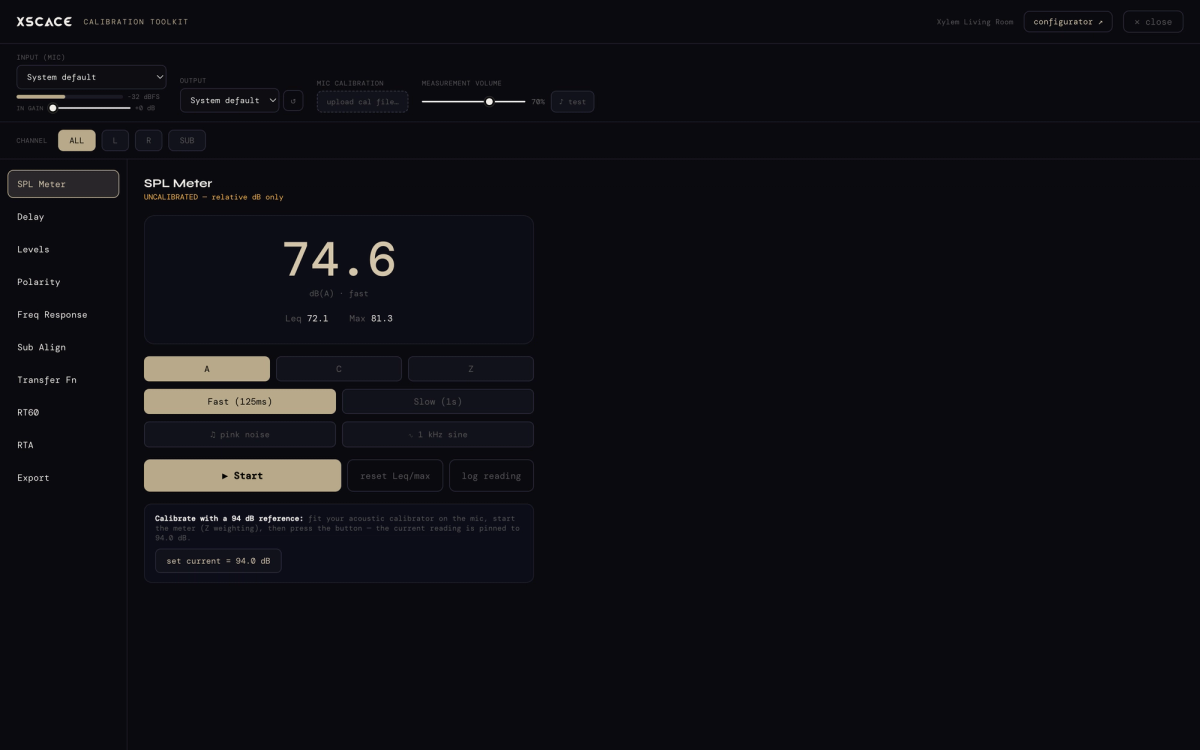
QuadCane publishes 95dB sensitivity and a 116dB maximum SPL — the figures the coverage prediction works from, and the ones the finished room should measure.