Contents6 sections
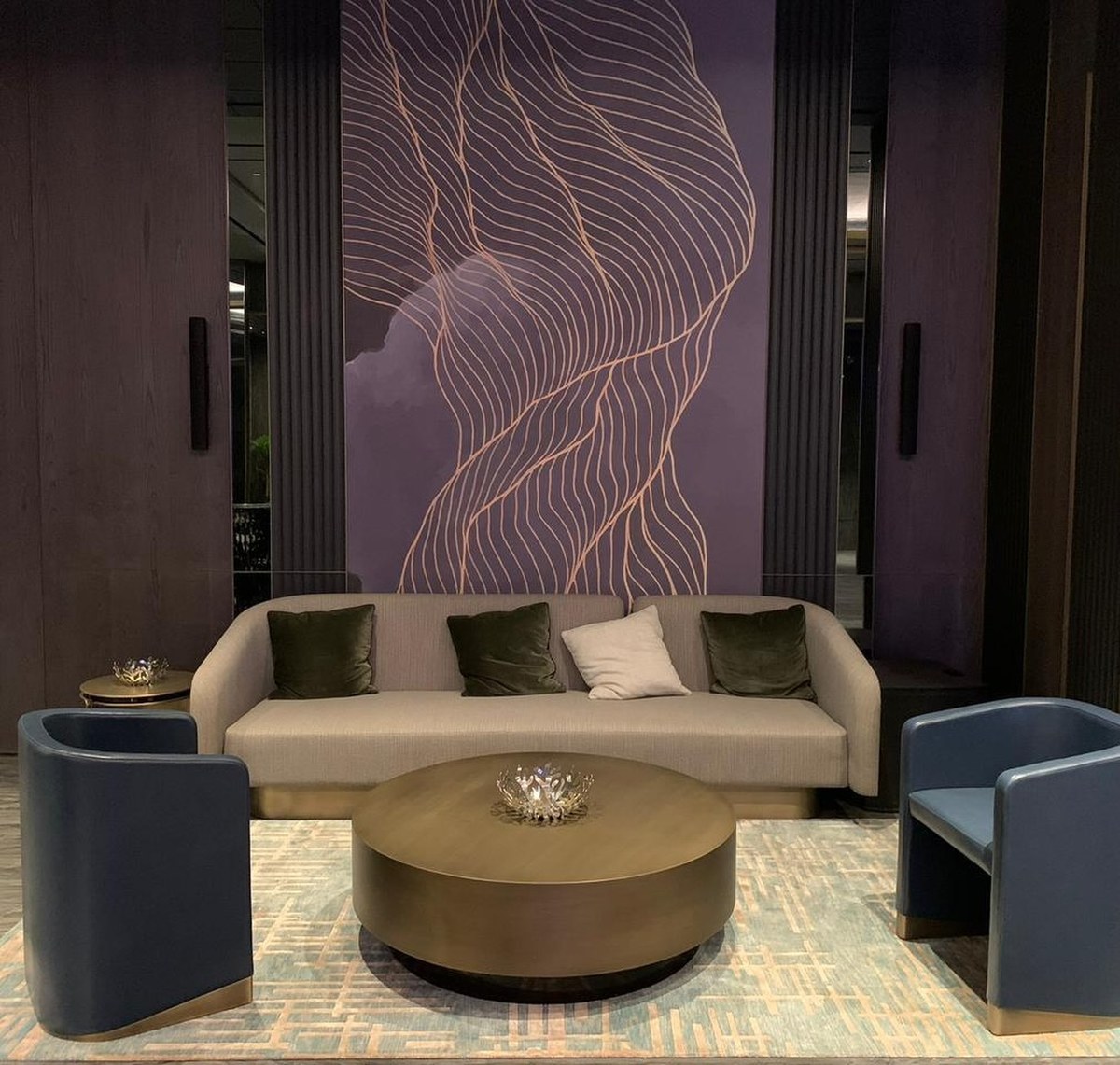
A home lounge with a purple wave-pattern mural, navy leather barrel chairs, and a brass drum coffee table used a symmetrical layout that a single off-centre speaker would have visibly disrupted — so the design placed two black-finish Cedar speakers on matching fluted dark wood pilasters, one either side of the artwork. It's a deliberate stereo layout that doubles as a framing device for the mural itself.
Case Study at a Glance
- Property: multi-room residence — corridor, living room, wine cellar, mural lounge
- Product: Cedar (74.9mm, 100W RMS, 96dB)
- Mounting surface: fluted dark wood pilasters (lounge)
- Finish: black aluminium
- Goal: a matched stereo pair framing a symmetrical wall mural
Reserving the higher-output model for the room that needs it
Not every room in this property used Cedar — it was reserved specifically for the mural lounge, the room the client identified as where they wanted the fullest, highest-fidelity sound in the house. That kind of selective specification, rather than running one model everywhere regardless of room demands, is common in larger multi-room projects where budget and acoustic priority are matched room by room rather than spread evenly.

Symmetry as a design constraint
When a room is built around a centred, symmetrical feature like a mural, speaker placement has to respect that symmetry or the whole composition reads as unbalanced — which is why this install used a matched pair flanking the artwork rather than a single speaker positioned for coverage alone.
Part of a larger multi-room system
This mural lounge was one room in a larger residential install that also included a tropical-leaf-wallpapered corridor, a minimalist living room, and a home bar and wine cellar with a backlit onyx ceiling — Cedar was reserved specifically for this lounge, the room where higher-output, higher-fidelity sound mattered most.
The system
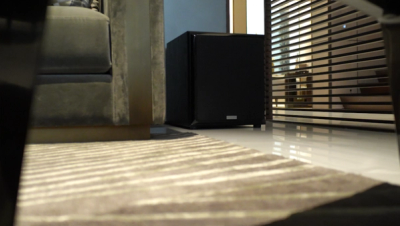
A Juniper subwoofer (350W RMS, 25Hz–200Hz) anchors the low end for the paired Cedar speakers, delivering full-range sound for a room used for both music and film.
Planned, controlled and calibrated
Every XSCACE installation follows the same three stages: planned in the simulator, controlled from the app that matches the hardware, and calibrated with measurement. A living room has one or two seats that matter and a great many surfaces that do not cooperate.
Planned
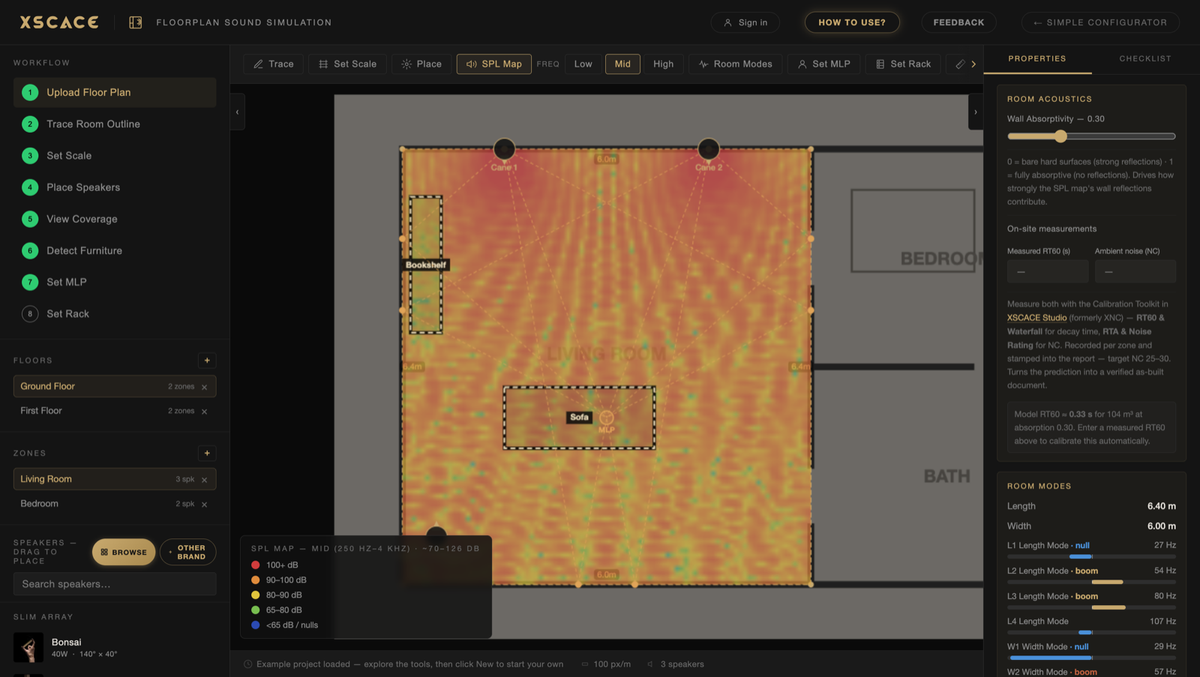
XSCACE Floorplan Sound Simulation takes a plan from trace to bill of quantities in the browser. For a room like this the outputs that matter are:
Coverage at the seating position rather than the room centre
First-reflection points flagged, which decides placement more often than taste does
Room modes located, so uneven bass is designed out rather than equalised later
Controlled
Which control app applies depends on the amplifier the speakers are driven from: XSCACE Controller for the Air streaming amplifiers, and XSCACE Studio for the Xylem, Root and Lucifer DSP amplifiers.
Calibrated
The calibration toolkit inside XSCACE Studio measures what the room actually does — eleven instruments covering SPL, delay, levels, polarity, frequency response, THD, sub alignment, transfer function, RT60, RTA and export, free on macOS. Here the ones that earn their place are:
Delay and polarity from a single sweep per channel
Sub Align, which integrates the subwoofer then re-measures to prove the correction
Frequency response at the listening position, not at the speaker
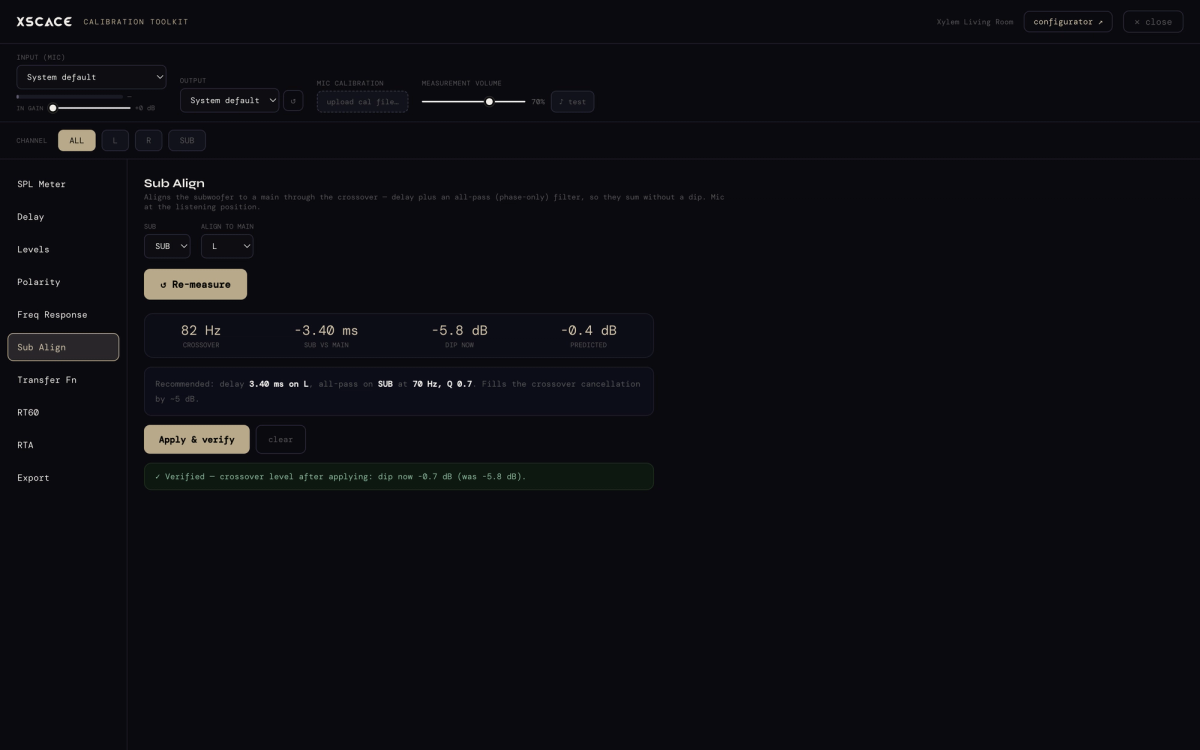
Cedar runs down to 100Hz against Juniper's 25Hz, and the two records recommend different crossover points (100Hz and 200Hz). Which suits the room is a measurement, not a preference.