Contents7 sections
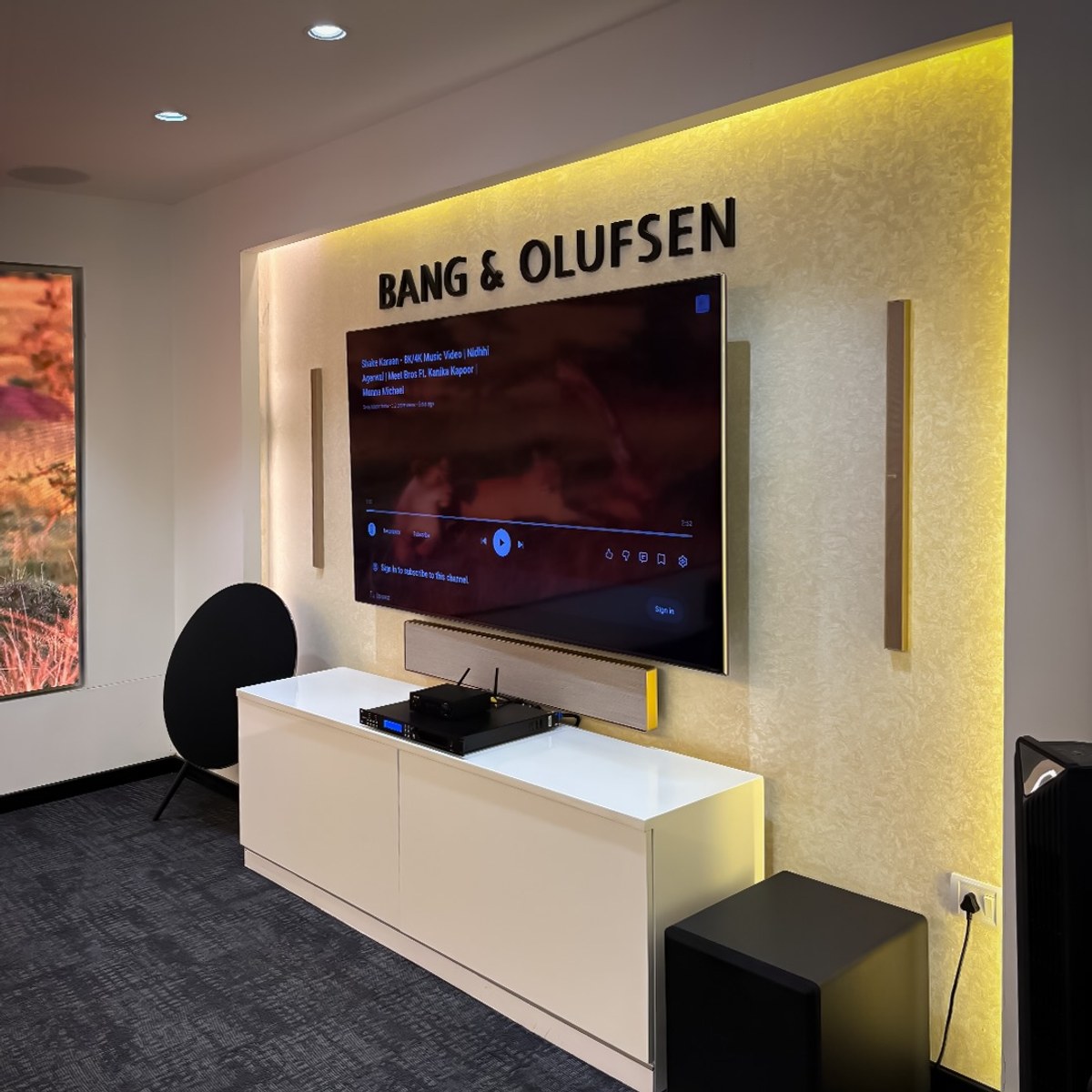
Two champagne-finish XSCACE QuadCane speakers are installed on the demo wall of a Bang & Olufsen showroom, flanking the screen, beside a Beosound A9 and a Beolab tower. Each one is 21 mm deep and carries sixteen drivers. They are auditioned out loud, every day, by people whose profession is comparing audio equipment.
That is the whole point of the installation. A demo wall is not a room where a speaker is heard politely once; it is a room built for direct comparison, where a visitor can switch between systems in the same minute, in the same acoustic, at the same level. Very few architectural speakers are ever placed in that position.
At a glance
- Space: a Bang & Olufsen branded AV showroom demo wall
- Product: two × QuadCane slim array, 21 mm deep, matte champagne
- Placement: flanking a large-format screen, beside B&O reference systems including a Beosound A9 and a Beolab tower
- Support: compact DSP amplifier on the console below the screen, passive subwoofer for low-frequency extension
- Brief: hold up acoustically and visually under direct, repeated A/B comparison
| Specification | QuadCane |
|---|---|
| Depth | 21 mm |
| Drivers | 16 × Power Dense custom woofers |
| Sensitivity | 95 dB |
| Maximum SPL | 116 dB |
| Power handling | 100 W RMS |
| Frequency response | 150 Hz – 20 kHz (±3 dB) |
| Dispersion | 140° horizontal × 25° vertical |
| Recommended crossover | 200 Hz |
| Housing | Aerospace-grade aluminium |
A showroom is a harder brief than a living room
A private system has to satisfy one household, in one room, on its own terms. Nobody stands next to it playing something else. A showroom speaker is judged against the alternative playing four feet away, by a listener who has no loyalty to it and every opportunity to prefer something else.
It is also a harder brief visually. The speakers had to sit on a wall designed by another brand to present that brand, without visually competing with it — which is what a 21 mm aluminium profile in matte champagne is for.
Sixteen drivers is the reason a 21 mm speaker can be compared at all
The obvious objection to any ultra-thin speaker is physics: a shallow enclosure cannot house a large driver, a small driver moves little air, and output suffers. QuadCane answers that by not using one driver. It uses sixteen.
Sixteen small drivers in an array present a combined cone area that a single driver would need far more depth to match, and the result is measurable rather than rhetorical: 95 dB sensitivity and 116 dB maximum SPL from a 21 mm enclosure. For comparison, a typical slim architectural speaker sits at 86–92 dB. That sensitivity difference is what allows QuadCane to reach demonstration levels on a compact amplifier instead of needing a large one.
The dispersion pattern is what suits it to a demo wall specifically
The specification that matters most in this room is one that rarely gets discussed: QuadCane disperses 140° horizontally but only 25° vertically. That asymmetry is deliberate.
A wide horizontal pattern covers people standing anywhere along the demo wall, so the comparison is fair from wherever the visitor happens to be standing. A narrow vertical pattern sends proportionally less energy into the ceiling and the floor — the two hard, reflective surfaces closest to a wall-mounted speaker. In a showroom of glass, stone and screens, keeping energy out of those reflections is what keeps a demo intelligible rather than merely loud.
The system behind the wall
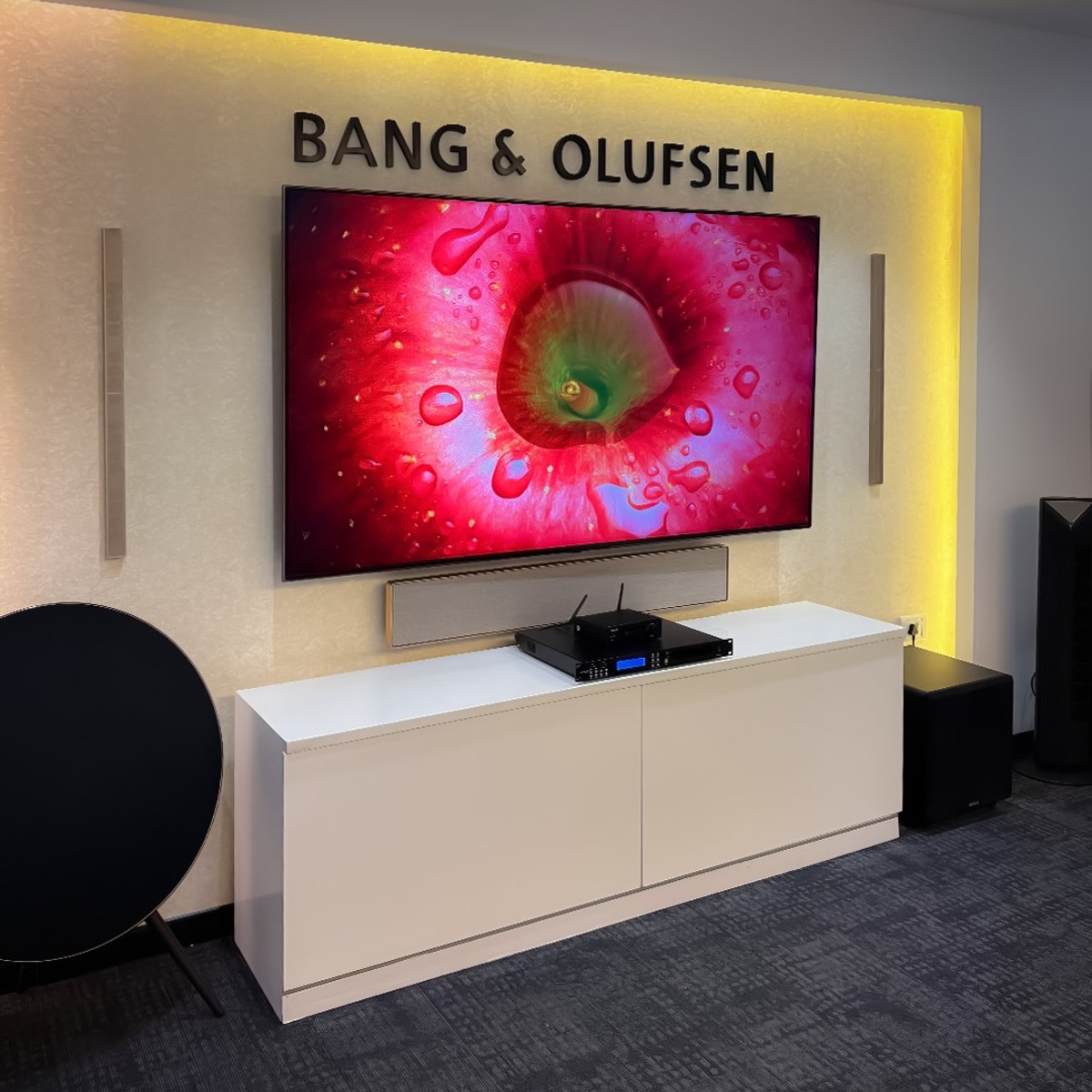
The pair runs from a compact DSP amplifier on the console below the screen, with a passive subwoofer carrying everything below QuadCane’s 200 Hz recommended crossover. The subwoofer is not optional here: QuadCane reaches 150 Hz, and a demo covering film as well as music needs the octaves underneath that.
The configuration was built for fast source switching rather than for a single fixed input, because a demo wall is only useful if it can move between sources as quickly as the conversation does.
What a showroom placement demonstrates that a private install cannot
A residential case study shows that a system was specified well for one client. It is, by construction, unfalsifiable — nobody else heard the alternative in that room.
A showroom placement is different. It invites the comparison rather than avoiding it, in a space where the alternatives are present, powered and one button away. That is a claim that can be checked by anyone who walks in, which is the only kind of claim worth making about audio.
How the room was planned, controlled and calibrated
Every XSCACE installation runs the same three stages, and a commercial room is judged on consistency — the visitor at one end of the wall should hear what the visitor at the other end hears.
Planned
XSCACE Floorplan Sound Simulation takes a plan from trace to bill of quantities in the browser: coverage checked position by position so there is no bad place to stand, room modes located before fit-out covers the structure, and a bill of quantities to price against. The full sequence is described in the XSCACE installation workflow.
Controlled
Which control application applies depends on the amplifier: XSCACE Controller for the Air streaming amplifiers, and XSCACE Studio for the Xylem, Root and Lucifer DSP amplifiers.
Calibrated
The calibration toolkit inside XSCACE Studio measures what the room actually does — eleven instruments covering SPL, delay, levels, polarity, frequency response, THD, sub alignment, transfer function, RT60, RTA and export, free on macOS. In a room like this the ones that earn their place are RTA noise rating (NC-15 to NC-65), setting the level the system must clear once the floor is busy; SPL measured along the wall against the design target; and RT60 to ISO 3382, showing whether the hard surfaces need treating as well as covering.
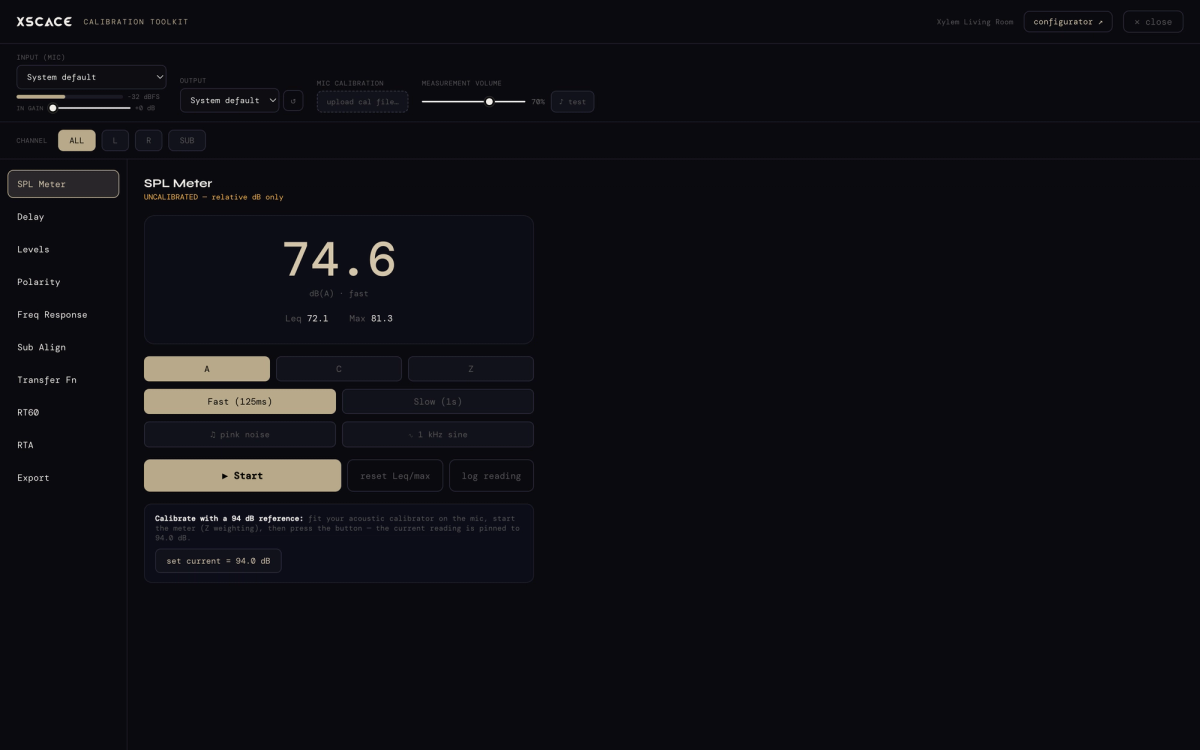
QuadCane publishes 95 dB sensitivity and 116 dB maximum SPL. Those are the figures the coverage prediction works from, and the figures the finished room is measured against.