Contents4 sections
The ultra-thin architectural speaker is the architectural audio industry's most marketed concept and its least examined category. Achieving a 12mm profile is a genuine engineering accomplishment. But "12mm" on a specification sheet tells you nothing about what the speaker sounds like at 12mm — or what engineering trade-offs were made to achieve that number. The market for ultra-thin architectural speakers has expanded rapidly, and with that expansion has come a category-wide tendency to lead with the dimension and follow with very little else.
What 'Ultra-Thin' Actually Requires (And What It Costs, Acoustically)
Acoustic enclosures operate under laws that do not negotiate. Helmholtz resonance — the frequency at which an enclosed air volume resonates — is a function of enclosure geometry. As internal volume decreases, the resonant frequency moves upward. A thinner enclosure means less internal volume, which means the enclosure's natural resonance supports higher frequencies and actively works against low-frequency extension. A speaker that is physically 12mm may achieve bass response identical to a 12mm cardboard box unless the driver engineering specifically compensates for this physics.
What most ultra-thin speakers sacrifice to achieve thinness is not one thing but four: bass extension, efficiency, thermal management, and crossover quality. The reason is structural. Thinness is achieved by removing things. The enclosure gets thinner. The chassis gets cheaper. The crossover gets simpler. The magnets get smaller. None of these removals improve acoustic performance. They improve the number on the data sheet.
A 12mm specification is only impressive if the 12mm speaker sounds better than a 60mm speaker — not merely looks better. The dimension should be the result of solving the acoustic problem, not the excuse for not solving it.
Six Things a Spec Sheet Cannot Tell You About a Slim Speaker

Specification sheets for ultra-thin architectural speakers are designed to communicate what the manufacturer wants you to know. They are rarely designed to communicate what you need to know before committing to a ceiling or wall installation. Here are six performance dimensions that a spec sheet will not tell you:
- Bass extension at real listening levels: frequency response measured at 1 watt (the spec sheet standard) does not predict bass performance at 90dB sustained. A speaker that measures to 60Hz at 1W may roll off to 120Hz at real listening levels due to excursion limiting.
- Thermal compression: thin enclosures concentrate heat. A driver running at sustained high volume in a thin enclosure heats its voice coil, which raises DC resistance, which drops output — sometimes by 3–6dB after 60 minutes. This is audible as gradual volume loss and tonal shift that most installers attribute to the amplifier.
- Chassis material and long-term reliability: polymer-framed drivers expand and contract with temperature cycles. In ceiling and wall installations, this movement stresses the driver surround and crossover connections over years. The consequence is not immediate — it appears at the 5-year mark when the speaker you installed is no longer serviceable.
- Crossover component quality: electrolytic capacitors in a crossover drift in capacitance as they age. A speaker that measured ±0.5dB response at installation may measure ±3dB at year eight. Film capacitors do not drift. The crossover component list is a predictor of long-term acoustic consistency.
- Phase coherence through the crossover band: the audible consequence of a poorly designed crossover is not a frequency dip — it is degraded stereo imaging. When the woofer and tweeter are not in phase through the crossover region (typically 2–4kHz), the brain cannot resolve the precise spatial cues that create stereo imaging. You hear music; you do not hear placement.
- Dispersion pattern and coverage uniformity: a speaker can measure flat on-axis and become severely coloured at 30° off-axis. In-ceiling speakers rarely have listeners positioned directly below them. Meaningful coverage specification requires measurements at 30°, 60°, and 90° off-axis — data that most ultra-thin speaker manufacturers do not publish.
The XSCACE Approach: Engineering the Acoustics, Then Achieving the Dimension

XSCACE's engineering sequence inverts what is common in this category. We define the acoustic target first — frequency response, dispersion, efficiency, power handling — and then engineer the enclosure to satisfy that specification. The dimension is a consequence of the engineering, not a marketing decision made before the engineering began.
Our Nano Resonance™ technology addresses the fundamental problem of small enclosure volume directly. By engineering the resonant behaviour of the enclosure chamber — tuning port geometry, internal bracing, and driver back-cavity volume simultaneously — we achieve low-frequency extension from enclosures that physics would otherwise restrict to upper-bass reproduction. This is not equalization. Equalization boosts a signal; it does not add excursion headroom or enclosure volume. Nano Resonance™ creates the acoustic conditions for genuine bass extension within the enclosure constraints.
AeroFrame Chassis™ addresses the thermal problem that thin enclosures create. Heat generated at the voice coil must be conducted away from the motor system; in a thin enclosure with limited internal airflow, this requires a chassis designed as a heat path, not merely a driver mount. AeroFrame Chassis™ draws heat conductively through the frame geometry and into the installation surface, keeping voice coil temperatures stable over sustained operation. The result is measurable: sensitivity does not compress over a 2-hour pink noise test at 90dB.
PowerDense Dynamics™ handles the efficiency consequence of small enclosures. A speaker working against an unfavourable enclosure volume demands more power to achieve the same output level. We engineer the motor system — magnet grade, voice coil geometry, gap flux density — to compensate for lower inherent efficiency, so that the system sensitivity remains usable without requiring amplifier power that scales with the speaker's acoustic limitations.
PrecisionXover Array™ preserves the acoustic work accomplished by the drivers through a precision crossover. We use film capacitors, not electrolytics. We measure crossover alignment in the anechoic chamber and verify phase coherence through the crossover band before any product ships. The result is a crossover that performs at year ten as it performed at installation, and a stereo image that resolves with the precision the drivers are capable of delivering.
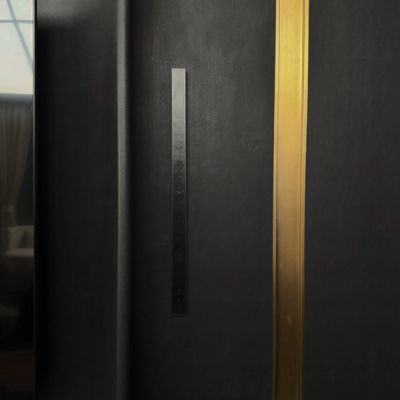
The Bonsai's 12mm profile is the dimension that results from solving each of these problems in sequence. It is not a design target — it is an outcome. We did not begin with "how thin can we make this." We began with "what must this speaker do," and 12mm is where those engineering answers converged.
Where a client wants the speaker gone altogether rather than merely shallow, the comparison that matters is invisible speakers against ultra-slim architectural speakers.
How to Evaluate an Ultra-Thin Speaker Before You Specify It
Whether you are an architect specifying for a project, an AV integrator building a system, or a homeowner investing in permanent installation audio, the evaluation criteria for an ultra-thin speaker should be consistent and rigorous. The dimension is not the specification. The following questions are:
- Request frequency response at -3dB: the -3dB point is the practical lower limit of usable bass output. Anything above 80Hz means the speaker produces no meaningful bass and will require a subwoofer in every installation regardless of room size.
- Ask for sensitivity in dB/W/m: below 82dB sensitivity means very high power demand and cost-compounding on amplification. A speaker rated at 84dB/W/m requires half the amplifier power of an 81dB/W/m speaker to achieve the same output level.
- Ask for chassis material: polymer frames expand and contract with temperature cycles. For ceiling and wall installation, cast aluminium or steel chassis material is the correct specification. Polymer chassis are appropriate for consumer products designed to be replaced, not for permanent architectural installation.
- Ask for the crossover component list: if the manufacturer cannot or will not specify capacitor type, assume electrolytic. Electrolytic capacitors in a crossover drift over time and will alter the speaker's tonal balance within 5–10 years of installation.
- Request a thermal test: ask the manufacturer to play pink noise at 90dB for 2 hours, then measure sensitivity before and after. A well-engineered ultra-thin speaker should show no more than 1dB of sensitivity degradation. More than that indicates thermal compression that will be audible in real-world use.
- Listen at volume: do not evaluate any speaker at background levels only. Ultra-thin speakers that sound acceptable at 60dB may become compressed, harsh, or bass-thin at 85dB. The evaluation level should approximate the listening level at which the system will actually be used.
The thinnest speaker that sounds the best is the right speaker. The thinnest speaker that merely looks the best is expensive regret — especially when it is installed in a ceiling you cannot easily reopen.