Contents6 sections
A distributor asked us recently for a photograph showing champagne next to gold, because she could not tell them apart on the website. It is a completely fair question, and the honest answer is that a photograph on its own was never going to settle it — not because the photograph would be bad, but because anodised metal does not hold still the way a printed colour does.
This page explains how the finishes on architectural speakers are actually made, because once you know that, the differences between them stop being mysterious and start being predictable. The short version: anodising and powder coating are not two ways of doing the same thing. They are different processes with different physics, and which one a part gets is decided by what the part is made of.
Anodised versus powder coated: the difference is where the colour sits
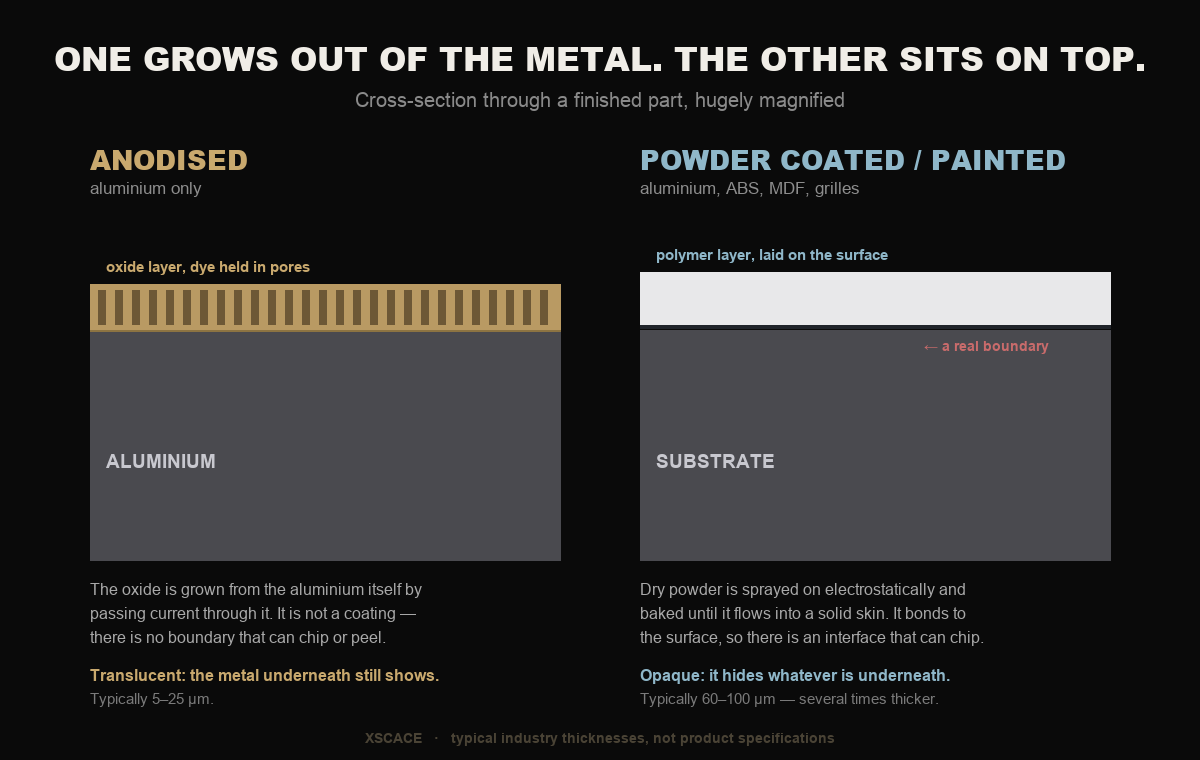
Powder coating is a coating in the ordinary sense. Dry polymer powder is sprayed onto the part electrostatically and baked until it flows into a continuous skin. It sits on the surface, it is opaque, and it hides whatever is underneath. Typical thickness is somewhere around 60 to 100 microns — thick enough that there is a real boundary between the coating and the part, which is why a powder coated edge can chip if it is struck hard enough.
Anodising is not a coating at all. The part is made the anode in an electrolytic bath and current is passed through it, which grows a layer of aluminium oxide out of the aluminium itself. That layer is porous while it forms, dye is absorbed into the pores, and the surface is then sealed to close them. Typical decorative thickness is 5 to 25 microns.
The consequence that matters: there is no interface. The finish is the outermost part of the metal rather than something applied to it, so it cannot peel or flake. It also cannot be applied to anything that is not aluminium, which is why the same colour has to be achieved a different way on a plastic or a timber part.
Those figures are typical industry ranges rather than XSCACE specifications, and they are given to show the scale of the difference rather than to describe a particular product.
Matte is the standard, and the finish is not what people usually change
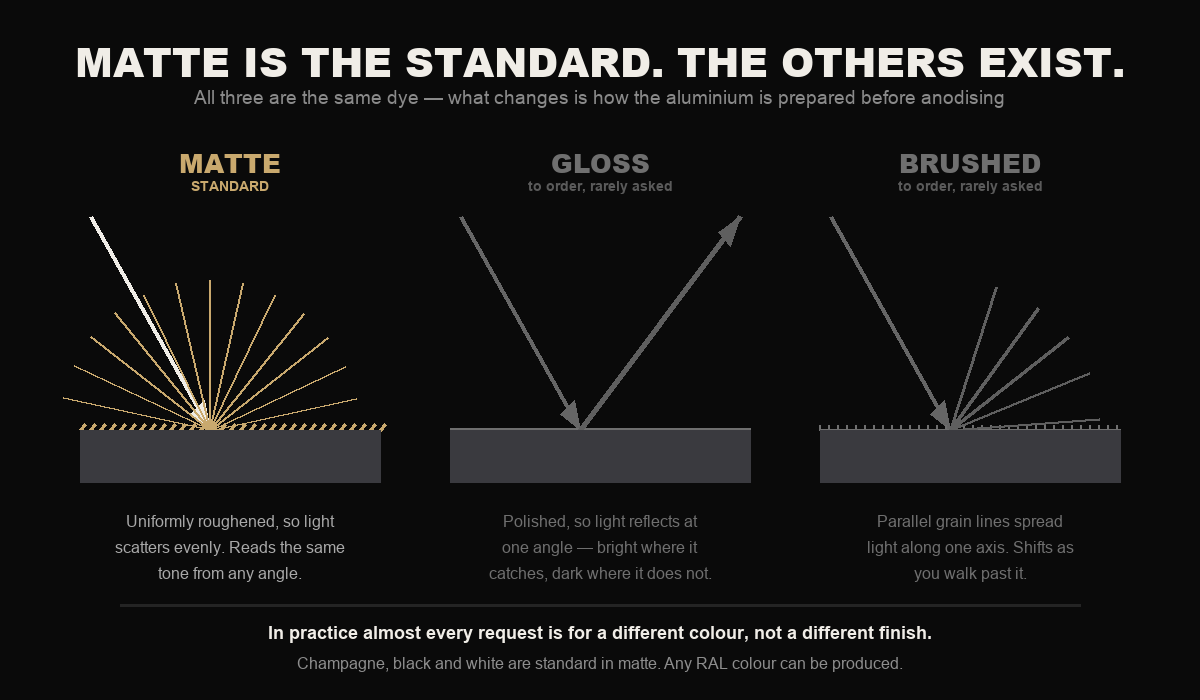
The anodised oxide layer is translucent. You are not looking at a layer of colour on top of metal, you are looking through a tinted layer at the metal underneath — which means the texture of that metal still shows.
Our standard finish is matte, in champagne, black and white. Gloss and brushed can be produced to order but are very rarely asked for. All three are mechanical preparations of the aluminium carried out before anodising — not three different colours and not three different coatings:
- Matte — the standard. The surface is uniformly roughened, so light scatters in every direction and the part reads as an even tone from any angle.
- Gloss — to order. The surface is polished, so light reflects at a single angle: bright where it catches the light, noticeably darker where it does not.
- Brushed — to order. The surface carries fine parallel grain lines, so light spreads along one axis and the finish changes as you walk past it.
In practice almost nobody changes the finish. What people ask for is a different colour, which is why custom RAL matters far more than gloss or brushed ever will. And the reason a colour like champagne is hard to judge from a website is not the finish at all — it is that an anodised metallic is translucent. You are seeing dye and metal at once, and a colour with metal behind it shifts with the colour temperature of the light in a way a flat printed pigment does not. Add an uncalibrated screen at the other end, and two people can look at the same photograph and reasonably disagree about what they are seeing.
Why white is the exception
Every standard aluminium colour we make is anodised except white, which is powder coated. That is not a preference, it is a limitation of the process.
Anodised colour comes from dye absorbed into microscopic pores in the oxide layer. Dyes work because their molecules are small enough to enter those pores. White is not a dye — it is a pigment, and pigment particles are physically too large to be absorbed. There is no commercially reliable way to produce a true white by conventional anodising, which is why white parts across the whole industry, not just ours, are coated rather than anodised.
It has a practical consequence worth knowing before you specify a mixed scheme. A white part is opaque coated and a champagne part is translucent anodised, so they will not age or catch the light in the same way even though they came from the same factory.
What each material gets
Which process a part receives follows from what it is made of, not from which product it belongs to.
| Material | Process | Finishes available | Colour range |
|---|---|---|---|
| Aluminium | Anodised | Matte as standard; gloss or brushed to order | Any RAL, plus the standard range |
| Aluminium — white only | Powder coated | As the coating specifies | White |
| ABS | Powder coated or painted | As the coating specifies | Any RAL |
| MDF | Primed and hand painted | As the paint specifies | Any RAL |
| Grilles | Powder coated | As the coating specifies | Any RAL |
So a single speaker can carry two processes at once — an anodised aluminium body with a powder coated grille — and that is normal rather than a compromise. The grille is a separate part with a separate job, and coating it lets the grille colour be matched to a ceiling or a wall independently of the body.
Custom RAL, and what it can and cannot promise
Any RAL reference can be produced. RAL is a standardised colour system, so specifying one removes the ambiguity of a colour name entirely — RAL 9010 means the same thing to every finisher in the world, where “off-white” does not.
There is one honest limitation. A powder coat or a paint is a mixed pigment, so it can hit a RAL reference and repeat it exactly, batch after batch. An anodised colour is dye in an oxide layer grown on a specific alloy, and it carries slight natural variation between batches for the same reason a natural material does. If a project needs two deliveries months apart to be indistinguishable, a coated finish is the safer specification. If it wants the depth and the durability that only anodising gives, accept that the second batch may be a fraction different and order the whole job at once.
Custom RAL carries a surcharge and a longer lead time than a standard finish. Both are stated on each product page rather than here, because they vary by product.
What this means when you are specifying
- Do not judge a metal finish from a photograph, and never from a render. A render shows what a material shader was told to do; anodised aluminium does something more complicated with real light.
- Ask for a physical sample when the finish matters. It is the only thing that settles it, and it takes days rather than the weeks a wrong delivery costs.
- Expect a white part and an anodised part to differ, because one is coated and the other is dyed metal.
- Specify the colour, not the finish. Matte is standard across the range and covers almost every project; changing the finish is possible but is rarely what a scheme actually needs.
- Order a whole job in one batch where an anodised colour has to be consistent across many units.
- Specify by RAL reference, not by colour name, whenever a third party is producing anything that has to match.
- Remember the grille is a separate part with its own colour — matching it to the ceiling rather than to the speaker is usually the more discreet choice.